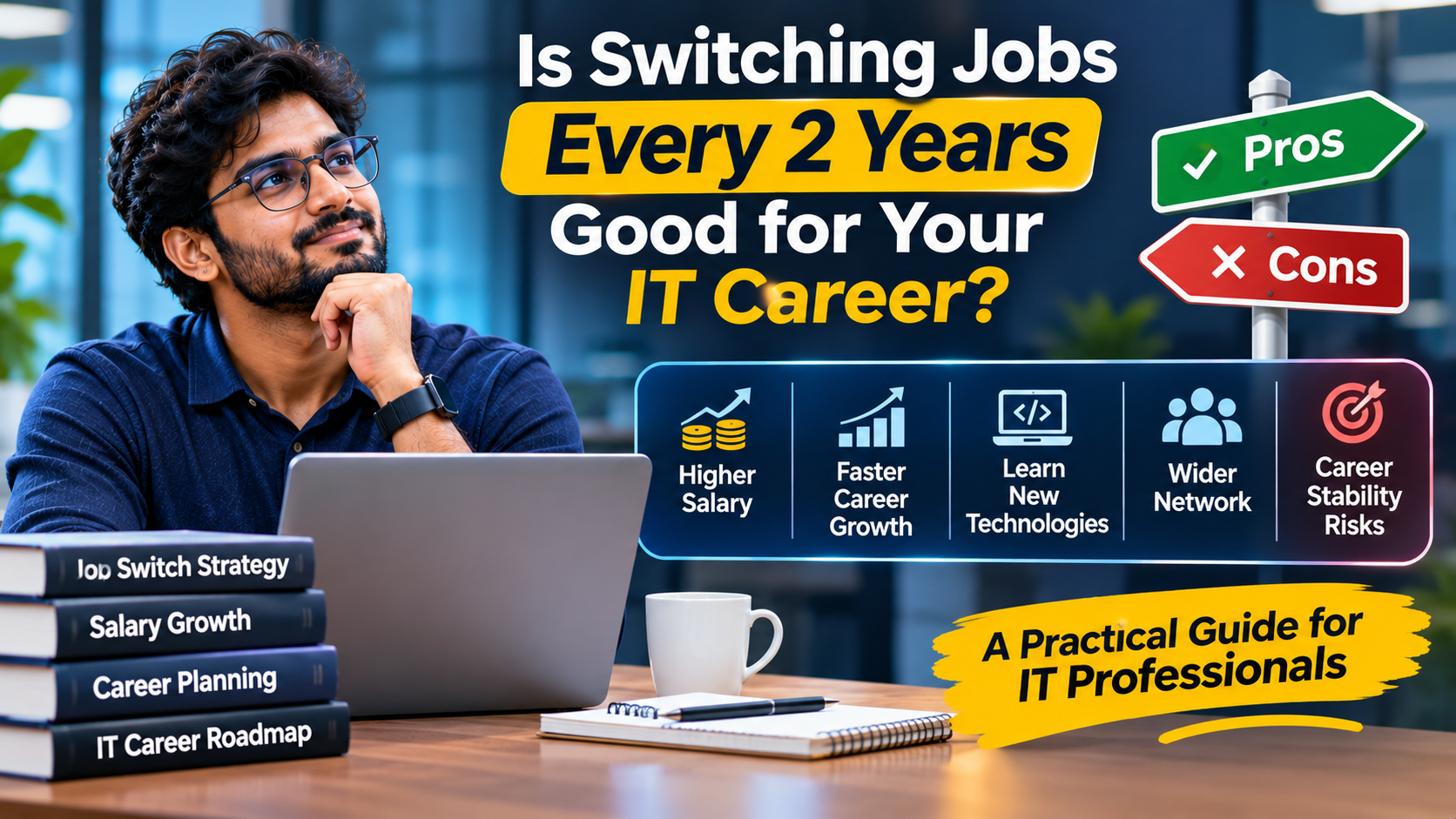
Have you ever wondered whether staying in the same IT company for five years is helping your career or holding you back?
In today's competitive IT industry, changing jobs has become a common strategy for professionals looking for better salaries, advanced technologies, career growth, and improved work environments.
Many software developers switch companies every two or three years to explore new opportunities. Some receive significant salary increases, while others move into better technical roles and gain exposure to new technologies.
However, frequent job switching also comes with risks. Recruiters may question your employment history, you may struggle to build deep technical expertise, and constantly adjusting to new organizations can affect your professional stability.
So, is switching jobs every two years actually good for your IT career?
The answer depends on your experience, career goals, technical growth, salary expectations, and the opportunities available in the market.
In this article, let's understand the advantages and disadvantages of switching jobs every two years and how to decide when it is the right time to make your next career move.
1. Why Are IT Professionals Switching Jobs Every 2 Years?
The IT industry is different from many traditional industries. Technology changes quickly, companies continuously adopt new tools, and professionals often look outside their current organizations for better opportunities.
Here are some of the major reasons why IT professionals consider switching jobs every two years.
1. Better salary opportunities
Salary growth is one of the biggest reasons behind job switching.
In many organizations, annual increments may not match the compensation offered by other companies for similar roles.
For example, a developer earning ₹8 LPA might discover that another company is offering ₹12 LPA for a similar position.
Instead of waiting several years for internal salary revisions, the developer may consider switching.
2. Limited career growth
Some developers spend years working on similar tasks without getting opportunities to take on bigger responsibilities.
They may continue maintaining the same application, fixing bugs, and implementing minor features without learning new technologies.
When professional growth becomes limited, exploring other companies can be a reasonable decision.
3. Learning new technologies
Technology evolves continuously.
A developer working with an older technology stack may want to explore:
- Generative AI.
- Cloud Computing.
- Microservices.
- Kubernetes.
- Data Engineering.
- Modern frontend frameworks.
- Distributed Systems.
Switching organizations can sometimes provide access to better technical environments and more challenging projects.
4. Better work environment
Work culture also plays an important role in career decisions.
Professionals may look for companies that offer better management, reasonable working hours, flexible working arrangements, and healthier team environments.
5. Better job designation
A job switch may provide an opportunity to move from Software Developer to Senior Software Engineer, Technical Lead, or another advanced position.
However, a better designation should also come with appropriate responsibilities and compensation.
2. Advantages of Switching Jobs Every 2 Years
Changing jobs strategically can provide several professional and financial benefits.
A. Faster salary growth
One of the biggest advantages of switching jobs is the possibility of receiving a higher salary.
Consider this example:
A software developer starts with a salary of ₹6 LPA.
After gaining two years of experience, the developer receives an opportunity offering ₹9 LPA.
After another two years, a new opportunity offers ₹13 LPA.
<text> </text>
Career stageSalary
Starting salary
₹6 LPA
After first switch
₹9 LPA
After second switch
₹13 LPA
After third switch
₹18 LPA
<text> </text>
This is an illustrative example, not a guaranteed salary progression. Actual offers depend on technical skills, market conditions, company budgets, and interview performance.
The important point is that exploring the market can help you understand your actual compensation value.
B. Exposure to different technologies
Working in different organizations can expose you to different technology stacks and engineering practices.
For example:
- Company A: Angular, Java, and MySQL.
- Company B: React, Node.js, and MongoDB.
- Company C: Microservices, AWS, and Kubernetes.
This exposure can help you become a more versatile developer.
However, switching companies is not the only way to learn new technologies. You should also seek opportunities within your current organization.
C. Building a stronger professional network
Every organization introduces you to new colleagues, managers, architects, clients, and industry professionals.
Over time, these professional connections can help you discover new opportunities, gain industry knowledge, and build your career.
D. Better career opportunities
A new organization may offer responsibilities that are unavailable in your current company.
For example, you might move from maintaining existing applications to designing new systems, leading development teams, or working on large-scale products.
These experiences can strengthen your professional profile.
E. Understanding different business environments
Working across different organizations helps you understand how businesses operate.
You may experience different development methodologies, release processes, project management approaches, and engineering cultures.
This knowledge can be particularly useful when moving into senior engineering or leadership positions.
3. Disadvantages of Switching Jobs Too Frequently
Although job switching can accelerate career growth, changing companies without a clear reason can create problems.
A. Recruiters may question your employment history
Imagine a recruiter reviewing your resume.
Your employment history looks like this:
- Company A: 8 months.
- Company B: 11 months.
- Company C: 1 year.
- Company D: 10 months.
The recruiter may wonder why you have not stayed long enough in any organization.
Some companies may be concerned about employee retention and whether you will remain long enough to contribute to their projects.
A few short employment periods are not automatically a problem, especially when there are valid reasons. However, a repeated pattern of very short tenures may require explanation.
B. Limited project ownership
Software development involves more than writing code.
You need to understand the complete lifecycle of an application, including development, deployment, monitoring, maintenance, and production troubleshooting.
If you leave every few months, you may miss opportunities to experience the long-term results of your technical decisions.
C. Difficulty developing deep technical expertise
Working with different technologies is useful, but constantly changing your technology stack can prevent you from developing deep specialization.
For example, learning React for one year, Angular for another year, and then moving to a completely different field may not provide the same technical depth as building expertise in a particular area.
D. Losing company benefits
Leaving an organization may mean losing certain financial and professional benefits.
Before switching, consider:
- Unvested stock options.
- Retention bonuses.
- Joining bonuses with repayment conditions.
- Notice period obligations.
- Leave encashment.
- Gratuity eligibility.
- Insurance and other benefits.
Always review your employment agreement and the new offer carefully.
E. Repeated adjustment to new environments
Every job change involves learning new processes, understanding the codebase, building relationships, and adapting to management expectations.
Frequent transitions can become exhausting, particularly if you are not gaining meaningful career benefits from them.
4. How Often Should Software Developers Switch Jobs?
There is no universal rule that every IT professional should switch jobs after exactly two years.
However, the following table provides a practical way to think about career progression.
Experience levelSuggested career focus
0–2 years
Build strong fundamentals and practical experience
2–5 years
Explore growth opportunities and market compensation
5–8 years
Develop specialization and take ownership
8–12 years
Focus on architecture, leadership, and deeper expertise
12+ years
Prioritize strategic responsibilities and long-term growth
These are career-planning suggestions, not mandatory switching intervals.
For example, a developer with three years of experience may benefit from staying another year to complete a major project and gain production experience.
Another developer with the same experience may need to leave because there is no technical growth or reasonable opportunity for advancement.
The right time to switch is determined by the quality of your current opportunity, not simply the number of months you have worked there.
5. Does Switching Jobs Every 2 Years Increase Your Salary?
It can, but frequent switching does not automatically guarantee higher compensation.
Your salary depends on several factors:
- Current market demand.
- Technical specialization.
- Years of relevant experience.
- Interview performance.
- Company compensation structure.
- Negotiation skills.
- Current and expected responsibilities.
Let's consider another example.
Two developers have five years of experience.
Developer A:
- Started at ₹4 LPA.
- Stayed in the same organization.
- Received regular annual increments.
- Current salary: ₹7 LPA.
Developer B:
- Started at ₹4 LPA.
- Switched companies twice.
- Gained experience with advanced technologies.
- Current salary: ₹12 LPA.
This scenario illustrates how external opportunities can sometimes accelerate salary growth.
However, it does not prove that Developer B will always earn more. A professional who receives strong internal promotions and takes on valuable responsibilities can also achieve excellent salary growth.
A McKinsey Global Institute study found that role changes can help workers acquire new skills and increase earnings. Its analysis reported average wage increases of 6–10% per role move across the dataset studied, although outcomes varied. The study also includes moves within organizations, not only external job switches.
6. When Should You Switch Jobs?
Here are some situations where exploring a new opportunity may make sense.
1. Your salary is significantly below market value
If professionals with comparable experience and skills are earning substantially more than you, it may be time to evaluate external opportunities.
2. You are no longer learning
If your responsibilities have remained the same for years and you have limited opportunities to develop new skills, consider exploring other roles.
3. You are not getting promoted
If you consistently deliver good work but have no clear path towards senior responsibilities, discuss career progression with your manager.
If nothing changes, external opportunities may be worth exploring.
4. You want to move into a different technology
For example, you may want to move from traditional frontend development into full stack engineering or AI application development.
A company offering the right project and mentorship could help you make that transition.
5. Your work environment is affecting your career
An unhealthy work environment, unrealistic expectations, or persistent management issues may be valid reasons to consider leaving.
7. When Should You Avoid Switching Jobs?
Not every difficult situation requires changing companies.
Sometimes staying can provide better long-term benefits.
Consider staying when:
- You are learning valuable technologies.
- You have a clear promotion opportunity.
- You are about to complete an important project.
- Your manager is supporting your career growth.
- You have recently joined and have not yet understood the full role.
- You have significant unvested compensation or benefits.
- Your current company offers opportunities to move into a better internal role.
Before resigning, evaluate whether your current problems can be resolved through an internal role change, salary discussion, or project transfer.
Also, avoid resigning based only on a verbal job offer. Review the written offer and its conditions first.
8. Does Frequent Job Switching Affect Your Resume?
Yes, frequent job changes can influence how recruiters evaluate your resume.
Recruiters generally look at more than the number of companies you have worked for.
They may consider:
- Total years of experience.
- Duration at each organization.
- Project complexity.
- Technical skills.
- Career progression.
- Job responsibilities.
- Reasons for leaving.
How to make your resume stronger
If you have changed companies several times, focus on demonstrating meaningful contributions.
Instead of simply listing technologies, highlight:
- Applications you developed.
- Major features you delivered.
- Production issues you resolved.
- Performance improvements.
- Technical decisions you made.
- Responsibilities you handled.
If there are several short tenures, be prepared to explain the reasons honestly and professionally.
Your resume should demonstrate career progression rather than just a sequence of job changes.
9. How to Make Every Job Switch Count
If you decide to change companies every two or three years, make sure each move contributes something valuable to your career.
Follow these strategies:
Step 1: Identify your career objective
Decide whether your next goal is a higher salary, a senior designation, better technical exposure, or a move into a specialized field.
Step 2: Upgrade your technical skills
Learn technologies that are relevant to your target role.
For example:
- Java developers: Spring Boot, Microservices, System Design.
- React developers: TypeScript, Next.js, Frontend Architecture.
- Node.js developers: NestJS, Redis, Microservices.
- Full Stack developers: Cloud Computing, DevOps, System Design.
- Backend developers: Distributed Systems and Database Optimization.
Step 3: Build measurable achievements
Complete meaningful projects and understand their business impact.
Step 4: Research companies before applying
Evaluate company stability, engineering culture, technical opportunities, salary structure, and work-life balance.
Step 5: Negotiate professionally
Understand your market value and negotiate compensation based on your skills and the responsibilities of the new role.
Step 6: Choose career growth over salary alone
A higher salary is valuable, but make sure the new role also provides opportunities to develop professionally.
10. A Simple Checklist: Should You Switch Jobs Now?
Before making a decision, ask yourself these questions:
- Am I learning new technical skills?
- Is my salary competitive with the current market?
- Do I have opportunities for promotion?
- Am I getting meaningful project responsibilities?
- Does my current role support my long-term career goals?
- Is my work environment healthy?
- Will a new company provide better opportunities?
- Have I researched the new organization's culture and stability?
If most of your answers indicate that your current organization is no longer supporting your career goals, it may be worth exploring the market.
Do not make the decision based on a single bad week or someone else's salary package.
11. Should Freshers and Experienced Developers Follow the Same Job-Switching Strategy?
No. Career decisions should change as you gain experience.
For freshers (0–2 years)
Focus on learning programming fundamentals, understanding software development processes, and gaining practical project experience.
Avoid switching companies repeatedly before developing a solid technical foundation unless there is a compelling reason to leave.
For mid-level developers (2–5 years)
This is a good stage to evaluate salary, technical exposure, and career opportunities.
You can explore companies that offer better responsibilities, modern technologies, and opportunities to work on challenging projects.
For senior developers (5–10 years)
Focus on technical specialization, System Design, architecture, mentoring, and leadership.
At this stage, a move should ideally increase your scope of responsibility rather than simply change your employer.
For experienced professionals (10+ years)
Consider long-term career opportunities such as:
- Technical Architect.
- Principal Engineer.
- Engineering Manager.
- Solution Architect.
- Director of Engineering.
At senior levels, deep expertise, organizational impact, and leadership experience become increasingly important.
12. Frequently Asked Questions (FAQs)
1. Is switching jobs every 2 years bad for your career?
No. Switching jobs every two years is not inherently bad. It can help improve salary, technical exposure, and career opportunities. However, each move should provide meaningful professional growth.
2. How many years should I stay in my first IT company?
There is no fixed duration. Focus on developing technical skills, understanding real-world projects, and building a strong professional foundation. Consider switching when a better opportunity aligns with your career goals.
3. Does job hopping affect your chances of getting hired?
Frequent short employment periods may raise questions during recruitment. However, recruiters also evaluate your technical skills, project experience, achievements, and reasons for switching.
4. Can I switch jobs after one year of experience?
Yes. You can switch after one year if you have a valid reason and the new role offers better opportunities. However, ensure that you have developed sufficient technical knowledge and can explain your contributions.
5. Is it better to stay in one company for five years or switch every two years?
Neither option is automatically better. Staying for five years can provide deep technical knowledge and internal career growth. Switching every two years can expose you to new opportunities and compensation. Choose based on your career progression.
6. How much salary hike should I expect when switching jobs?
There is no standard percentage. Your potential increase depends on your skills, current salary, target role, company budget, and market conditions. Evaluate the complete compensation package rather than focusing only on the percentage hike.
7. Do product-based companies prefer candidates who stay longer?
Some recruiters may value employment stability, but product-based companies also hire professionals with varied employment histories. Relevant technical experience, project ownership, problem-solving, and role fit are important.
8. Should I switch jobs only for a higher salary?
Not necessarily. Salary is important, but consider technical learning, career progression, work culture, responsibilities, and long-term opportunities before accepting a new position.
Conclusion
Switching jobs every two years can be a useful career strategy for IT professionals, but it should never become a fixed rule.
The purpose of changing companies should be to improve your professional value, not simply increase the number of organizations on your resume.
If your current company offers excellent learning opportunities, career growth, and competitive compensation, staying longer can be a smart decision.
On the other hand, if your salary is below market value, your learning has stopped, or you have limited career opportunities, exploring new organizations may help you move forward.
Remember that successful IT professionals are not necessarily those who switch jobs most frequently. They are the ones who continuously improve their skills, take ownership of challenging projects, and make thoughtful career decisions.
Don't switch jobs just because two years have passed. Switch when the next opportunity makes your career better.