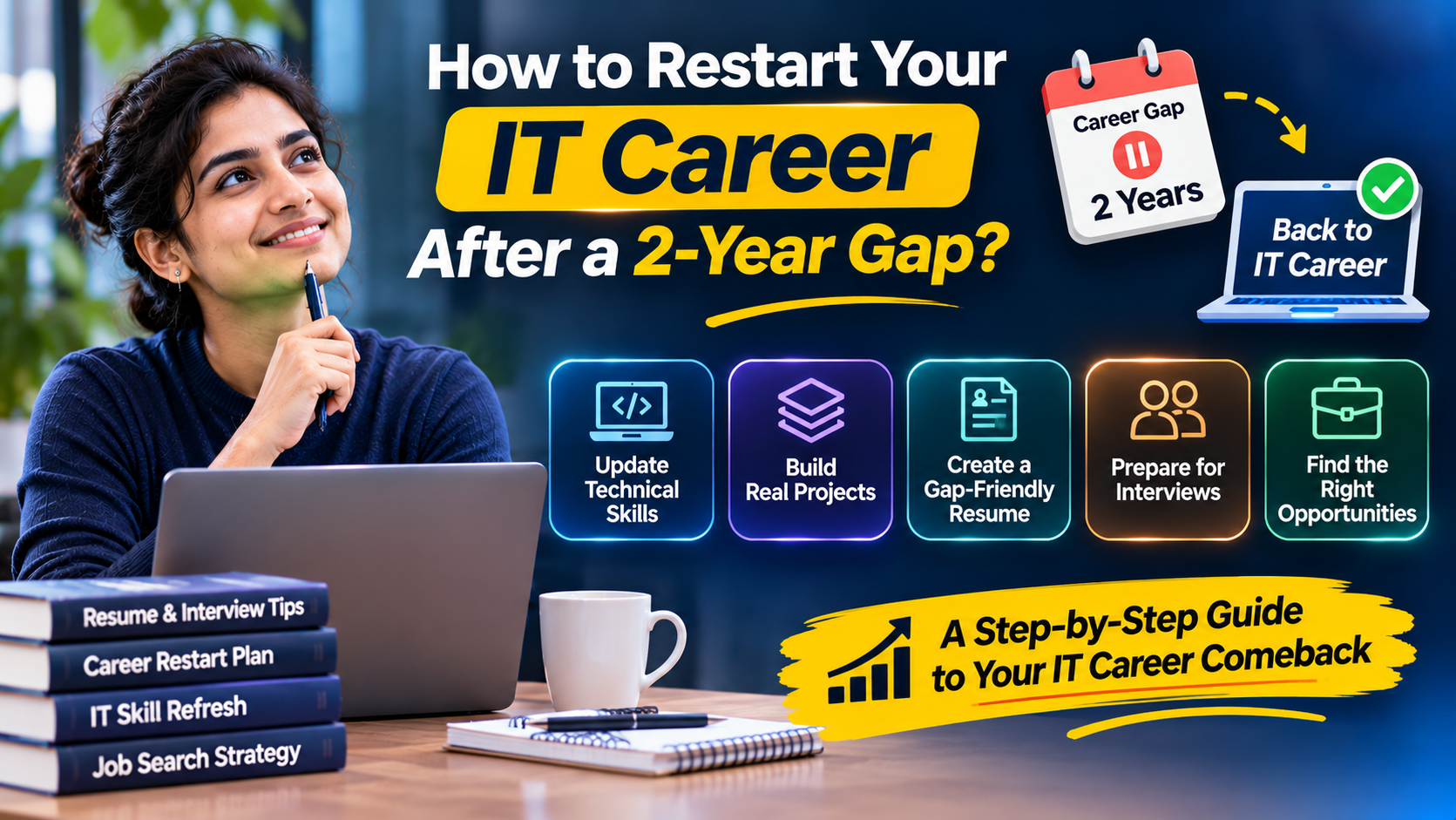
Taking a break from your professional career can happen for many reasons. Family responsibilities, health concerns, higher studies, personal commitments, layoffs, or preparing for competitive examinations can sometimes require you to step away from work.
But when you decide to return to the IT industry after two years, several questions may come to mind.
- Will companies hire someone with a two-year career gap?
- Are my previous technical skills still relevant?
- Do I need to learn everything from the beginning?
- Will recruiters reject my resume because of the gap?
- Can I get the same salary I was earning before?
- How should I explain my career break during interviews?
These concerns are common among professionals returning to the IT industry.
The good news is that a two-year career gap does not automatically disqualify you from getting another IT job. Your previous experience, current technical knowledge, practical skills, and ability to demonstrate that you are ready to work can all help you restart your career.
Whether you were previously a Java developer, React developer, Python developer, software tester, or IT support engineer, this guide will help you understand how to return to the IT industry in 2027.
1. Can You Get an IT Job After a 2-Year Career Gap?
Yes! You can get an IT job even after a two-year career break.
Companies evaluate candidates based on several factors, including technical knowledge, relevant experience, problem-solving ability, communication, and suitability for the position.
A career gap may lead to additional questions during recruitment, but it does not mean your previous professional experience becomes worthless.
For example, consider two candidates.
Candidate A:
- 4 years of experience as a Java Developer.
- 2-year career break.
- Updated knowledge of Java and Spring Boot.
- Built a recent backend project.
- Prepared for technical interviews.
Candidate B:
- 4 years of experience as a Java Developer.
- No career break.
- Has not updated technical skills for two years.
- Struggles with modern interview questions.
Although Candidate A has a career gap, they may be better prepared for the role.
The important lesson is that companies need professionals who can perform the job today. Your previous experience combined with updated technical skills can make you a competitive candidate.
2. Understand Where You Stand Before Restarting
Before applying for jobs, evaluate your existing technical knowledge.
You don't need to learn everything again. Start by identifying which skills you already know, which skills need revision, and which technologies have changed since you left your previous job.
For example, if you were a React developer before your career break, you may already understand:
- JavaScript.
- HTML and CSS.
- React components.
- Hooks.
- REST API integration.
- State management.
You may only need to refresh your knowledge and explore newer development practices.
Create a technical skills assessment
Divide your skills into three categories:
Category 1: Skills you already know
These are technologies and concepts you used in your previous job.
Category 2: Skills that need revision
These are concepts you understand but have not used recently.
Category 3: New skills to learn
These are technologies or tools that have become relevant to your target job role.
This simple exercise helps you avoid wasting time learning everything from scratch.
3. Choose the Right Technology to Restart Your Career
One of the biggest mistakes professionals make after a career break is trying to learn multiple technologies simultaneously.
Instead, select one career path based on your previous experience.
If you were a Java Developer
Focus on:
- Core Java.
- Java 17+ features.
- Spring Boot.
- Hibernate and JPA.
- REST API development.
- Microservices.
- SQL and database concepts.
- Docker and cloud fundamentals.
If you were a React Developer
Focus on:
- JavaScript ES6+.
- TypeScript.
- React Hooks.
- Redux Toolkit.
- Next.js fundamentals.
- API integration.
- Jest and React Testing Library.
- Frontend performance optimization.
If you were a Node.js Developer
Focus on:
- JavaScript and TypeScript.
- Node.js fundamentals.
- Express.js or NestJS.
- REST APIs.
- MongoDB and PostgreSQL.
- Authentication and authorization.
- Redis and caching.
- Microservices fundamentals.
If you were a Python Developer
Focus on:
- Python fundamentals.
- Object-oriented programming.
- Django or FastAPI.
- REST APIs.
- SQL.
- Data processing.
- Testing.
- Cloud deployment.
If you were a Software Tester
Focus on:
- Manual testing.
- Test case preparation.
- Selenium.
- Playwright.
- Cypress.
- API testing.
- Postman.
- Automation frameworks.
- CI/CD fundamentals.
Important: You don't need to change your entire technology stack just because you took a career break. Build on your existing experience first.
4. Follow a Structured 90-Day Learning Plan
Returning to IT becomes easier when you follow a structured learning schedule.
Instead of spending months watching random tutorials, divide your preparation into manageable stages.
Days 1–30: Refresh your fundamentals
Your first objective is to regain confidence in your existing technical knowledge.
Activities:
- Revise your primary programming language.
- Practice basic coding problems.
- Understand core development concepts.
- Refresh database knowledge.
- Review your previous project architecture.
- Identify important changes in your technology stack.
Goal: Become comfortable with your previous technical skills.
Days 31–60: Upgrade your technical skills
Now focus on technologies and practices relevant to current job openings.
Activities:
- Learn relevant framework updates.
- Understand modern development tools.
- Practice API development.
- Learn basic cloud deployment.
- Revise application architecture.
- Work on practical coding assignments.
Goal: Become comfortable with the technical requirements of your target role.
Days 61–90: Build projects and prepare for interviews
The final stage focuses on demonstrating your technical ability.
Activities:
- Build one complete real-world project.
- Upload your code to GitHub.
- Prepare your resume.
- Practice technical interviews.
- Attend mock interviews.
- Update your LinkedIn profile.
- Start applying for relevant openings.
Goal: Become ready to demonstrate your skills to recruiters and interviewers.
5. Build at Least One Real-World Project
One of the best ways to demonstrate your current technical knowledge is by building a practical project.
Certificates can show that you completed a course, but a working project gives interviewers something concrete to evaluate.
Choose a project based on your previous technology.
Project ideas for returning developers
Java Full Stack Developer
Build an Employee Management System with:
- Java and Spring Boot.
- React or Angular.
- MySQL.
- REST APIs.
- JWT authentication.
- Role-based access control.
React Developer
Build a dashboard application with:
- React.
- TypeScript.
- Redux Toolkit.
- REST API integration.
- Data visualization.
- Responsive UI.
Node.js Developer
Build an Inventory Management System with:
- Node.js and Express.
- MongoDB.
- Authentication.
- CRUD APIs.
- File uploads.
- API validation.
Python Developer
Build a Data Analytics Dashboard with:
- Python.
- Pandas.
- SQL.
- FastAPI.
- Data visualization.
What should your project demonstrate?
- Clean code.
- Proper project structure.
- Database integration.
- API development.
- Authentication.
- Error handling.
- Practical problem-solving.
- Deployment, where possible.
You should be able to explain the project architecture and the technical decisions you made during an interview.
6. How to Prepare Your Resume After a 2-Year Career Gap
Your resume is often the first thing recruiters evaluate.
If you have a career gap, don't try to hide it by changing employment dates or presenting misleading experience.
Instead, create a professional resume that highlights your previous experience, current technical skills, and recent learning.
Recommended resume structure
- Professional Summary.
- Technical Skills.
- Previous Work Experience.
- Key Projects.
- Recent Technical Training.
- Certifications.
- Education.
Example professional summary
"Software Developer with 4 years of professional experience in Java, Spring Boot, REST API development, and MySQL. Experienced in developing enterprise applications and working with cross-functional teams. Recently refreshed technical skills through practical projects and updated training. Looking to contribute to a software engineering team and continue growing professionally."
How to mention your career gap
You can include a simple entry in your employment timeline:
Career Break | 2024–2026
"Planned career break for personal responsibilities. During this period, refreshed technical knowledge and completed practical projects to prepare for returning to software development."
Use only details that accurately reflect your circumstances and activities.
Resume mistakes to avoid
- Hiding employment dates.
- Adding fake work experience.
- Listing technologies you cannot explain.
- Adding irrelevant certifications.
- Using an outdated resume format.
- Writing lengthy explanations about your career break.
Your resume should focus more on what you can contribute now than on repeatedly explaining why you took a break.
7. How to Explain a 2-Year Career Gap in an Interview
This is one of the biggest concerns for professionals returning after a career break.
Recruiters may ask:
"Why do you have a two-year career gap?"
Don't panic or feel uncomfortable answering this question.
The best approach is to provide a short, honest explanation and bring the conversation back to your professional readiness.
Example 1: Career break due to family responsibilities
"I took a planned career break due to family responsibilities. During this period, I had an opportunity to focus on personal commitments. I have now completed those responsibilities and refreshed my technical skills. I'm fully prepared to return to a professional role."
Example 2: Career break due to higher studies
"I took a break to focus on my higher studies and personal development. During this period, I also continued improving my technical knowledge. I'm now looking forward to returning to the IT industry and applying my previous experience."
Example 3: Career break due to health reasons
"I took time away from work to address a personal health matter. That period is now behind me, and I'm ready to return to my professional career. I have also refreshed my technical skills and prepared for current industry requirements."
You do not need to disclose private medical or family details.
Example 4: Career break due to layoff or personal circumstances
"After leaving my previous organization, I took time to evaluate my career direction and prepare for my next opportunity. I have used the time to update my technical knowledge and work on practical projects. I'm now focused on returning to a full-time software development role."
Remember these three things
- Be honest about your career break.
- Keep your explanation short and confident.
- Focus on your current skills and readiness.
Avoid apologizing repeatedly for taking a break.
8. How to Find IT Jobs After a Career Gap
Once your technical preparation and resume are ready, start exploring suitable job opportunities.
Don't depend on only one job portal.
Best job search platforms in India
1. Naukri
Useful for finding software development, testing, support, and other IT opportunities.
2. LinkedIn Jobs
Useful for connecting with recruiters, hiring managers, and former colleagues.
3. Indeed
Provides job listings across different industries and experience levels.
4. Foundit
Another platform for exploring IT and technology openings.
5. Instahyre
Useful for discovering opportunities with technology companies and startups.
6. Company career pages
Apply directly through official company websites whenever possible.
Use your professional network
Reconnect with:
- Former colleagues.
- Previous managers.
- College friends.
- Technical communities.
- Recruiters.
- LinkedIn connections.
Referrals can help your profile reach the right hiring team.
9. Explore Returnship Programs and Career Re-entry Opportunities
Some organizations offer structured return-to-work programs for professionals who have taken an extended career break.
These programs may include training, mentorship, project exposure, and opportunities to transition into regular employment.
Examples worth researching in India include:
- Tata SCIP.
- Accenture Career Reboot.
- Wipro Re-Engage.
- IBM Tech Re-entry.
- Godrej Careers 2.0.
Program eligibility, availability, and application requirements can change. Check the official company careers pages for current openings.
Returnship programs can be especially helpful for professionals who want a structured transition back into the workplace.
You can also consider contract positions, freelance projects, or suitable entry points into your previous technical domain.
10. Will You Get the Same Salary After a 2-Year Career Gap?
This is another important concern.
Your previous salary does not necessarily disappear because you took a break.
However, your next salary may depend on:
- Previous work experience.
- Technical skills.
- Current market demand.
- Interview performance.
- Target company.
- Role and responsibilities.
- Length and nature of the career break.
For example, consider a developer who previously earned ₹10 LPA with four years of experience.
After a two-year break, the developer refreshes Java, Spring Boot, Microservices, and SQL, and builds a recent project.
Depending on the market and interview performance, the developer may be able to secure a role with competitive compensation.
You may receive an offer close to your previous salary, a higher package, or a lower one. There is no fixed rule.
Pro Tip: Don't automatically accept a significantly lower salary just because you have a career gap. Evaluate your actual technical ability and market value before negotiating.
11. Common Mistakes to Avoid When Restarting Your IT Career
Many professionals make avoidable mistakes while returning to work.
Mistake 1: Trying to learn everything
Don't attempt to master Java, Python, React, AI, AWS, and DevOps simultaneously.
Choose one target role and learn the skills relevant to it.
Mistake 2: Depending only on certifications
Certifications can help demonstrate learning, but practical implementation and project knowledge are equally important.
Mistake 3: Hiding the career gap
Never change employment dates or create fake experience to avoid explaining your break.
Mistake 4: Applying without preparation
Update your technical knowledge and resume before applying extensively.
Mistake 5: Losing confidence
A career break does not erase the professional experience you gained before it.
Mistake 6: Ignoring interview preparation
Technical interviews may cover programming fundamentals, project experience, databases, coding, and problem-solving.
Practice these areas before attending interviews.
Mistake 7: Paying for fake job opportunities
Be cautious of recruiters or agencies asking for money in exchange for guaranteed jobs or fake experience certificates. Verify opportunities through official company channels.
12. A Practical 30-Day Job Restart Checklist
Once you have refreshed your skills, use this checklist to organize your job search.
- Finalize your target IT role.
- Identify the technical skills required.
- Update your programming fundamentals.
- Complete a practical project.
- Update your resume.
- Add your recent learning and projects to LinkedIn.
- Prepare an explanation for your career gap.
- Practice technical interview questions.
- Contact former colleagues and recruiters.
- Research returnship opportunities.
- Apply for relevant job openings.
- Attend mock interviews.
Remember that this is a job-search checklist, not a guarantee that you will receive an offer within 30 days. Your timeline will depend on your preparation, experience, and hiring opportunities.
Frequently Asked Questions (FAQs)
1. Can I get an IT job after a 2-year gap in India?
Yes. A two-year career gap does not automatically prevent you from getting an IT job. Update your technical skills, build practical projects, prepare for interviews, and explain your career break honestly.
2. Is a 2-year career gap a problem for software developers?
It may lead to additional questions during recruitment, but it is not necessarily a barrier. Your previous experience, current technical knowledge, and ability to demonstrate your skills are important.
3. Which IT course is best after a 2-year career gap?
Choose a course based on your previous experience. Java developers can refresh Spring Boot and Microservices, React developers can focus on React and TypeScript, and Python developers can explore Python backend development or Data Analytics.
4. Should I mention my career gap in my resume?
Yes, when the gap is significant, it is generally better to present the employment timeline honestly. You can mention the career break briefly without sharing unnecessary personal information.
5. How do I explain a career gap in an IT interview?
Briefly explain why you took the break, mention relevant learning or projects if applicable, and explain why you are ready to return to work.
6. Can I get a job after a 3–5 year career gap?
Yes. The longer the break, the more important it may be to demonstrate updated skills and practical knowledge. Focus on a specific job role, build recent projects, and prepare for technical interviews.
7. Can I restart my IT career without previous experience?
Yes. If you do not have previous professional IT experience, you can start by learning programming fundamentals, completing practical projects, and applying for suitable entry-level positions.
8. Will companies offer lower salaries to candidates with career gaps?
Not necessarily. Compensation depends on your experience, technical skills, role, market demand, and interview performance. Some companies may offer less, while others may value your previous professional experience.
9. Can women restart their IT careers after maternity breaks?
Yes. Women returning after maternity or childcare breaks can explore regular IT openings, flexible work arrangements, and company returnship programs where available.
10. How long does it take to prepare for an IT job after a career gap?
A focused 8–12 week technical refresh can be a useful starting point for professionals with previous experience. The actual preparation and job-search duration will depend on the technology, role, and existing skill level.
Conclusion
Restarting your IT career after a two-year break may feel challenging, but it is absolutely possible.
You don't have to forget your previous experience or start your professional journey from zero.
Instead, focus on updating your existing technical skills, learning relevant technologies, building practical projects, preparing a strong resume, and developing confidence for interviews.
The IT industry continues to evolve, and professionals who are willing to learn and adapt can find opportunities at different stages of their careers.
Whether your break was due to family responsibilities, higher studies, health, personal commitments, or other circumstances, your career journey does not have to end there.
Your career break is a part of your journey, not the end of your professional future.
Start learning again, build your confidence, and take the first step towards returning to the IT industry.