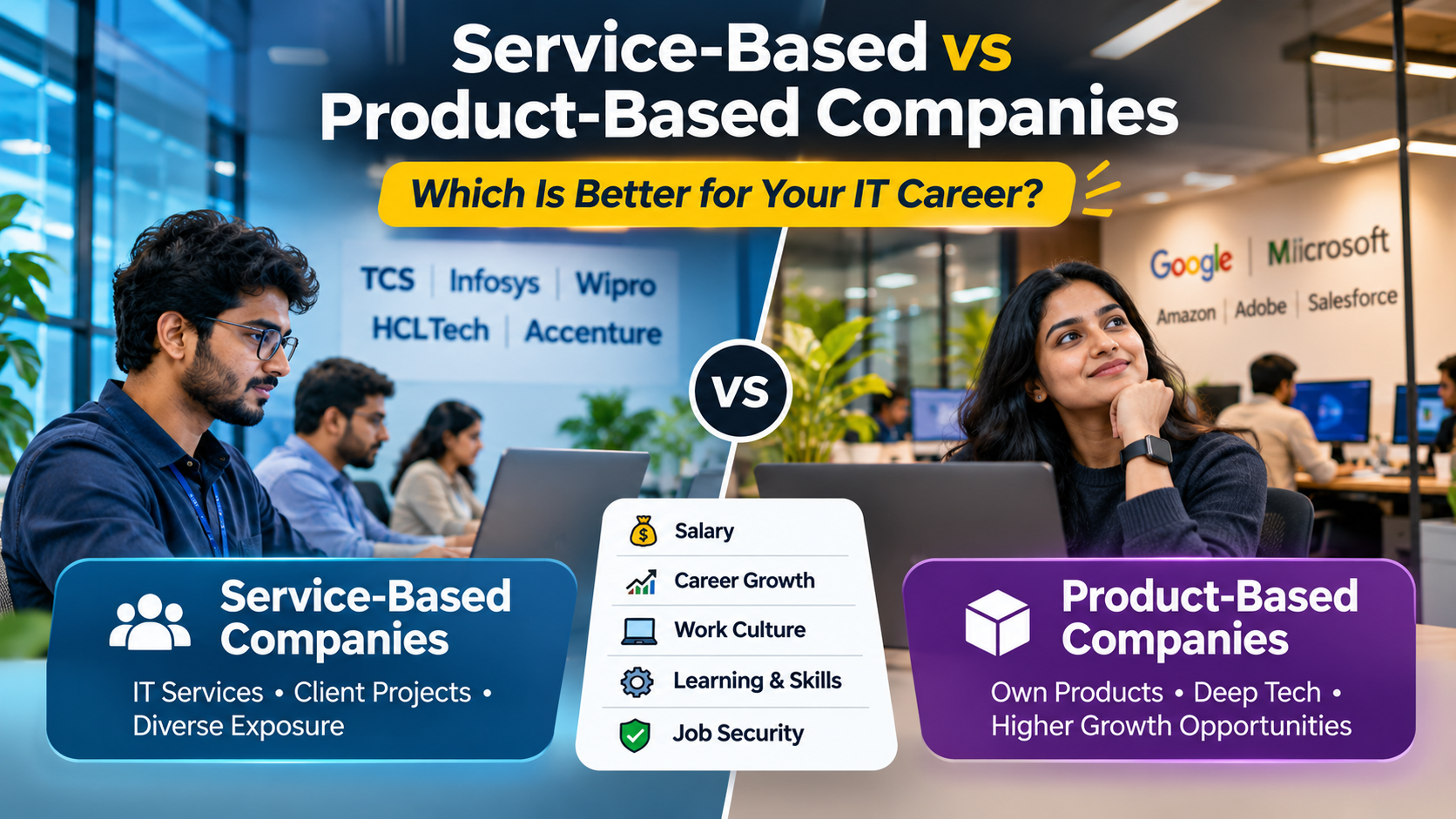
Choosing the right company is one of the most important decisions in an IT professional's career.
If you are planning to enter the IT industry or considering switching jobs after gaining a few years of experience, you have probably come across two common terms: service-based companies and product-based companies.
Companies such as TCS, Infosys, Wipro, and HCLTech are well-known examples of service-based organizations. On the other hand, Google, Microsoft, Amazon, Adobe, and Atlassian are examples of product-focused technology companies.
But what exactly makes these companies different?
Why do some developers prefer product-based companies for higher salary packages, while others choose service-based companies for their diverse project exposure and career opportunities?
In this blog, we will compare service-based and product-based companies across different factors, including salary, work culture, technical skills, career growth, job security, and work-life balance.
Let's understand which option is better for your career.
1. What Are Service-Based Companies?
Service-based companies provide IT services, software development, consulting, maintenance, and technology solutions to other businesses.
These companies work with multiple clients across different industries, such as banking, healthcare, retail, finance, education, and telecommunications.
Their primary business model is based on providing technology services to clients.
Examples of service-based companies
- Tata Consultancy Services (TCS)
- Infosys
- Wipro
- HCLTech
- Accenture
- Cognizant
- Capgemini
- Tech Mahindra
- LTIMindtree
How do service-based companies work?
Imagine a banking organization wants to develop a new mobile banking application.
Instead of building its own development team, the bank may hire an IT services company to develop and maintain the application.
The service-based company assigns developers, testers, business analysts, project managers, and other professionals to work on the project.
Depending on the project, you might work with:
- Java and Spring Boot.
- React and Angular.
- Node.js.
- Python.
- Cloud technologies.
- Database management.
- Testing and automation.
As an employee, you may work on different client projects depending on business requirements and internal project allocations.
2. What Are Product-Based Companies?
Product-based companies develop, own, maintain, and sell their own software products, platforms, applications, or technology solutions.
Their primary focus is building products that solve specific problems for customers or businesses.
Instead of developing software exclusively for clients, these companies invest in their own products and continuously improve them.
Examples of product-based companies
- Microsoft
- Amazon
- Apple
- Adobe
- Salesforce
- Atlassian
- Oracle
- Zoho
- Flipkart
- PhonePe
- Freshworks
How do product-based companies work?
Consider a company developing a cloud-based customer relationship management (CRM) platform.
The company has its own engineering team responsible for:
- Developing new features.
- Improving application performance.
- Fixing bugs.
- Designing scalable architectures.
- Managing cloud infrastructure.
- Improving product security.
- Understanding customer requirements.
Developers work on the same product or related services over time and contribute to its long-term development.
This often provides opportunities to understand the complete software development lifecycle.
3. Service-Based vs Product-Based Companies: Key Differences
Let's compare both business models across important career factors.
FactorService-BasedProduct-Based
Business model
Client services
Own products
Projects
Multiple client projects
Company-owned products
Salary
Varies by company and role
Can be highly competitive
Hiring process
Varies; often multiple rounds
Often rigorous technical rounds
Technical exposure
Depends on client projects
Depends on product and team
Work culture
Client and project dependent
Product and team dependent
Career growth
Depends on performance and opportunities
Depends on performance and opportunities
Technology
Depends on project requirements
Depends on product requirements
Ownership
Client deliverables
Long-term product development
Learning
Multiple domains and technologies
Deep product and engineering knowledge
Neither model is automatically better. Your experience depends heavily on the company, team, project, and responsibilities.
4. Salary Comparison: Which Companies Pay More?
Salary is one of the biggest reasons developers consider switching from service-based to product-based companies.
Many product-focused technology organizations offer competitive compensation, especially for experienced software engineers and specialized technical roles.
However, not every product company pays more than every service company. Compensation depends on experience, skills, location, job level, and negotiation.
Illustrative salary comparison in India
The following figures are indicative examples, not verified company-wide salary averages.
ExperienceService-Based CompaniesProduct-Based Companies
Fresher
₹3–6 LPA
₹5–12 LPA
2–3 Years
₹5–9 LPA
₹8–16 LPA
4–5 Years
₹7–14 LPA
₹12–25 LPA
6–8 Years
₹12–20 LPA
₹18–35 LPA
9–12 Years
₹18–30 LPA
₹25–50+ LPA
Actual offers can fall outside these ranges.
Why can product-based companies offer higher salaries?
Some reasons include:
- Revenue from scalable software products.
- Demand for specialized engineering skills.
- Competition for experienced technical talent.
- Business impact of engineering contributions.
- Compensation structures involving bonuses and stock-based benefits.
Remember to compare fixed salary, variable pay, bonuses, stock compensation, and benefits instead of looking only at total CTC.
5. Work Culture: Which Is Better?
Work culture varies significantly between organizations.
However, there are some common differences in how teams operate.
Work culture in service-based companies
- Work may be driven by client requirements.
- Project deadlines can be influenced by client expectations.
- Employees may work across different time zones.
- Technology choices may depend on client requirements.
- Project allocation can influence day-to-day responsibilities.
One advantage is exposure to different clients, industries, and business environments.
Work culture in product-based companies
- Teams generally focus on building and improving company products.
- Developers may have greater ownership of specific features.
- Engineering decisions can involve long-term product considerations.
- Teams may focus on performance, scalability, reliability, and user experience.
- Work may involve deeper technical problem-solving.
However, product companies can also have demanding release schedules, production incidents, and high performance expectations.
Which is better?
If you enjoy working across different business domains, service-based companies can offer valuable exposure.
If you enjoy building and continuously improving a product, product-based companies may be a better fit.
6. Technical Skills: What Do Companies Expect?
Technical expectations depend on the job role rather than simply whether a company is service-based or product-based.
However, experienced engineering roles in many product-focused companies place significant emphasis on problem-solving, coding, system design, and software architecture.
Skills commonly required for service-based company roles
- Java, Python, C#, or JavaScript.
- React, Angular, or other frontend frameworks.
- SQL and database fundamentals.
- REST API development.
- Software testing.
- Agile methodologies.
- Cloud fundamentals.
Skills commonly expected for product-focused engineering roles
- Strong data structures and algorithms.
- Problem-solving.
- Object-oriented programming.
- System design.
- Database optimization.
- Distributed systems fundamentals.
- Application scalability.
- Cloud architecture.
- Performance optimization.
- Testing and debugging.
These are general patterns, not strict rules. Many service companies also have advanced engineering roles, and many product companies hire developers for roles that do not require extensive system design.
7. Interview Process: Service-Based vs Product-Based
The recruitment process is another important difference to understand.
Service-based company interviews
Depending on the company and position, the selection process may include:
- Aptitude or online assessment.
- Programming assessment.
- Technical interview.
- Managerial interview.
- HR discussion.
Experienced professionals may also be evaluated on project experience, technical knowledge, and client communication.
Product-based company interviews
The process may include:
- Online coding assessment.
- Data structures and algorithms.
- Technical programming rounds.
- Low-level system design.
- High-level system design.
- Managerial or behavioral interview.
- HR and compensation discussion.
The number and type of rounds vary by company and seniority.
What should you prepare?
If you are targeting product-focused engineering roles, prioritize:
- DSA practice.
- Problem-solving.
- Core programming concepts.
- Object-oriented design.
- System design.
- Real-world project explanations.
Platforms such as LeetCode, HackerRank, and GeeksforGeeks can help you practice technical interview questions.
8. Job Security: Which Is Safer?
Job security is an important consideration, especially for professionals with family responsibilities and financial commitments.
There is no universal rule that service-based companies provide better job security or that product-based companies are more stable.
Both types of organizations can experience:
- Layoffs.
- Hiring freezes.
- Project cancellations.
- Business restructuring.
- Performance-based exits.
Service-based organizations may have opportunities across multiple client accounts, but employees can still face project allocation challenges.
Product-based organizations may be affected by product performance, revenue, market conditions, and strategic changes.
Before joining any organization, research its financial performance, employee reviews, business outlook, and recent hiring trends.
9. Career Growth: Where Can You Learn More?
Career growth is not determined only by the company category.
It depends on the responsibilities you receive, the technologies you use, the quality of mentorship, and your ability to take ownership.
Career opportunities in service-based companies
You may grow into roles such as:
- Senior Software Developer.
- Technical Lead.
- Solution Architect.
- Project Manager.
- Delivery Manager.
- Technology Consultant.
Working across clients can help develop communication, domain knowledge, and consulting skills.
Career opportunities in product-based companies
You may grow into roles such as:
- Senior Software Engineer.
- Staff Engineer.
- Principal Engineer.
- Engineering Manager.
- Technical Architect.
- Director of Engineering.
You may also develop deeper expertise in product architecture, distributed systems, and engineering leadership.
The right career path depends on whether you want to specialize technically, move into management, or develop broader business responsibilities.
10. Can You Switch from a Service-Based Company to a Product-Based Company?
Absolutely!
Many developers start their careers in service-based companies and later move into product-focused organizations.
Your existing experience can be valuable, provided you can demonstrate strong technical knowledge and relevant engineering contributions.
Step-by-step roadmap to make the transition
Step 1: Strengthen your programming fundamentals
Choose your primary programming language and become confident with its core concepts.
Step 2: Master Data Structures and Algorithms
Practice arrays, strings, trees, graphs, linked lists, recursion, and dynamic programming.
Step 3: Learn System Design
Understand application architecture, caching, load balancing, databases, scalability, and distributed systems.
Step 4: Build strong real-world projects
Develop applications that demonstrate your understanding of backend architecture, frontend development, APIs, databases, and deployment.
Step 5: Prepare for technical interviews
Practice coding problems and participate in mock interviews.
Step 6: Update your resume and LinkedIn profile
Highlight your technical contributions, achievements, project ownership, and measurable impact.
Step 7: Start applying strategically
Target positions that match your experience rather than applying randomly to every opening.
Consistency and preparation are key to making a successful transition.
11. Which Is Better for Freshers?
For fresh graduates, both service-based and product-based companies offer valuable career opportunities.
Service-based companies may be suitable if:
- You are looking for your first IT job.
- You want exposure to enterprise projects.
- You want to understand different business domains.
- You are starting your career with foundational technical skills.
Product-based companies may be suitable if:
- You have strong programming fundamentals.
- You enjoy problem-solving.
- You are interested in building software products.
- You are comfortable with technical interview preparation.
Don't reject a good service-based opportunity while waiting indefinitely for a product-based offer.
Your first job is an opportunity to develop professional experience. You can continue preparing for your preferred career path.
12. Which Is Better for Experienced Developers?
For professionals with 3–10 years of experience, the decision should be more strategic.
At this stage, companies expect more than basic coding knowledge.
They may expect you to:
- Design and develop scalable applications.
- Solve complex technical problems.
- Review code and guide junior developers.
- Optimize application performance.
- Understand business requirements.
- Make technical decisions.
- Take ownership of production applications.
If you are currently working in a service-based company and want to move into a product-based organization, focus on developing these skills.
However, don't switch simply because a company is labelled product-based.
A senior engineering position in a strong service-based organization may provide better learning, compensation, and leadership opportunities than a poorly structured role in a product company.
13. Top Skills to Learn in 2027 for Better IT Career Opportunities
Regardless of the company you choose, continuous learning is essential.
Here are some technology areas worth exploring:
Artificial Intelligence and Generative AI
- Large Language Models.
- Prompt engineering.
- AI application development.
- RAG architecture.
- AI agents.
Cloud Computing
- AWS.
- Microsoft Azure.
- Google Cloud.
Modern Backend Development
- Java and Spring Boot.
- Node.js.
- Python.
- Microservices architecture.
Frontend Development
- React.
- Angular.
- Next.js.
- TypeScript.
DevOps and Infrastructure
- Docker.
- Kubernetes.
- CI/CD.
- Infrastructure as Code.
Data Engineering
- SQL.
- Python.
- Apache Spark.
- Data pipelines.
- Cloud data platforms.
Choose technologies based on your existing expertise and the roles you want to pursue.
Conclusion
So, service-based vs product-based companies: which is better for your career?
The answer depends on your professional goals.
Service-based companies can provide opportunities to work across different clients, industries, and technologies. Product-based companies can offer opportunities to build products, develop deeper engineering expertise, and work on long-term technical challenges.
Both can lead to successful and rewarding careers.
If your goal is to work in a product-focused technology organization, start preparing early. Strengthen your programming fundamentals, practice DSA, learn system design, build meaningful projects, and prepare for technical interviews.
Your career growth is not defined by the type of company you work for. It is defined by the skills you build, the problems you solve, and the value you create.
Start investing in your skills today, and make your next career move count.