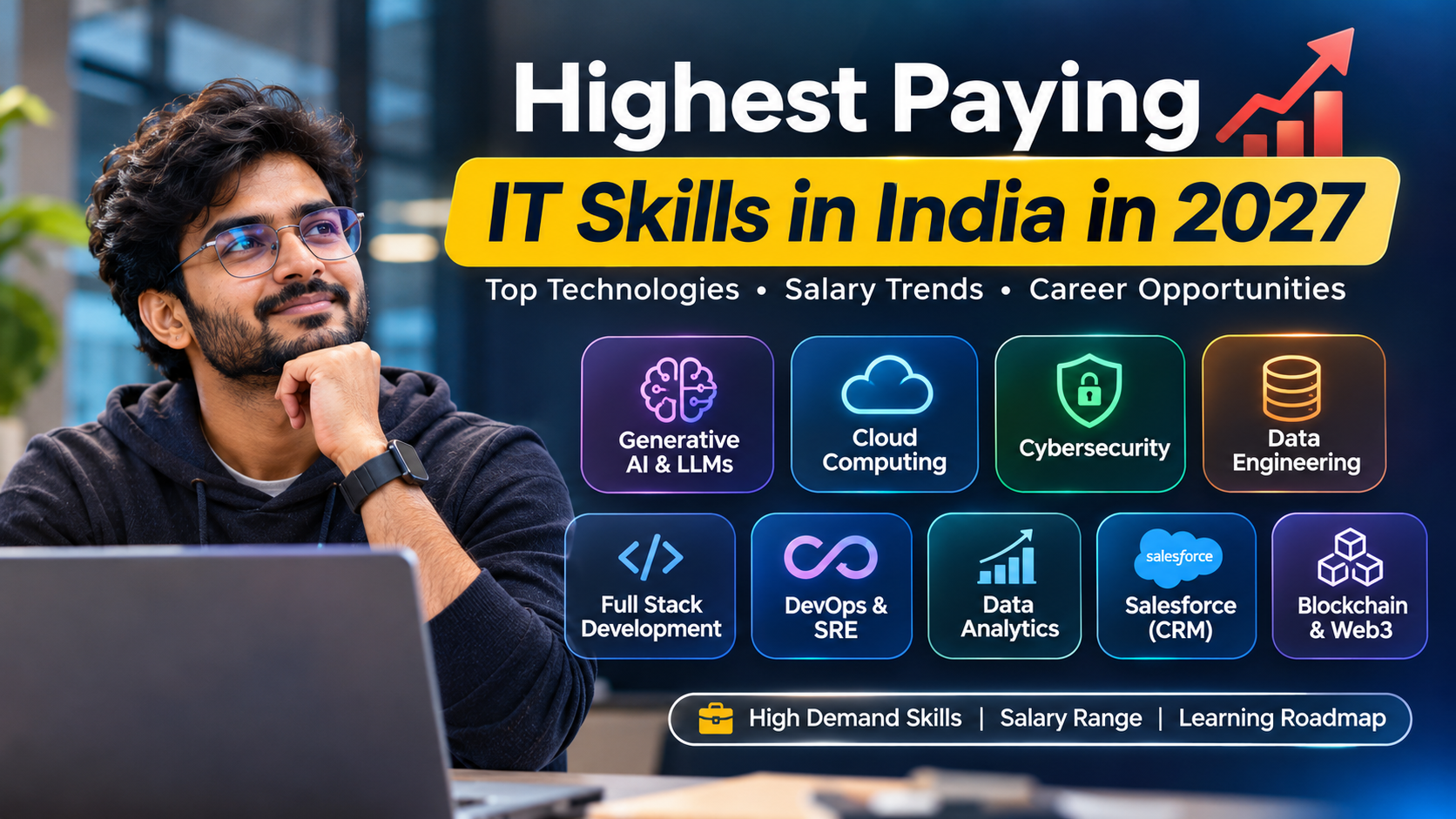
The IT industry in India is changing rapidly. Technologies that were considered advanced a few years ago are now becoming essential for modern software development.
Artificial Intelligence, Generative AI, Cloud Computing, Cybersecurity, Data Engineering, and Automation are creating new career opportunities for software professionals.
At the same time, companies are looking for developers who can do more than write code. They need professionals who can build intelligent applications, manage cloud infrastructure, secure systems, process large amounts of data, and solve complex business problems.
For fresh graduates and experienced IT professionals, choosing the right technology to learn can make a significant difference in long-term career growth.
But which IT skills offer the highest salaries in India in 2027? Which technologies have strong career opportunities? And what should you learn to stay competitive in the IT industry?
In this article, we will explore the top 10 highest-paying IT skills in India, their career opportunities, expected salary ranges, and the skills required to enter these fields.
1. Generative AI and Large Language Models (LLMs)
Generative AI is one of the most exciting technology areas transforming the software industry.
Businesses are increasingly adopting AI-powered applications to automate tasks, improve customer experiences, analyze information, and increase productivity.
Technologies such as ChatGPT, Gemini, Claude, and open-source Large Language Models have created opportunities for developers who can build practical AI-powered solutions.
Why is Generative AI in demand?
Organizations are exploring Generative AI for:
- AI-powered customer support.
- Automated document processing.
- Intelligent chatbots.
- AI-powered search engines.
- Business process automation.
- AI coding assistants.
- Enterprise knowledge management.
Skills you should learn
- Python programming.
- Large Language Models (LLMs).
- Prompt engineering.
- Retrieval-Augmented Generation (RAG).
- LangChain and LangGraph.
- Vector databases.
- AI agents and tool calling.
- Model APIs and deployment.
Career opportunities
- Generative AI Engineer.
- AI Application Developer.
- LLM Engineer.
- AI Automation Engineer.
- AI Solutions Architect.
Expected salary in India: Approximately ₹8–15 LPA for early-career opportunities, ₹15–35 LPA for experienced professionals, with specialized senior roles potentially reaching ₹40–60 LPA or more.
Generative AI salaries vary considerably depending on practical experience, specialization, company, and ability to build production-ready applications.
2. Artificial Intelligence and Machine Learning
Artificial Intelligence and Machine Learning are transforming industries such as healthcare, banking, manufacturing, e-commerce, education, and finance.
Unlike traditional software applications, AI-powered systems can identify patterns, make predictions, process natural language, and support intelligent decision-making.
Companies need professionals who understand how to develop, train, evaluate, and deploy machine learning models.
Why should you learn AI and ML?
AI and ML are being used for:
- Fraud detection.
- Recommendation systems.
- Predictive analytics.
- Image recognition.
- Natural language processing.
- Customer behavior analysis.
- Intelligent automation.
Skills you should learn
- Python.
- Mathematics and statistics.
- Machine learning algorithms.
- Deep learning.
- TensorFlow or PyTorch.
- Natural Language Processing.
- Computer Vision.
- Model evaluation and deployment.
Career opportunities
- Machine Learning Engineer.
- AI Engineer.
- Data Scientist.
- Deep Learning Engineer.
- Computer Vision Engineer.
Expected salary in India: Approximately ₹6–12 LPA for early-career roles, ₹12–30 LPA for experienced professionals, and higher compensation for specialized senior positions.
AI and ML are particularly suitable for developers who enjoy mathematics, programming, data analysis, and solving complex problems.
3. Cloud Computing (AWS, Microsoft Azure and Google Cloud)
Cloud Computing has become an essential part of modern software infrastructure.
Instead of maintaining all their servers and infrastructure physically, organizations use cloud platforms to host applications, store data, manage databases, and scale their services.
Amazon Web Services (AWS), Microsoft Azure, and Google Cloud Platform (GCP) are among the major cloud platforms used by organizations worldwide.
Why is Cloud Computing in demand?
Companies use cloud services for:
- Application hosting.
- Database management.
- Cloud storage.
- Serverless computing.
- Disaster recovery.
- Application scalability.
- Enterprise infrastructure management.
Skills you should learn
AWS:
- EC2.
- S3.
- Lambda.
- RDS.
- VPC.
- CloudFront.
- IAM.
- ECS and EKS.
Microsoft Azure:
- Azure Virtual Machines.
- Azure App Service.
- Azure Functions.
- Azure DevOps.
- Azure Storage.
- Azure Kubernetes Service.
Google Cloud:
- Compute Engine.
- Cloud Storage.
- Cloud Run.
- BigQuery.
- Google Kubernetes Engine.
Career opportunities
- Cloud Engineer.
- AWS Solutions Architect.
- Azure Cloud Engineer.
- Cloud Consultant.
- Cloud Architect.
- Cloud Security Engineer.
Expected salary in India: Approximately ₹5–12 LPA for early-career roles, ₹12–30 LPA for experienced professionals, with senior cloud architects potentially earning ₹30–45 LPA or more.
Cloud Computing is a strong career option for software developers, system administrators, and infrastructure professionals looking to move into advanced technology roles.
4. Cybersecurity and Ethical Hacking
As businesses become increasingly digital, protecting applications, networks, and sensitive information has become a major priority.
Cyberattacks, ransomware, data breaches, phishing, and identity theft create significant security challenges for organizations.
Cybersecurity professionals help companies identify vulnerabilities, prevent attacks, monitor threats, and protect digital infrastructure.
Why is Cybersecurity in demand?
Organizations need security professionals to:
- Protect sensitive business information.
- Identify application vulnerabilities.
- Secure cloud infrastructure.
- Monitor suspicious activities.
- Conduct security assessments.
- Ensure regulatory compliance.
- Respond to cyber incidents.
Skills you should learn
- Networking fundamentals.
- Linux.
- Operating system security.
- Web application security.
- Ethical hacking.
- Penetration testing.
- SIEM tools.
- Cloud security.
- Security monitoring.
- Incident response.
Career opportunities
- Cybersecurity Analyst.
- Security Engineer.
- Penetration Tester.
- Security Consultant.
- Cloud Security Engineer.
- Application Security Engineer.
Expected salary in India: Approximately ₹4–10 LPA for early-career roles, ₹10–25 LPA for experienced professionals, and ₹25–50 LPA or more for specialized senior security positions.
Cybersecurity is a particularly interesting option for professionals who enjoy investigation, problem-solving, networking, and understanding how systems can be protected.
5. Data Engineering and Big Data Technologies
Every organization generates large amounts of data through applications, transactions, customer interactions, and business operations.
However, raw data is not always useful. It needs to be collected, processed, cleaned, transformed, and stored before businesses can use it for analytics and decision-making.
This is where Data Engineers play an important role.
Why is Data Engineering in demand?
Companies need reliable data infrastructure to support:
- Business intelligence.
- AI and Machine Learning.
- Real-time analytics.
- Customer analytics.
- Financial reporting.
- Predictive analytics.
Skills you should learn
- Python.
- SQL.
- Apache Spark.
- Apache Kafka.
- ETL and ELT pipelines.
- Data Warehousing.
- Snowflake.
- Databricks.
- Apache Airflow.
- Cloud data services.
Career opportunities
- Data Engineer.
- Big Data Engineer.
- Data Architect.
- Analytics Engineer.
- Data Platform Engineer.
Expected salary in India: Approximately ₹5–12 LPA for early-career roles, ₹12–27 LPA for experienced professionals, with senior data engineering and architecture roles potentially offering higher packages.
Data Engineering is an excellent career option for developers who enjoy backend programming, databases, distributed systems, and working with large datasets.
6. DevOps and Site Reliability Engineering (SRE)
Modern software applications need continuous development, deployment, monitoring, and maintenance.
DevOps combines software development and IT operations to improve the speed, reliability, and efficiency of software delivery.
Site Reliability Engineering focuses on maintaining the reliability, availability, and performance of applications and infrastructure.
Why is DevOps in demand?
Organizations want to:
- Automate software deployments.
- Reduce manual infrastructure management.
- Improve application availability.
- Monitor production systems.
- Manage cloud infrastructure.
- Improve development workflows.
Skills you should learn
- Linux.
- Git and GitHub.
- Docker.
- Kubernetes.
- Jenkins.
- GitHub Actions.
- Terraform.
- Ansible.
- AWS or Azure.
- Monitoring tools such as Prometheus and Grafana.
Career opportunities
- DevOps Engineer.
- Site Reliability Engineer.
- Platform Engineer.
- Cloud DevOps Engineer.
- Infrastructure Automation Engineer.
Expected salary in India: Approximately ₹5–12 LPA for early-career roles, ₹12–28 LPA for experienced professionals, with senior SRE and platform engineering roles potentially paying ₹30 LPA or more.
DevOps is especially suitable for developers and system administrators interested in automation, cloud infrastructure, and production engineering.
7. Full Stack Development (React, Angular, Node.js and Java)
Full Stack Development continues to be an important skill area in the IT industry.
Companies need developers who can build complete applications, from user interfaces to backend services and databases.
Full Stack Developers understand how different parts of an application communicate and work together.
Why is Full Stack Development in demand?
Businesses need professionals who can:
- Develop web applications.
- Build REST APIs.
- Design databases.
- Integrate third-party services.
- Develop scalable backend systems.
- Deploy applications to cloud platforms.
- Maintain existing software products.
Skills you should learn
Frontend:
- HTML, CSS and JavaScript.
- React.js.
- Angular.
- TypeScript.
- Next.js.
Backend:
- Node.js.
- Java and Spring Boot.
- Python and Django.
- REST APIs.
- Microservices.
Database and Infrastructure:
- MongoDB.
- MySQL.
- PostgreSQL.
- Redis.
- AWS or Azure.
- Docker.
Career opportunities
- Full Stack Developer.
- React Developer.
- Java Full Stack Developer.
- Node.js Developer.
- Software Engineer.
- Backend Developer.
Expected salary in India: Approximately ₹4–10 LPA for early-career roles, ₹10–25 LPA for experienced professionals, with senior engineering roles potentially paying ₹30 LPA or more.
Full Stack Development is a good choice for freshers entering the IT industry and experienced developers looking to expand their technical expertise.
8. Salesforce and Enterprise CRM Development
Salesforce is a leading cloud-based customer relationship management platform used by organizations to manage sales, customer service, marketing, and business processes.
Companies across industries use CRM platforms to improve customer relationships and automate business operations.
Why is Salesforce in demand?
Organizations use Salesforce for:
- Sales automation.
- Customer relationship management.
- Marketing automation.
- Customer support.
- Business process automation.
- Enterprise application integration.
Skills you should learn
- Salesforce Administration.
- Apex Programming.
- Lightning Web Components (LWC).
- Salesforce Flow.
- SOQL and SOSL.
- Salesforce integrations.
- CRM architecture.
Career opportunities
- Salesforce Developer.
- Salesforce Administrator.
- Salesforce Consultant.
- Salesforce Architect.
- CRM Technical Consultant.
Expected salary in India: Approximately ₹4–10 LPA for early-career roles, ₹10–25 LPA for experienced professionals, with specialized architects and consultants potentially earning more.
Salesforce can be a good option for professionals interested in enterprise applications, CRM development, and business automation.
9. Blockchain Development and Web3
Blockchain technology provides a distributed way of recording and verifying transactions.
Although cryptocurrency is one of its best-known applications, blockchain technology is also explored in areas such as supply chain management, digital identity, financial services, and smart contracts.
Why is Blockchain Development relevant?
Potential applications include:
- Smart contracts.
- Decentralized applications.
- Digital identity.
- Tokenization.
- Supply chain tracking.
- Blockchain-based financial systems.
Skills you should learn
- Solidity.
- Ethereum fundamentals.
- Smart contract development.
- Web3.js or Ethers.js.
- Blockchain architecture.
- Cryptography fundamentals.
- Smart contract security.
Career opportunities
- Blockchain Developer.
- Smart Contract Developer.
- Web3 Developer.
- Blockchain Consultant.
- Blockchain Security Engineer.
Expected salary in India: Approximately ₹5–12 LPA for early-career roles, ₹12–25 LPA for experienced professionals, with specialized roles offering higher compensation.
Blockchain is a specialized field. Research actual job openings before choosing it as your primary career path, as hiring demand can vary significantly.
10. Data Analytics and Business Intelligence
Data Analytics helps organizations understand business performance and make informed decisions using data.
Companies need professionals who can collect information, identify patterns, create reports, and communicate meaningful insights.
It is also one of the accessible entry points for people interested in data-related careers.
Why is Data Analytics in demand?
Organizations use data analytics for:
- Sales performance analysis.
- Customer behavior analysis.
- Financial reporting.
- Marketing optimization.
- Business forecasting.
- Operational efficiency.
Skills you should learn
- Advanced Excel.
- SQL.
- Python.
- Power BI.
- Tableau.
- Data visualization.
- Statistics.
- Business intelligence.
Career opportunities
- Data Analyst.
- Business Analyst.
- BI Developer.
- Reporting Analyst.
- Business Intelligence Analyst.
Expected salary in India: Approximately ₹3–7 LPA for early-career roles, ₹7–15 LPA for experienced professionals, with specialized senior analytics roles potentially paying more.
Data Analytics is a good starting point for graduates from different educational backgrounds who enjoy working with numbers, business problems, and technology.
Highest Paying IT Skills in India in 2027: Salary Comparison
Here is a quick comparison of the technologies and career paths discussed above.
TechnologyEarly-career salaryExperienced salary
Generative AI
₹8–15 LPA
₹15–35+ LPA
AI & Machine Learning
₹6–12 LPA
₹12–30+ LPA
Cloud Computing
₹5–12 LPA
₹12–30+ LPA
Cybersecurity
₹4–10 LPA
₹10–25+ LPA
Data Engineering
₹5–12 LPA
₹12–27+ LPA
DevOps & SRE
₹5–12 LPA
₹12–28+ LPA
Full Stack Development
₹4–10 LPA
₹10–25+ LPA
Salesforce
₹4–10 LPA
₹10–25+ LPA
Blockchain
₹5–12 LPA
₹12–25+ LPA
Data Analytics
₹3–7 LPA
₹7–15+ LPA
Note: These are indicative planning ranges, not guaranteed salary offers or official 2027 averages. Actual compensation varies by experience, company, city, specialization, and interview performance. Some niche senior roles can pay substantially more.
Which IT Skill Should You Learn Based on Your Experience?
Choosing a technology based on your current experience can make your learning journey more effective.
If you are a fresher
Start with strong programming and technical fundamentals.
Recommended skills:
- Java Full Stack Development.
- Python Programming.
- React Development.
- SQL and Database Management.
- Cloud Fundamentals.
Focus on building projects and developing problem-solving skills before specializing.
If you have 1–3 years of experience
Build on your existing technical knowledge.
Recommended skills:
- Advanced React and Node.js.
- Spring Boot and Microservices.
- AWS or Azure.
- Data Engineering.
- Generative AI application development.
If you have 3–6 years of experience
Focus on specialization and advanced engineering responsibilities.
Recommended skills:
- System Design.
- Cloud Architecture.
- DevOps and Kubernetes.
- AI and LLM Application Development.
- Data Engineering and Distributed Systems.
If you have 6–10+ years of experience
Consider moving towards senior technical and architecture positions.
Recommended skills:
- Enterprise Architecture.
- AI Solutions Architecture.
- Cloud Architecture.
- Platform Engineering.
- Cybersecurity Architecture.
- Technical Leadership.
At this stage, technical depth, decision-making, system ownership, and business impact can be just as important as learning another programming language.
How to Choose the Right IT Skill for Your Career?
With so many technologies available, choosing one can be confusing.
Before enrolling in a course or starting a learning journey, consider these factors.
1. Your existing technical knowledge
Choose a technology that complements your current experience. For example, a Java developer can explore Spring Boot, Microservices, AWS, or Generative AI application development.
2. Market demand
Check job openings on LinkedIn, Naukri, and company career pages. Identify the skills repeatedly mentioned in relevant job descriptions.
3. Long-term career opportunities
Don't choose a technology only because it is trending. Understand whether it has practical applications and a sustainable job market.
4. Practical learning opportunities
Look for courses that include real-world projects, hands-on assignments, and practical implementation.
5. Your career goals
Decide whether you want to become a developer, AI engineer, cloud architect, data engineer, security specialist, or technical leader.
The right choice should align with both your interests and your career objectives.
90-Day Roadmap to Learn a High-Paying IT Skill
If you want to upgrade your technical skills in 2027, here is a practical 90-day learning plan.
Days 1–30: Build the fundamentals
- Understand the core concepts of your selected technology.
- Learn the required programming language.
- Practice basic exercises.
- Understand commonly used tools.
- Follow structured learning resources.
Days 31–60: Develop practical skills
- Work on real-world assignments.
- Build a small application or project.
- Learn industry-standard tools.
- Understand deployment and integration.
- Solve practical technical problems.
Days 61–90: Become job-ready
- Build a complete portfolio project.
- Update your resume.
- Prepare for technical interviews.
- Practice coding and problem-solving.
- Attend mock interviews.
- Apply for relevant job opportunities.
The timeline depends on your starting knowledge and the complexity of the technology. Advanced specializations may require substantially more preparation.
Frequently Asked Questions (FAQs)
1. Which IT skill has the highest salary in India in 2027?
Generative AI, AI/ML engineering, cloud architecture, cybersecurity, and specialized data engineering are among the technology areas with strong salary potential. Actual compensation depends on expertise, experience, and the organization.
2. Which technology is best for freshers in 2027?
Java Full Stack Development, Python, React, and cloud fundamentals are practical starting points for fresh graduates. Students can later specialize in AI, Data Engineering, or Cloud Computing.
3. Is Generative AI a good career option in 2027?
Yes. Generative AI offers opportunities in AI application development, LLM integration, RAG systems, AI agents, and automation. However, practical programming and software engineering knowledge are important.
4. Can non-IT students learn high-paying IT skills?
Yes. Students from non-IT backgrounds can enter the technology industry by learning programming, databases, web development, data analytics, or other suitable technical skills. Consistent practice and project experience are important.
5. Which IT skills are best for experienced software developers?
Experienced developers can explore System Design, Generative AI, Cloud Architecture, DevOps, Microservices, Cybersecurity, and Data Engineering depending on their existing technical background.
6. Can I get a 20 LPA package after learning a new technology?
It is possible, but completing a course alone does not guarantee a particular salary. Companies evaluate practical expertise, previous experience, project contributions, problem-solving abilities, and interview performance.
7. Which programming language should I learn in 2027?
Python, Java, JavaScript, and TypeScript remain useful choices across different technology roles. Select a language based on your target career rather than popularity alone.
Conclusion
The highest-paying IT skills in India in 2027 are increasingly connected to Artificial Intelligence, Cloud Computing, Cybersecurity, Data Engineering, and advanced software development.
However, learning a trending technology is only the first step.
To build a successful IT career, you need strong fundamentals, practical experience, real-world project knowledge, and the ability to solve business problems using technology.
Whether you are a fresher looking for your first IT job or an experienced developer planning your next career move, investing in the right technical skills can open new opportunities.
Don't just learn the technology that is trending today. Build the skills that companies will need tomorrow.
Start learning, build practical projects, and prepare yourself for the next generation of IT opportunities.