Getting your first software development job and becoming a Senior Software Engineer are two very different career milestones.
When you have 4, 5, 7, or 10 years of experience, companies expect more than your ability to write code. They want to understand how you design scalable applications, solve complex technical problems, make architectural decisions, handle production issues, and guide other developers.
Many experienced developers make a common mistake when preparing for interviews: they spend most of their preparation time solving coding problems but ignore System Design, architecture, project discussions, and leadership skills.
This can become a major disadvantage when applying for senior positions in product-based companies and established technology organizations.
If you are planning to switch jobs, target a higher salary package, or move into a Senior Software Engineer or Technical Lead position, structured preparation is essential.
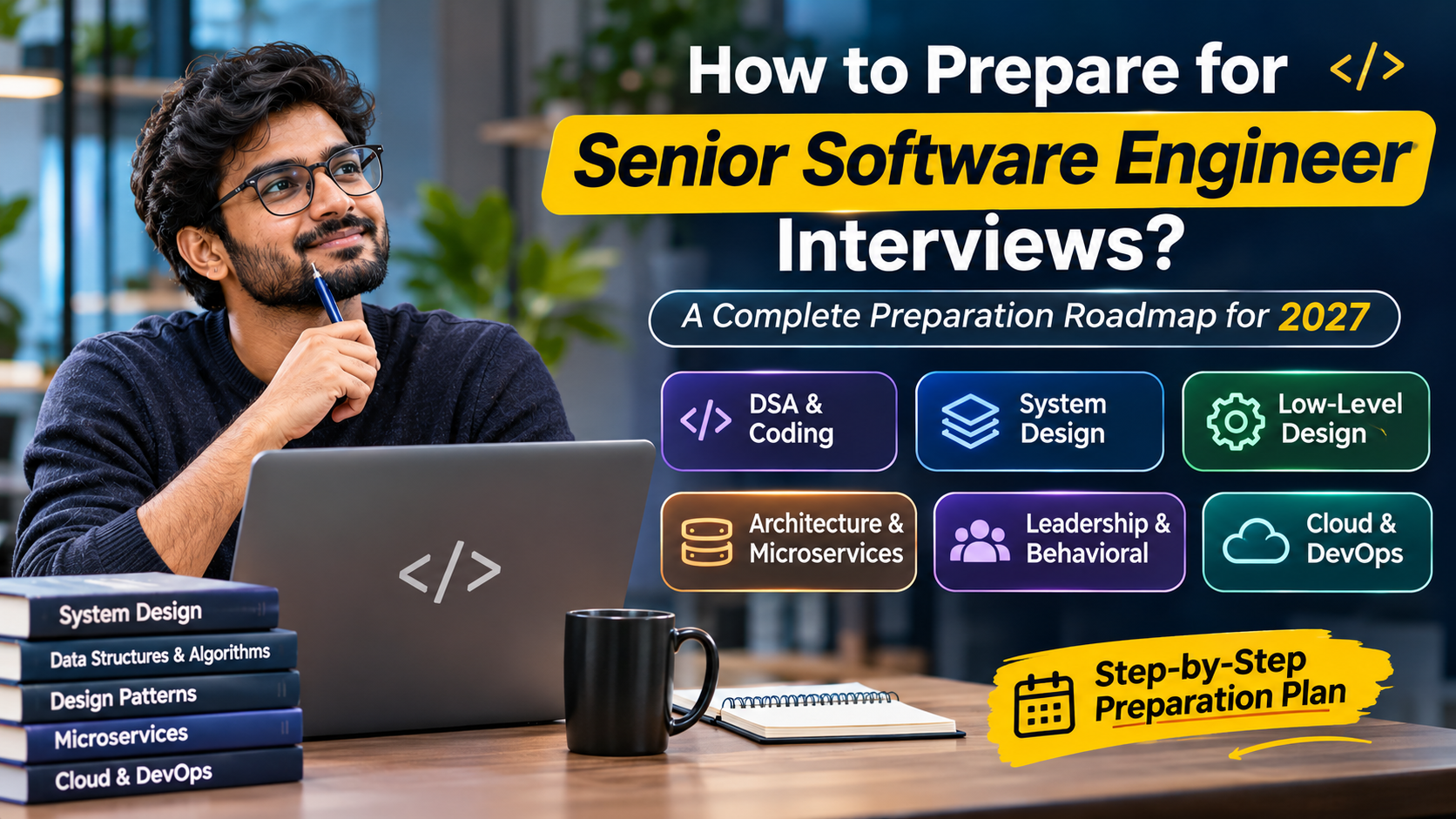
In this guide, we will explore how to prepare for Senior Software Engineer interviews, which technical topics to focus on, commonly asked questions, and a practical 60-day preparation roadmap.
1. Understand What Companies Expect from a Senior Software Engineer
Before starting your preparation, understand what separates a senior developer from a junior or mid-level developer.
A junior developer generally focuses on implementing assigned tasks, while a senior developer is expected to understand the bigger picture and take ownership of technical solutions.
Key expectations from senior developers
Technical expertise
- Strong programming fundamentals.
- Advanced knowledge of at least one programming language.
- Understanding of application architecture.
- Experience with databases and APIs.
- Knowledge of performance optimization.
System design and architecture
- Designing scalable applications.
- Understanding distributed systems.
- Choosing appropriate databases.
- Designing reliable APIs.
- Handling application security and scalability.
Problem-solving
- Debugging complex issues.
- Identifying performance bottlenecks.
- Handling production incidents.
- Improving existing applications.
- Making informed technical decisions.
Leadership and ownership
- Mentoring junior developers.
- Conducting code reviews.
- Collaborating with different teams.
- Taking ownership of project delivery.
- Communicating technical decisions.
A senior engineer is not simply someone who has worked for many years. It is someone who can independently solve complex problems and take responsibility for engineering outcomes.
2. Master Data Structures and Algorithms (DSA)
Even with several years of professional experience, Data Structures and Algorithms remain important for technical interviews.
Many product-based companies use coding rounds to evaluate your problem-solving approach, programming fundamentals, and ability to write efficient code.
You don't necessarily need to solve hundreds of problems randomly. Focus on understanding commonly used patterns and applying them to unfamiliar problems.
Important DSA topics to prepare
Arrays and Strings
- Two pointers.
- Sliding window.
- Prefix sums.
- Subarray problems.
- String manipulation.
Linked Lists
- Reversing linked lists.
- Detecting cycles.
- Finding middle elements.
- Merging sorted linked lists.
Trees and Graphs
- Binary trees.
- Binary search trees.
- Tree traversal.
- Breadth-First Search (BFS).
- Depth-First Search (DFS).
- Shortest path algorithms.
HashMaps and Sets
- Frequency counting.
- Duplicate detection.
- Grouping elements.
- Finding pairs and combinations.
Advanced topics
- Dynamic programming.
- Backtracking.
- Heaps and priority queues.
- Binary search.
- Greedy algorithms.
Common DSA interview questions
- Find the longest substring without repeating characters.
- Find the maximum sum subarray.
- Detect a cycle in a linked list.
- Find the kth largest element in an array.
- Merge overlapping intervals.
- Find the lowest common ancestor in a binary tree.
- Implement an LRU cache.
- Find the shortest path in a graph.
Recommended practice platforms
- LeetCode.
- HackerRank.
- GeeksforGeeks.
- CodeSignal.
Pro Tip: Don't just memorize solutions. Understand time complexity, space complexity, edge cases, and why one approach is better than another.
3. Become Strong in System Design
System Design is one of the most important preparation areas for experienced software engineers.
Companies want to understand whether you can design applications that support large numbers of users, handle increasing traffic, and remain reliable under different conditions.
You may be asked to design an application similar to WhatsApp, YouTube, Uber, Amazon, or Instagram.
The goal is not to reproduce an existing architecture from memory. It is to demonstrate how you approach a real engineering problem.
Important System Design concepts
Scalability
- Horizontal scaling.
- Vertical scaling.
- Load balancing.
- Auto-scaling.
Database Design
- SQL vs NoSQL.
- Database indexing.
- Replication.
- Sharding.
- Data partitioning.
Caching
- Redis.
- CDN.
- Cache invalidation.
- Cache eviction strategies.
Distributed Systems
- Message queues.
- Kafka.
- Event-driven architecture.
- Distributed transactions.
- Eventual consistency.
Reliability and Performance
- Fault tolerance.
- High availability.
- Rate limiting.
- Retry mechanisms.
- Monitoring and observability.
Common System Design interview questions
- Design WhatsApp.
- Design YouTube.
- Design an URL Shortener.
- Design an online shopping platform.
- Design a notification system.
- Design a payment processing system.
- Design a ride-booking application.
- Design a real-time chat application.
- Design a video streaming platform.
- Design a distributed rate limiter.
How to approach a System Design question
Follow this structured approach:
Step 1: Understand requirements
Ask questions about users, functionality, traffic, and expected system behavior.
Step 2: Identify functional and non-functional requirements
Understand what the application should do and requirements such as scalability, reliability, availability, and latency.
Step 3: Estimate system scale
Estimate users, requests per second, data storage, and bandwidth requirements.
Step 4: Design the high-level architecture
Identify frontend applications, APIs, backend services, databases, caches, and message queues.
Step 5: Explain database and API design
Discuss data models, API endpoints, database selection, and communication between services.
Step 6: Discuss scalability and trade-offs
Explain how your architecture handles increasing traffic, failures, and performance bottlenecks.
The interviewer wants to understand your reasoning, not just your ability to draw architecture diagrams.
4. Prepare for Low-Level Design (LLD)
Low-Level Design focuses on how individual software components, classes, interfaces, and modules are structured.
While High-Level Design focuses on the overall architecture, Low-Level Design examines how you implement that architecture in maintainable code.
Important LLD concepts
- Object-Oriented Programming.
- SOLID principles.
- Design patterns.
- Class relationships.
- Interfaces and abstractions.
- Dependency injection.
- Encapsulation.
- Composition.
- Concurrency fundamentals.
- Code maintainability and testability.
Important design patterns
Creational Patterns
- Singleton.
- Factory.
- Abstract Factory.
- Builder.
Structural Patterns
- Adapter.
- Decorator.
- Facade.
- Proxy.
Behavioral Patterns
- Observer.
- Strategy.
- Command.
- State.
Common LLD interview questions
- Design a Parking Lot Management System.
- Design an Elevator System.
- Design a Library Management System.
- Design an Online Food Ordering System.
- Design a Payment Gateway.
- Design a Notification Service.
- Design a Movie Ticket Booking System.
- Design a Logging Framework.
Pro Tip: Practice explaining why you selected a particular design pattern. Applying patterns unnecessarily is not good software design.
5. Deeply Understand Your Primary Programming Language
Senior developers are expected to have strong command over at least one primary programming language.
You should be comfortable discussing language internals, performance, memory management, concurrency, and best practices.
For Java Developers
Focus on:
- Collections Framework.
- Java 8+ features.
- Streams and Lambda expressions.
- Multithreading.
- Concurrency.
- JVM architecture.
- Garbage Collection.
- Exception handling.
- Spring Boot.
- Hibernate and JPA.
- Microservices.
For JavaScript and React Developers
Focus on:
- JavaScript execution model.
- Closures and scope.
- Event loop.
- Promises and async/await.
- Memory management.
- React rendering lifecycle.
- Hooks.
- State management.
- Performance optimization.
- TypeScript.
- Frontend architecture.
For Node.js Developers
Focus on:
- Event loop.
- Asynchronous programming.
- Streams and buffers.
- Worker threads.
- Clustering.
- API performance.
- Memory leaks.
- Authentication and authorization.
- Express.js or NestJS.
- Database optimization.
For Python Developers
Focus on:
- Python internals.
- Decorators and generators.
- Iterators.
- Memory management.
- Multithreading and multiprocessing.
- Asyncio.
- Data structures.
- FastAPI or Django.
- Testing and profiling.
Choose the topics relevant to your primary technology rather than trying to master every programming language.
6. Learn Microservices and Backend Architecture
Modern enterprise applications frequently use distributed architectures, making Microservices knowledge valuable for many senior backend and full stack positions.
You should understand how multiple services communicate, share data, handle failures, and maintain consistency.
Important topics
- Monolithic vs Microservices architecture.
- API Gateway.
- Service discovery.
- Inter-service communication.
- Synchronous vs asynchronous communication.
- Message queues.
- Kafka and RabbitMQ.
- Circuit breaker pattern.
- Distributed transactions.
- Saga pattern.
- Service authentication.
- Centralized logging.
Common interview questions
- What are the advantages and disadvantages of Microservices?
- How do you handle communication between services?
- How do you manage distributed transactions?
- What happens when a downstream service fails?
- How do you implement authentication across Microservices?
- How would you prevent duplicate message processing?
- How do you monitor a distributed application?
Try explaining these concepts using examples from applications you have actually developed.
7. Prepare for Database and Performance Optimization Questions
A senior developer should understand how applications interact with databases and how to identify performance problems.
Companies may ask you to troubleshoot slow queries, optimize database operations, or design data storage for high-traffic applications.
SQL topics
- Joins.
- Indexes.
- Query optimization.
- Transactions.
- Normalization.
- Stored procedures.
- Execution plans.
- Database locking.
NoSQL topics
- MongoDB document modeling.
- Aggregation pipelines.
- Indexing strategies.
- Replication.
- Sharding.
- Data consistency.
Performance-related questions
- How do you optimize a slow database query?
- What is the difference between clustered and non-clustered indexes?
- When would you choose SQL over NoSQL?
- How do you handle millions of database records?
- How would you identify a database bottleneck?
- What causes database deadlocks?
- How do you improve API response time?
Don't limit your preparation to theoretical definitions. Be ready to explain how you solved database performance issues in real projects.
8. Prepare for Real-World Project Discussions
One of the most important parts of a senior-level interview is discussing your previous projects.
Interviewers want to understand what you personally contributed, what decisions you made, and how you handled challenges.
Simply saying that you worked on a large application is not enough.
You should be able to explain the architecture and your contribution in detail.
Prepare answers for these questions
- Explain your current project architecture.
- What was your biggest technical challenge?
- How did you improve application performance?
- How did you handle production issues?
- What architectural decisions did you make?
- How did you handle increasing application traffic?
- How did you improve code quality?
- How did you reduce API response time?
- How did you handle database optimization?
- What would you change if you redesigned the application?
Use this structure to explain your project
1. Project Overview: What does the application do?
2. Architecture: Explain frontend, backend, database, and infrastructure.
3. Your Responsibilities: Describe your actual role and ownership.
4. Technical Challenges: Explain the difficult problems you encountered.
5. Solutions: Describe the technical decisions you made.
6. Results: Share measurable outcomes wherever available.
For example, instead of saying:
"I worked on a React and Node.js application."
Explain:
"I worked on a full stack application using React, Node.js, and MongoDB. I was responsible for API development, frontend architecture, database integration, and application performance improvements. I also contributed to production debugging and deployment."
Use your real project experience and avoid claiming responsibilities you did not have.
9. Develop Leadership and Communication Skills
Senior engineers are expected to contribute beyond individual coding tasks.
Companies want people who can collaborate with teams, mentor developers, review code, and make technical decisions.
Important leadership areas
- Code review.
- Mentoring junior developers.
- Technical documentation.
- Sprint planning.
- Task estimation.
- Conflict resolution.
- Cross-team collaboration.
- Production incident management.
- Technical decision-making.
Common behavioral interview questions
- Tell me about a time you handled a difficult production issue.
- How do you handle disagreements with another developer?
- Have you ever mentored a junior developer?
- How do you prioritize multiple technical tasks?
- Tell me about a technical decision you made that did not work.
- How do you handle tight project deadlines?
- How do you improve code quality within your team?
- Describe a project you owned from beginning to completion.
Use the STAR method:
- Situation: Explain the situation.
- Task: Describe your responsibility.
- Action: Explain what you did.
- Result: Share the outcome and what you learned.
Prepare genuine examples from your professional experience.
10. Understand Cloud, DevOps, and Application Deployment
Senior developers should understand how applications are deployed, monitored, and maintained in production.
You don't necessarily need to be a dedicated DevOps engineer, but you should understand the infrastructure behind your applications.
Important areas
- AWS, Azure, or Google Cloud.
- Docker.
- Kubernetes fundamentals.
- CI/CD pipelines.
- GitHub Actions or Jenkins.
- Infrastructure monitoring.
- Application logging.
- Load balancing.
- CDN.
- Environment configuration.
- Application security.
Common questions
- How do you deploy a React and Node.js application?
- What is Docker and why is it used?
- How does Kubernetes manage containers?
- What is CI/CD?
- How do you monitor production applications?
- How do you manage application secrets?
- How do you handle zero-downtime deployments?
Understanding the complete application lifecycle can help you demonstrate stronger engineering ownership.
11. Explore AI-Assisted Software Development
AI is increasingly becoming part of modern software engineering workflows.
Senior developers should understand how to use AI tools effectively while maintaining code quality, security, and reliability.
Areas worth exploring
- AI coding assistants.
- GitHub Copilot.
- ChatGPT for development.
- AI-assisted debugging.
- Automated test generation.
- Code review assistance.
- LLM API integration.
- RAG-based applications.
- AI agents and automation.
For experienced developers, understanding how to integrate AI into existing applications can also be valuable.
However, AI tools should complement your engineering knowledge rather than replace your ability to understand, debug, and validate code.
12. Common Senior Software Engineer Interview Questions
Here are 30 questions worth practicing before attending senior-level interviews.
Programming and DSA
- Explain the difference between processes and threads.
- How does the event loop work?
- What is the difference between synchronous and asynchronous programming?
- How do you identify time and space complexity?
- Explain how an LRU cache works.
- How would you optimize an inefficient algorithm?
System Design and Architecture
- Design a scalable notification system.
- How would you design a distributed caching system?
- How do you handle millions of concurrent users?
- Explain horizontal and vertical scaling.
- How do you prevent duplicate requests?
- Explain eventual consistency.
- How would you design a payment processing system?
Backend and Database
- How do you optimize slow APIs?
- How do you handle database transactions?
- What is the N+1 query problem?
- How do you handle concurrent database updates?
- Explain the circuit breaker pattern.
- How do you secure REST APIs?
- How do you handle distributed transactions?
Leadership and Project Experience
- Describe the most complex project you have worked on.
- How do you handle production incidents?
- How do you mentor junior developers?
- How do you handle technical disagreements?
- Describe a major technical decision you made.
- How do you ensure code quality?
- How do you estimate complex development tasks?
- Tell me about a project that failed and what you learned.
- How do you balance technical debt and new features?
- What makes you ready for a Senior Software Engineer role?
Practice explaining your answers rather than memorizing definitions.
13. A Practical 60-Day Senior Software Engineer Interview Preparation Plan
If you are currently working full-time, preparing for interviews can be challenging.
A structured 60-day plan helps you balance technical learning with your professional responsibilities.
Days 1–10: Programming and DSA
- Revise core programming concepts.
- Practice arrays and strings.
- Study linked lists and trees.
- Solve common coding problems.
- Revise time and space complexity.
Goal: Improve coding confidence and problem-solving speed.
Days 11–20: Advanced DSA and LLD
- Practice graphs and dynamic programming.
- Learn design patterns.
- Revise SOLID principles.
- Practice object-oriented design.
- Implement two or three LLD examples.
Goal: Become comfortable with coding and software component design.
Days 21–30: System Design
- Learn scalability concepts.
- Study caching and load balancing.
- Understand database sharding.
- Learn distributed systems fundamentals.
- Practice five system design problems.
Goal: Explain scalable application architecture confidently.
Days 31–40: Backend, Cloud and Performance
- Revise Microservices.
- Learn API optimization.
- Study database performance.
- Understand Docker and Kubernetes.
- Revise cloud fundamentals.
- Practice production troubleshooting scenarios.
Goal: Demonstrate real-world engineering knowledge.
Days 41–50: Project and Leadership Preparation
- Prepare two major project explanations.
- Document your technical achievements.
- Prepare STAR-based behavioral answers.
- Practice code review scenarios.
- Prepare leadership examples.
Goal: Demonstrate ownership and engineering maturity.
Days 51–60: Mock Interviews and Applications
- Attend mock coding interviews.
- Practice System Design interviews.
- Take technical assessments.
- Update your resume and LinkedIn.
- Research target companies.
- Start applying for suitable positions.
Goal: Become interview-ready and confidently approach hiring processes.
This roadmap is a starting point. Adjust the time based on your existing strengths, interview timeline, and target company.
14. Best Resources to Prepare for Senior Software Engineer Interviews
You don't need to purchase multiple courses to start preparing. Several useful learning resources are available online.
ResourceBest for
LeetCode
DSA and coding practice
GeeksforGeeks
Programming fundamentals
HackerRank
Coding assessments
System Design Primer
System Design fundamentals
Educative
Structured technical learning
InterviewBit
Interview preparation
GitHub
Practical projects and code examples
NeetCode
DSA learning roadmaps
Also review company-specific interview preparation guides before applying.
For example, Amazon publishes an official SDE III preparation guide covering coding, System Design, and behavioral interviews.
15. Common Mistakes to Avoid During Senior-Level Interviews
Even experienced developers make mistakes that can affect their interview performance.
1. Preparing only DSA: Senior positions often require System Design, architecture, and leadership skills.
2. Memorizing interview answers: Interviewers may ask follow-up questions to understand your actual technical knowledge.
3. Ignoring project experience: You should be able to explain your own technical contributions in detail.
4. Not understanding trade-offs: Senior engineers should explain why they selected one technical approach over another.
5. Ignoring communication: Technical knowledge is important, but clearly explaining your reasoning is equally valuable.
6. Overengineering solutions: A simple and maintainable solution is often better than an unnecessarily complex architecture.
7. Not practicing under time constraints: Technical interviews require clear thinking under limited time.
8. Ignoring behavioral interviews: Ownership, collaboration, mentoring, and accountability are important for senior roles.
Frequently Asked Questions (FAQs)
1. How many years of experience are required for a Senior Software Engineer role?
Requirements vary by company. Many organizations consider professionals with around 5–8 years of experience for senior engineering positions, but demonstrated technical ability and ownership matter more than years alone.
2. Is DSA required for Senior Software Engineer interviews?
Yes, many companies continue to evaluate DSA for senior roles. However, the depth and emphasis vary. System Design, practical coding, and project experience are also important.
3. Is System Design mandatory for experienced developers?
System Design is commonly evaluated for senior backend, full stack, and architecture-oriented positions, particularly in product-focused companies. The expected depth depends on the role.
4. How long does it take to prepare for a Senior Software Engineer interview?
A focused preparation period of 6–12 weeks can be a useful starting point for someone with existing professional experience. Candidates targeting highly competitive roles may need longer.
5. Which programming language is best for senior developer interviews?
Java, Python, C++, and JavaScript are commonly used. Choose a language you understand deeply and can use confidently during coding interviews.
6. Can a service-based company developer switch to a product-based company?
Yes. Developers from service-based companies can transition into product-focused organizations by strengthening DSA, System Design, programming fundamentals, and practical engineering skills.
7. What is the difference between a Senior Software Engineer and a Technical Lead?
A Senior Software Engineer generally focuses on technical implementation, design, and ownership of complex engineering work. A Technical Lead usually has additional responsibility for technical direction, team coordination, mentoring, and delivery. Actual responsibilities vary by organization.
8. What salary can a Senior Software Engineer expect in India?
Compensation varies widely depending on company, location, experience, and specialization. Senior software engineering positions can range from approximately ₹15 LPA to ₹40 LPA or more in competitive organizations, with some specialized positions offering higher packages.
Conclusion
Preparing for a Senior Software Engineer interview requires more than revising programming languages and solving coding problems.
Companies want engineers who can design scalable systems, make informed technical decisions, troubleshoot production issues, and take ownership of complex projects.
If you are targeting a senior role in 2027, focus on strengthening your DSA, System Design, Low-Level Design, backend architecture, cloud knowledge, and leadership abilities.
Most importantly, learn to explain your real-world engineering experience with confidence.
Don't prepare only to answer interview questions. Prepare to demonstrate that you can take ownership of engineering challenges at a senior level.
Your next career opportunity may depend not just on how much code you can write, but on how effectively you can design, build, improve, and lead software systems.