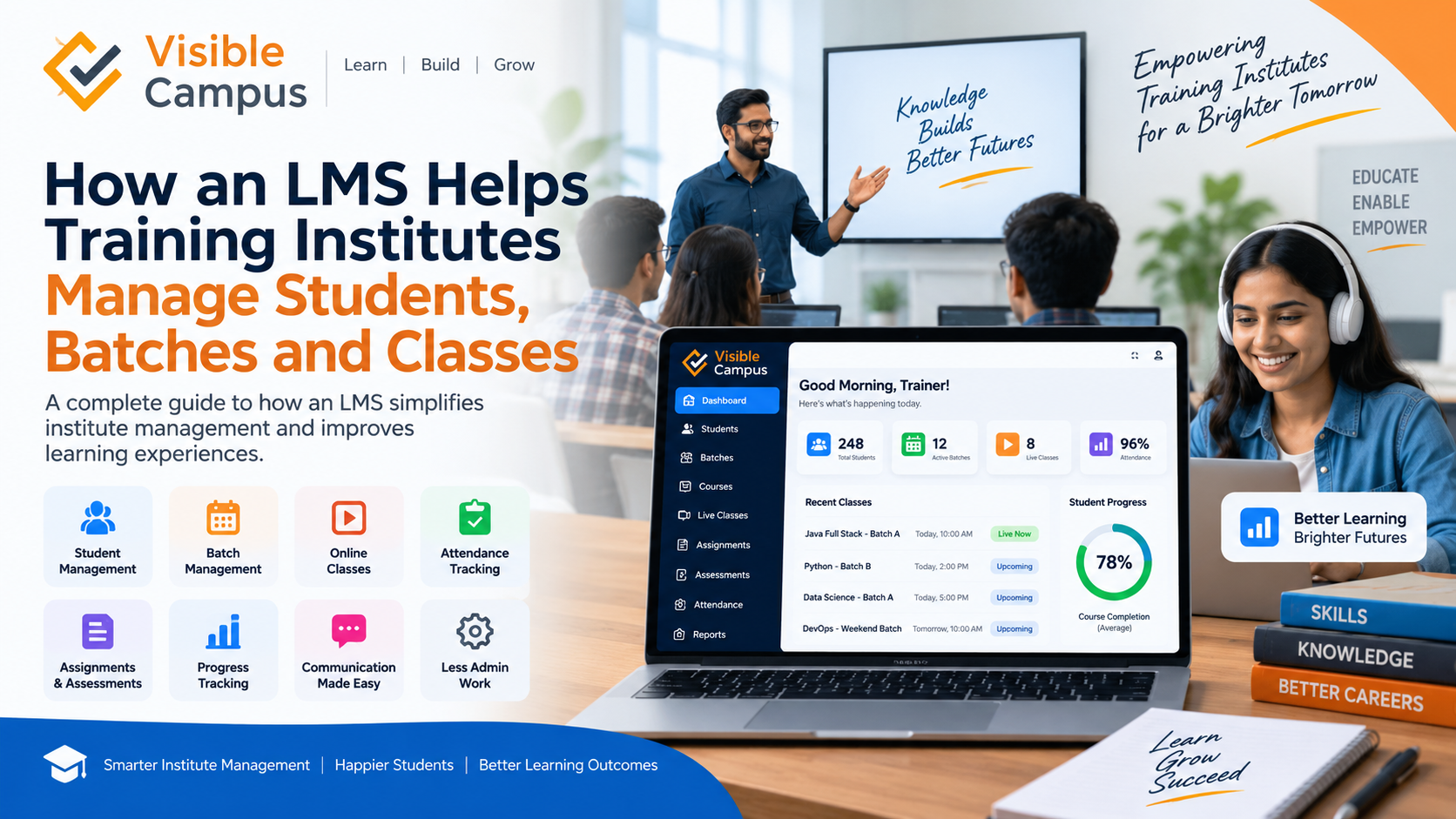
How an LMS Helps Training Institutes Manage Students, Batches and Classes
Managing a modern training institute involves much more than conducting classes. Institutes need to handle student admissions, batches, instructors, attendance, assignments, course materials, class recordings, assessments and student communication.
When these activities are managed using spreadsheets, multiple applications and WhatsApp groups, administrative work can quickly become difficult to manage.
A Learning Management System (LMS) provides a centralized platform where training institutes can manage their learning and administrative operations more efficiently.
From managing students and batches to conducting online classes and tracking attendance, an LMS can help institutes reduce repetitive work and create a more organized learning environment.
In this article, we explore how an LMS can help training institutes manage students, batches and classes more effectively.
What Is an LMS for Training Institutes?
A Learning Management System is software that helps educational and training organizations manage learning activities through a centralized platform.
For a training institute, an LMS can bring different activities together, including:
- Student management
- Course management
- Batch management
- Instructor management
- Online classes
- Attendance tracking
- Assignments
- Assessments
- Course recordings
- Student communication
- Learning progress tracking
Instead of maintaining information across different tools, an institute can use an LMS to organize these activities in one place.
1. Manage Students from One Centralized Platform
As the number of students grows, maintaining student information manually becomes increasingly difficult.
An LMS allows institutes to maintain student information in a centralized system.
Depending on the LMS, administrators can manage information such as:
- Student profiles
- Enrolled courses
- Batch details
- Attendance
- Assignments
- Assessments
- Learning progress
- Class participation
- Course access
This gives administrators and instructors a structured view of each student's learning journey.
For institutes running multiple courses and batches, centralized student management can significantly simplify day-to-day administration.
2. Simplify Batch Management
Training institutes often run multiple batches for the same or different courses.
For example, an institute may have:
- Java Full Stack – Morning Batch
- Java Full Stack – Evening Batch
- Python Full Stack – Weekend Batch
- Data Science – Weekday Batch
Managing these batches manually can create confusion around schedules, instructors, students and course content.
An LMS allows administrators to create and manage batches from a centralized dashboard.
You can organize students according to:
- Course
- Batch
- Instructor
- Schedule
- Start date
- End date
- Learning program
This makes it easier for administrators to understand which students belong to which batch and what training they are currently receiving.
3. Manage Online and Offline Classes
Modern training institutes often use a combination of classroom and online learning.
An LMS can help organize class schedules and provide students with access to their learning resources.
For online training, an LMS can integrate or provide access to:
- Live classes
- Class links
- Course materials
- Assignments
- Recordings
- Assessments
Students can access their learning resources from a centralized platform instead of searching through multiple WhatsApp messages or emails.
4. Automate Student Attendance
Attendance management is another important part of running a training institute.
Manually recording attendance using spreadsheets can take considerable administrative effort, particularly when an institute has multiple batches.
An LMS can help automate attendance tracking for online and offline learning environments.
Administrators can view attendance information based on:
- Student
- Batch
- Course
- Instructor
- Class
- Date
This can also help instructors identify students who may be missing classes frequently.
5. Manage Course Recordings
Recorded classes can be valuable for students who miss a session or want to revise a topic.
Without a centralized system, recordings may be shared through different links, messaging applications or cloud storage platforms.
An LMS can organize class recordings according to courses and batches.
For example:
Java Full Stack → Batch A → Week 1 → Class 1
Java Full Stack → Batch A → Week 1 → Class 2
This makes it easier for students to find previous sessions and revisit important topics.
Automatic cloud recording workflows can also reduce the amount of manual work required from instructors and administrators.
6. Manage Assignments and Assessments
Learning doesn't stop when a live class ends.
Students may need to complete coding assignments, quizzes, projects or other assessments.
An LMS allows institutes to distribute assignments and assessments through the same platform used for classes.
Instructors can:
- Create assignments
- Share learning materials
- Set deadlines
- Review submissions
- Provide feedback
- Track student progress
For technical training institutes, this can be particularly useful for coding exercises and project-based learning.
7. Give Instructors Better Control
An LMS isn't only useful for administrators and students. It can also simplify the instructor's workflow.
Instead of using separate systems for attendance, assignments, course materials and communication, instructors can manage many of these activities from one platform.
For example, an instructor can access a particular batch and manage:
Students → Classes → Attendance → Assignments → Assessments → Progress
This creates a more structured teaching workflow.
8. Improve Student Communication
Communication is an important part of the student experience.
Training institutes regularly need to send information about:
- Class schedules
- Batch changes
- Assignments
- Assessments
- Course updates
- Attendance
- Important announcements
An LMS can centralize communication and, when integrated with communication platforms such as WhatsApp, help institutes automate certain notifications and follow-ups.
This can reduce dependence on manually sending the same information to multiple student groups.
9. Track Student Learning Progress
Knowing whether students are actively participating in a course is important for training institutes.
An LMS can provide insights into activities such as:
- Classes attended
- Assignments completed
- Assessments attempted
- Course content accessed
- Learning progress
This information can help instructors identify students who may need additional support.
Instead of relying only on classroom observations, institutes can use learning data to understand student participation.
10. Reduce Administrative Work
One of the biggest benefits of an LMS is reducing repetitive administrative tasks.
Without an LMS, an institute may use:
Excel + WhatsApp + Google Drive + Zoom + Email + separate attendance tools
An LMS can bring many of these workflows into a centralized learning environment.
This can help institutes spend less time managing administrative processes and more time focusing on training and student outcomes.
Why Training Institutes Are Moving Towards LMS Platforms
As training institutes expand, managing everything manually becomes increasingly difficult.
An institute may start with a few students and one instructor. But as it grows, it may have:
- Multiple courses
- Multiple batches
- Hundreds or thousands of students
- Multiple instructors
- Online and offline classes
- Large volumes of recordings
- Regular assessments
- Student support requirements
At this stage, having a structured LMS for training institute management can make operations easier to organize.
What Features Should a Training Institute Look for in an LMS?
When choosing an LMS, institutes should consider the features that match their operational requirements.
Important features can include:
- Student management
- Course management
- Batch management
- Instructor management
- Attendance management
- Live classes
- Automatic class recordings
- Assignments and assessments
- Student progress tracking
- Communication tools
- WhatsApp integration
- AI-powered student support
- AI doubt solving
- AI mock interviews
- Coding environments
- Role-based access
- Reports and analytics
- Secure cloud infrastructure
The right combination depends on the size, courses and operating model of each institute.
How LMS Campus Helps Training Institutes
LMS Campus is designed to help training institutes manage their learning and operational workflows from a centralized platform.
With features for course and batch management, online classes, automatic cloud recordings, attendance, assignments, AI-powered learning support and student management, institutes can create a more organized digital learning environment.
The platform can also support features such as AI mock interviews, AI doubt solving, coding practice and WhatsApp-based communication workflows.
For institutes looking to move away from disconnected tools and manual processes, an integrated LMS can provide a single platform for managing different parts of the student learning journey.