DevOps engineering has become an important part of modern software development. Companies need professionals who can automate application deployments, manage cloud infrastructure, improve release reliability and maintain secure development environments.
As organisations adopt cloud platforms, containerisation and automated software delivery, DevOps skills are relevant across software companies, IT service providers, startups and enterprise technology teams.
For students and working professionals, one important question is: How much can a DevOps Engineer earn in India in 2026?
The answer depends on several factors, including work experience, technical skills, location, employer type and the responsibilities associated with the role.
This guide explores DevOps Engineer salary expectations in India, the skills employers look for, career opportunities and how aspiring professionals can prepare for this field.
What Is the Average DevOps Engineer Salary in India in 2026?
DevOps salaries vary considerably across employers and experience levels. Salary figures published by recruitment platforms, hiring reports and employee-reported databases may differ because they use different samples and definitions of compensation.
Flexiple's August 2026 salary data reports a median annual compensation of approximately ₹10.5 lakh for Azure DevOps roles across India and all experience levels. Its reported median ranges from ₹6.1 lakh for professionals with 0–2 years of experience to ₹28.9 lakh for those with 12 or more years.
These figures represent reported compensation data, not guaranteed salaries or a universal pay scale for every DevOps Engineer.
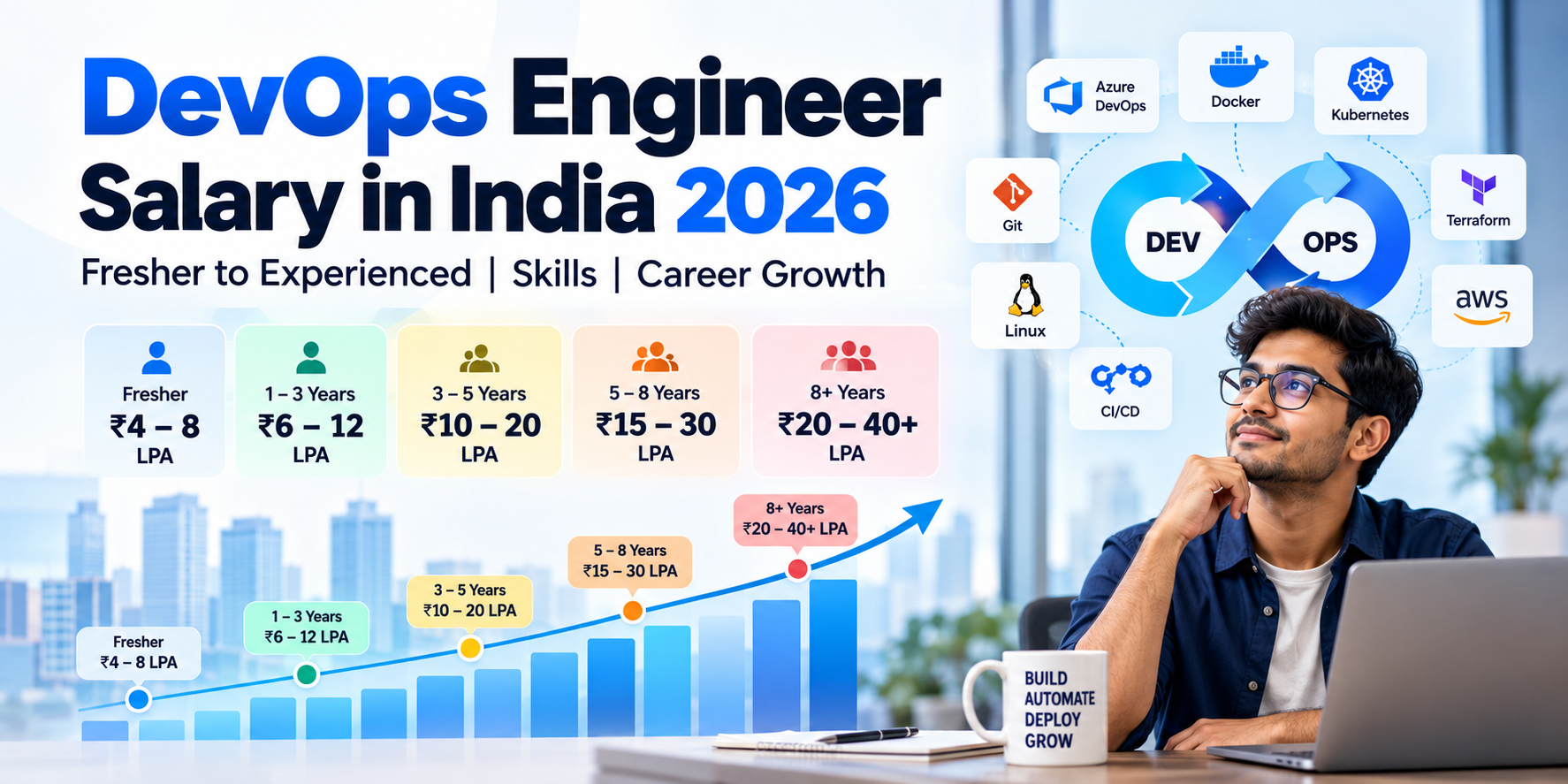
Indicative DevOps salary by experience
The following table provides broad salary-planning ranges for aspiring DevOps professionals. These are indicative market estimates, not official salary bands or guaranteed offers.
ExperienceIndicative annual salary
Fresher / entry-level
₹4–8 LPA
1–3 years
₹6–12 LPA
3–5 years
₹10–20 LPA
5–8 years
₹15–30 LPA
8+ years
₹20–40+ LPA
Actual offers may fall below or above these ranges. Product companies, global capability centres, service companies and startups can have different compensation structures. Some senior engineering and leadership positions may also include bonuses and stock-based compensation.
Source for further research: https://flexiple.com/salary/azure-devops
DevOps Engineer Salary for Freshers in India
Freshers entering DevOps typically begin in junior engineering, cloud operations, build and release, infrastructure support or related roles.
Employers may expect beginners to understand basic operating systems, version control, networking and scripting before working independently on production deployments.
Skills that can help freshers
- Linux fundamentals and command-line operations
- Git and source code management
- Basic shell scripting or Python
- Microsoft Azure or AWS fundamentals
- CI/CD concepts
- Docker fundamentals
- YAML configuration
- Basic networking and troubleshooting
Freshers who can demonstrate these skills through practical projects may be better prepared for technical interviews than candidates who have studied only theoretical concepts.
How to improve your chances of getting a first DevOps job
- Learn Linux, networking and Git.
- Understand cloud fundamentals.
- Create a CI/CD pipeline for a sample application.
- Containerise an application using Docker.
- Document your projects and troubleshooting steps.
- Practise explaining your technical decisions in interviews.
Your first role does not necessarily need to be titled DevOps Engineer. Junior cloud engineering, infrastructure automation and build-and-release roles can also provide relevant experience.
Azure DevOps Engineer Salary in India
Azure DevOps Engineers work with Microsoft's development and delivery ecosystem to manage source code, automate builds, execute tests and deploy applications.
Common responsibilities include creating Azure Pipelines, managing repositories, implementing release approvals, troubleshooting pipeline failures and integrating security checks.
Important Azure DevOps skills
- Azure Boards and Azure Repos
- Azure Pipelines and YAML
- Git branching and pull requests
- CI/CD automation
- Azure App Service and cloud infrastructure
- Identity and access management
- Infrastructure as Code
- Monitoring and application troubleshooting
According to Flexiple's published data updated in August 2026, the median annual compensation for Azure DevOps roles across India is approximately ₹10.5 LPA, with substantial variation by experience.
The important lesson is that learning Azure DevOps alone does not determine your salary. Employers also value cloud architecture knowledge, automation, security, troubleshooting and the ability to manage reliable production deployments.
Which Skills Can Help Increase a DevOps Engineer's Salary?
DevOps professionals can expand their career opportunities by developing skills beyond basic pipeline configuration.
1. Cloud Computing
Knowledge of Microsoft Azure, AWS or Google Cloud helps engineers provision infrastructure, manage access, deploy applications and troubleshoot cloud environments.
Start with one cloud platform and develop a strong practical foundation before expanding into multi-cloud technologies.
2. CI/CD Pipeline Automation
Continuous Integration and Continuous Delivery practices help teams automate application builds, testing and deployments.
Learn how to design pipelines, manage artifacts, configure environment approvals and implement deployment rollback strategies.
3. Docker and Kubernetes
Docker packages applications into containers, while Kubernetes orchestrates containerised workloads.
These technologies are useful in organisations running microservices, cloud-native applications and distributed systems.
4. Terraform and Infrastructure as Code
Terraform enables teams to manage infrastructure through version-controlled configuration.
Learn resource provisioning, variables, reusable modules, state management and automated infrastructure deployment.
5. DevSecOps
DevSecOps integrates security into development and deployment workflows.
Important topics include secret management, dependency scanning, code analysis, least-privilege access and secure CI/CD pipelines.
6. Monitoring and Reliability Engineering
Production systems need monitoring, alerting and incident response.
Learn to analyse logs, interpret metrics, investigate performance problems and improve application reliability using appropriate monitoring tools.
Does AI Affect DevOps Careers in 2026?
AI-assisted development is changing how software teams write code, review changes and troubleshoot technical problems.
AI tools can help engineers draft pipeline configuration, explain errors, summarise code changes and suggest possible fixes. Security automation can also help teams identify issues earlier in the development lifecycle.
However, AI does not remove the need for engineering fundamentals.
DevOps professionals still need to understand infrastructure, permissions, networking, security, testing and deployment risks. AI-generated configuration must be reviewed and validated before it is used in production.
For students, a useful strategy is to learn conventional DevOps workflows first and then explore AI-assisted engineering tools.
Best Certifications for DevOps Engineers
Certifications can provide a structured learning path and help demonstrate familiarity with specific technologies. They should be combined with practical experience and portfolio projects.
Microsoft Azure
Consider Microsoft Azure fundamentals and role-based Azure learning paths before progressing to advanced DevOps engineering topics.
The AZ-400 exam is associated with Microsoft's DevOps Engineer Expert certification. Check Microsoft's current certification requirements and exam objectives before preparing, as requirements can change.
AWS
AWS certifications can help learners understand cloud architecture, deployment and automation within the AWS ecosystem.
Choose an appropriate certification based on your existing experience and career goals.
Kubernetes
Kubernetes-related training and certifications can help demonstrate knowledge of container orchestration, workloads, networking and cluster operations.
Terraform
Terraform training helps develop Infrastructure as Code skills that are useful across many cloud environments.
Official learning resources:
- Microsoft Learn: https://learn.microsoft.com/training/
- Azure DevOps documentation: https://learn.microsoft.com/azure/devops/
- AWS Training: https://skillbuilder.aws/
- Kubernetes documentation: https://kubernetes.io/docs/
- Terraform documentation: https://developer.hashicorp.com/terraform/docs
Which Indian Cities Offer DevOps Career Opportunities?
DevOps and cloud engineering roles are available in major technology hubs across India.
Bengaluru
Bengaluru has a broad technology ecosystem that includes product companies, IT service providers, startups and global capability centres.
Hyderabad
Hyderabad has a strong technology and enterprise IT presence, with opportunities across cloud infrastructure and software engineering.
Pune
Pune offers opportunities in enterprise technology, software services, cloud operations and engineering.
Chennai
Chennai has employers across IT services, enterprise applications, cloud operations and software development.
Gurugram and Noida
The Delhi NCR region includes technology services, enterprise IT, fintech and other organisations that hire cloud and DevOps professionals.
Your salary will depend on the specific employer, role, experience and responsibilities. A city alone does not determine how much an engineer will earn.
DevOps Engineer vs Cloud Engineer vs Site Reliability Engineer
These roles overlap, but their primary responsibilities can differ.
RoleMain responsibilities
DevOps Engineer
CI/CD automation, deployment workflows and collaboration between development and operations
Cloud Engineer
Cloud infrastructure, networking, access management and resource operations
Site Reliability Engineer (SRE)
Production reliability, service availability, incident response and performance
Platform Engineer
Building internal platforms and reusable tools that improve developer productivity
DevSecOps Engineer
Integrating security controls into development, infrastructure and deployment workflows
Some organisations combine multiple responsibilities into one position, while others maintain separate engineering teams.
Understanding these differences can help students choose a learning path aligned with their interests.
How to Build a DevOps Portfolio That Attracts Employers
Practical projects are an effective way to demonstrate your skills to recruiters and technical interviewers.
Consider building the following projects.
Project 1: Automated Web Application Deployment
Create a simple React or Node.js application and configure a pipeline that installs dependencies, runs tests, builds the application and deploys it to a cloud environment.
Skills demonstrated: Git, CI/CD, pipeline configuration and deployment automation.
Project 2: Containerised Application
Package an application using Docker and publish the image to a container registry.
Skills demonstrated: Dockerfiles, image management and container deployment.
Project 3: Infrastructure Automation
Use Terraform to provision cloud resources and store infrastructure configuration in a Git repository.
Skills demonstrated: Infrastructure as Code, configuration management and cloud automation.
Project 4: Secure CI/CD Pipeline
Add automated tests, dependency checks, protected secrets and deployment approvals to an existing pipeline.
Skills demonstrated: DevSecOps, access control and secure delivery practices.
Project 5: Monitoring and Incident Troubleshooting
Deploy a sample application, configure monitoring and simulate a failure. Document how you detect the problem, investigate logs and restore service.
Skills demonstrated: Observability, troubleshooting and operational reliability.
For each project, include a README file, architecture diagram, setup instructions and screenshots or logs that demonstrate the workflow. Never publish real credentials, access tokens or private production data.
How Long Does It Take to Become a DevOps Engineer?
The time required depends on your starting point, study schedule and the amount of hands-on practice you complete.
A beginner may organise their learning into the following stages:
Learning stageIndicative duration
Linux, networking and Git
4–6 weeks
Cloud fundamentals
2–4 weeks
CI/CD and pipeline automation
4–6 weeks
Docker and Kubernetes fundamentals
4–6 weeks
Terraform, security and monitoring
4–6 weeks
Projects and interview preparation
2–4 weeks
These are planning estimates, not guarantees. Learners with existing programming or system administration experience may progress faster, while beginners may need additional practice.
Focus on understanding the concepts and building working projects rather than completing a fixed number of weeks.
Frequently Asked Questions
What is the salary of a DevOps Engineer fresher in India?
Entry-level salaries vary by employer, location and skill set. An indicative planning range is ₹4–8 LPA, but actual offers may be lower or higher.
Is DevOps a good career choice in 2026?
DevOps can be a suitable career path for people interested in cloud infrastructure, automation, software delivery and production systems. Job opportunities depend on market conditions, technical skills and relevant experience.
Is coding required for DevOps?
Yes, some coding and scripting knowledge is useful. Start with shell scripting, Python or another suitable language, along with Git and YAML.
Which is better: Azure DevOps or AWS DevOps?
Neither is universally better. Azure DevOps is a natural choice for organisations using Microsoft's development and cloud ecosystem. AWS-focused DevOps is useful for teams building on AWS. Learn one ecosystem well and understand the underlying DevOps principles.
Can freshers learn DevOps without experience?
Yes. Freshers can begin with Linux, Git, networking and cloud fundamentals. Practical projects and a clear understanding of CI/CD workflows can help them prepare for junior roles.
Does certification guarantee a high salary?
No. Certifications can help demonstrate knowledge, but compensation also depends on practical ability, experience, interview performance and the responsibilities of the role.
Conclusion
DevOps engineering offers a career path for professionals who enjoy automation, cloud infrastructure, deployment workflows and solving technical problems.
In India, salaries vary significantly according to experience, employer type, technical specialisation and the scope of the role. Instead of focusing only on salary figures, aspiring engineers should develop practical skills in cloud computing, CI/CD, Docker, Kubernetes, Terraform, security and monitoring.
Start with the fundamentals, build real projects, document your work and prepare to explain your technical decisions in interviews.