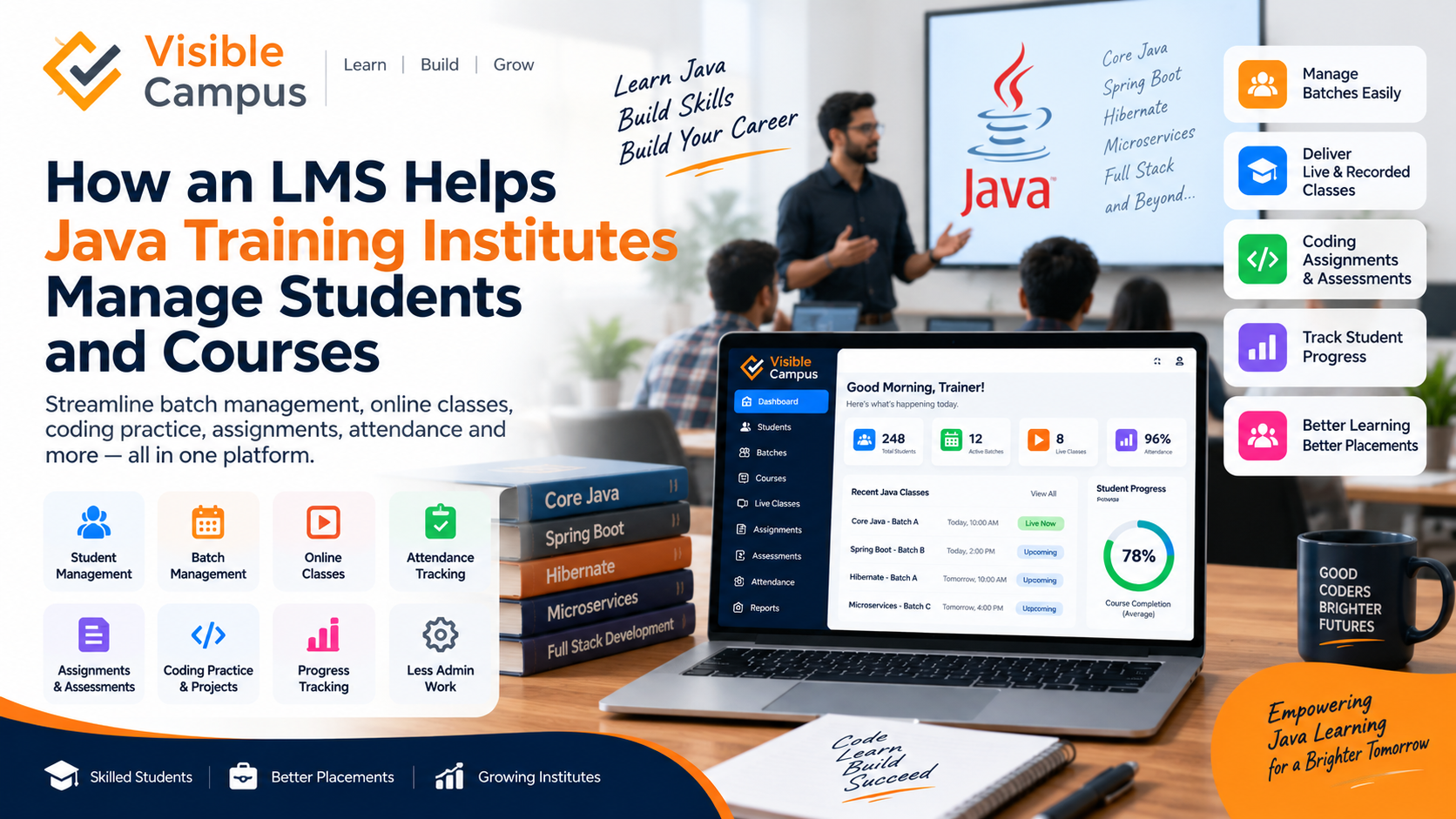
How an LMS Helps Java Training Institutes Manage Students and Courses
Java remains one of the most widely used programming languages for enterprise application development, backend development and full-stack development. As demand for Java skills continues, training institutes are conducting multiple Java courses, batches and online classes simultaneously.
Managing all these activities manually can become challenging.
Student information may be stored in spreadsheets, class links may be shared through WhatsApp, assignments may be sent through different platforms, and attendance and course progress may require separate tracking.
A Learning Management System (LMS) can bring these activities together and help Java training institutes manage their courses, students and learning operations from one centralized platform.
What Is an LMS for a Java Training Institute?
An LMS is a platform that helps training institutes manage courses, students, instructors, classes, assignments and learning activities.
For a Java training institute, an LMS can be used to manage programs such as:
- Core Java
- Advanced Java
- Java Full Stack Development
- Spring Boot
- Hibernate
- Microservices
- REST APIs
- Java with AI
- Java Agentic AI
- Backend Development
Instead of managing each activity separately, institutes can organize their Java training programs through a single learning platform.
1. Manage Java Students and Batches
Java institutes may have several batches running at the same time.
For example:
- Java Full Stack – Morning Batch
- Java Full Stack – Evening Batch
- Java Weekend Batch
- Advanced Java – Weekday Batch
- Spring Boot – Fast Track Batch
An LMS allows administrators to organize students according to their course and batch.
Administrators can manage:
- Student profiles
- Course enrollment
- Batch allocation
- Instructor assignment
- Class schedules
- Attendance
- Assignments
- Assessments
- Learning progress
This makes it easier to manage growing numbers of Java students.
2. Organize the Complete Java Course
A Java course often contains multiple technologies and modules.
A Java Full Stack course could include:
Frontend
- HTML
- CSS
- JavaScript
- React or Angular
Backend
- Core Java
- Advanced Java
- Spring
- Spring Boot
- REST APIs
Database
- MySQL
- MongoDB
Enterprise Development
- Microservices
- Cloud
- DevOps
An LMS can organize these topics into structured courses and modules so students can easily understand what they need to learn.
3. Conduct Java Classes Online
Many institutes now offer both classroom and online Java training.
An LMS can provide a centralized place for students to access their live classes and learning resources.
Students can find:
- Upcoming Java classes
- Live class links
- Course materials
- Previous recordings
- Assignments
- Assessments
This reduces the need to search through different WhatsApp messages or emails for class information.
4. Record Java Classes Automatically
Java development involves concepts that students often need to revise multiple times.
For example, students may want to revisit:
- OOP concepts
- Collections
- Multithreading
- Java Streams
- Spring Boot
- REST APIs
- Microservices
- Database integration
An LMS with cloud recording capabilities can organize recorded classes by course and batch.
Students can return to previous sessions whenever they need revision.
5. Give Java Students Coding Assignments
Learning Java requires hands-on practice.
Simply watching a Java class is not enough. Students need opportunities to write and execute code.
An LMS can help instructors provide coding assignments such as:
- Java programming exercises
- OOP challenges
- Data structure problems
- SQL exercises
- Spring Boot assignments
- REST API projects
- Full-stack projects
Institutes can use coding environments and assessment tools to create a more practical learning experience.
6. Track Student Progress
Java courses can contain a large number of topics.
An LMS can help instructors monitor student participation and progress across the course.
For example, instructors can track:
- Classes attended
- Assignments completed
- Assessments attempted
- Course modules completed
- Coding activities
- Overall learning progress
This can help instructors identify students who may require additional support.
7. Manage Java Assessments and Tests
Regular assessments can help institutes evaluate student understanding.
Java institutes can conduct:
- Programming quizzes
- Multiple-choice tests
- Coding assessments
- Module tests
- Mock interviews
- Project evaluations
An LMS can centralize these assessments and help instructors manage student submissions and results.
8. Prepare Students for Java Interviews
Java training is often career-focused.
Students preparing for Java developer roles may need practice with:
- Java interview questions
- Coding problems
- SQL
- Spring Boot
- Microservices
- System design
- Project discussions
- Communication
An LMS can provide structured learning and assessment activities to support interview preparation.
AI-powered features such as AI mock interviews can also provide an additional way for students to practice interview scenarios.
9. Improve Communication Between Students and Trainers
Java students frequently have questions about programming concepts and assignments.
An LMS can provide centralized communication and learning support.
Instead of searching through multiple messaging groups, students can access course-related resources and support from their learning platform.
Institutes can also use integrations such as WhatsApp automation for selected notifications and communication workflows.
10. Reduce Administrative Work for Java Institutes
As an institute grows, administrative work can consume significant time.
An LMS can help reduce repetitive tasks related to:
- Student enrollment
- Batch management
- Attendance
- Class scheduling
- Assignment distribution
- Assessments
- Course recordings
- Student communication
- Progress tracking
This allows administrators and instructors to spend more time focusing on training and student support.
Why Java Training Institutes Need an LMS
A small Java training center may initially manage students using spreadsheets and messaging applications.
However, as the institute grows, it may have:
- Multiple Java courses
- Multiple batches
- Multiple trainers
- Hundreds of students
- Online and offline classes
- Coding assignments
- Recorded sessions
- Regular assessments
- Placement preparation
At this stage, a centralized LMS for Java training institutes can help organize these processes.
How LMS Campus Supports Java Training
LMS Campus provides tools designed to help training institutes manage their learning operations from one platform.
Java training institutes can use an LMS to manage:
- Students
- Courses
- Batches
- Instructors
- Live classes
- Attendance
- Assignments
- Assessments
- Cloud recordings
- Student progress
- Coding practice
- AI learning support
- AI mock interviews
This can help Java institutes create a more structured and technology-driven learning environment.