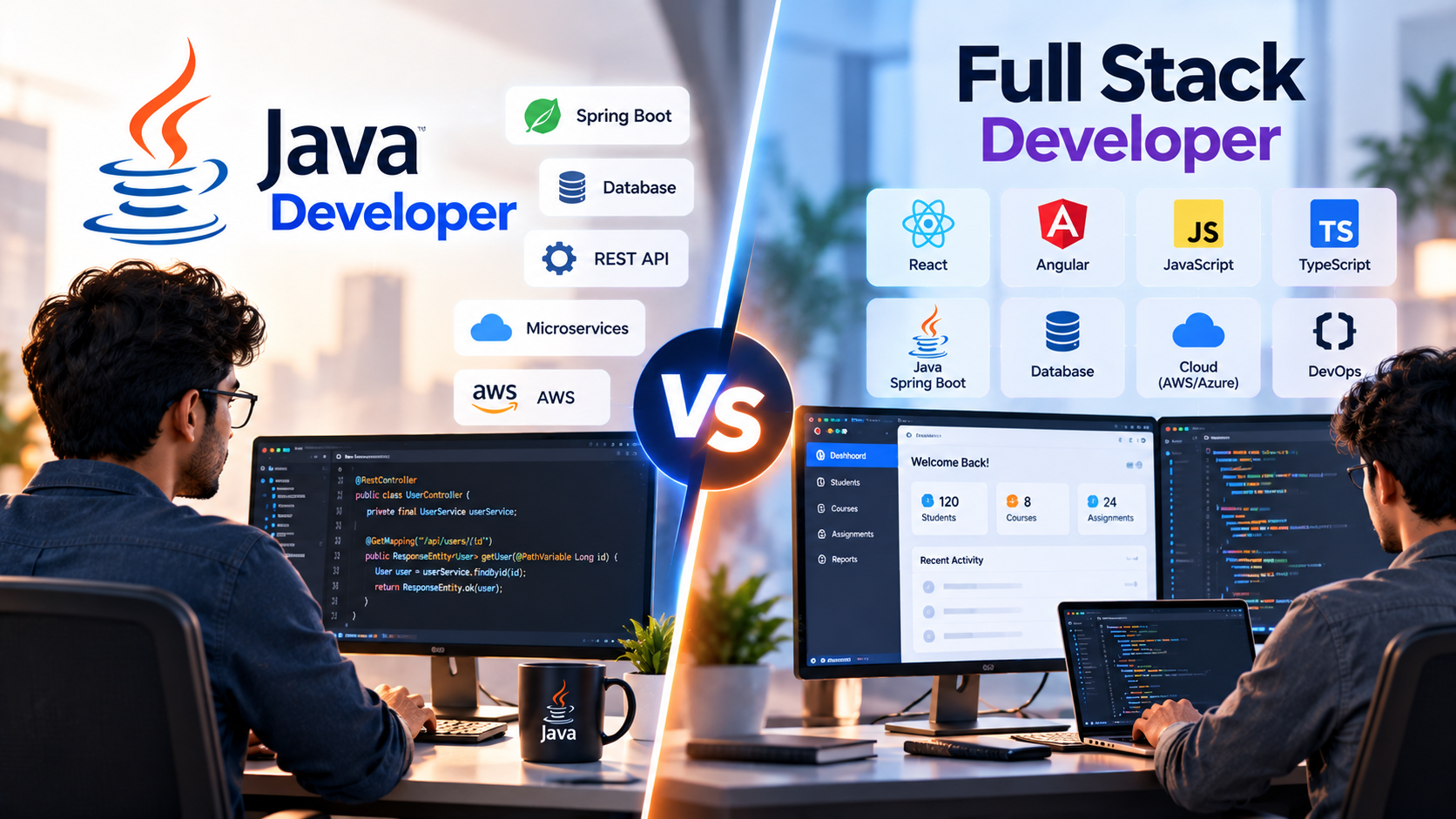
Java Developer vs Full Stack Developer: What's the Difference?
The terms Java Developer and Full Stack Developer are often used interchangeably, but they describe different areas of software development.
A Java developer primarily focuses on backend development using Java and related technologies, while a Full Stack Developer typically works across both the frontend and backend of an application.
For students and developers planning their careers, understanding this difference can help them choose the right learning path.
Java Developer vs Full Stack Developer at a Glance
AreaJava DeveloperFull Stack Developer
Primary focus
Backend development
Frontend + Backend
Main language
Java
Multiple technologies
Backend
Java, Spring Boot
Java/Spring Boot, Node.js, .NET, etc.
Frontend
Basic knowledge may be enough
Core responsibility
Databases
SQL, NoSQL
SQL, NoSQL
APIs
REST, GraphQL
REST, GraphQL
UI development
Usually limited
Major responsibility
Cloud
Increasingly important
Increasingly important
DevOps
Useful
Useful
AI
Increasingly useful
Increasingly useful
Typical role
Java Backend Developer
Full Stack Developer
What Is a Java Developer?
A Java Developer primarily builds the backend and server-side components of applications using Java.
Java is widely used for enterprise applications, banking systems, e-commerce platforms, APIs, microservices and large-scale business applications.
A typical Java developer works with technologies such as:
- Java
- Spring Boot
- Spring Framework
- Spring Security
- Hibernate
- JPA
- REST APIs
- SQL
- MySQL/PostgreSQL
- MongoDB
- Kafka
- Docker
- AWS/Azure
A typical architecture might look like:
Frontend
↓
REST API
↓
Spring Boot
↓
Business Logic
↓
JPA / Hibernate
↓
Database
The Java developer is primarily responsible for everything from the API layer through the business logic and database integration.
What Is a Full Stack Developer?
A Full Stack Developer works across both the frontend and backend of an application.
Instead of focusing only on the server side, a full stack developer may build:
- User interfaces
- Frontend applications
- Backend APIs
- Databases
- Authentication
- Integrations
- Deployment
A Java-based full stack developer might work with:
React / Angular
↓
JavaScript / TypeScript
↓
Spring Boot
↓
REST APIs
↓
Hibernate / JPA
↓
PostgreSQL / MySQL
↓
Docker / Cloud
So a Java Full Stack Developer is essentially a developer who uses Java technologies for the backend while also having the skills required to build the frontend.
What Does a Java Developer Do?
A Java developer's responsibilities can include:
Backend development
Building business logic using Java and Spring Boot.
API development
Creating REST APIs for web and mobile applications.
Database integration
Connecting applications to relational and NoSQL databases.
Security
Implementing authentication, authorization and secure APIs.
Microservices
Building distributed backend services.
Performance
Optimizing application performance, database queries and JVM behavior.
Testing
Writing unit and integration tests.
Deployment
Working with Docker, cloud platforms and CI/CD pipelines.
The main focus is usually backend engineering.
What Does a Full Stack Developer Do?
A full stack developer can work on both sides of the application.
Frontend
For example:
- HTML
- CSS
- JavaScript
- TypeScript
- React
- Angular
Backend
Depending on the stack:
- Java
- Spring Boot
- Node.js
- .NET
- Python
Database
- MySQL
- PostgreSQL
- MongoDB
- Redis
Infrastructure
- Git
- Docker
- CI/CD
- AWS/Azure
- Kubernetes
This means a full stack developer needs a broader technology skill set.
Java Developer vs Java Full Stack Developer
There is an important distinction here.
A Java Developer can specialize in backend development.
A Java Full Stack Developer combines Java backend development with frontend technologies.
For example:
Java Developer
Java
↓
Spring Boot
↓
REST API
↓
Database
Java Full Stack Developer
React / Angular
↓
JavaScript / TypeScript
↓
Spring Boot
↓
REST API
↓
Database
The second role covers a larger portion of the application.
Skills Required for a Java Developer
A strong Java backend developer should understand:
Core Java
- OOP
- Collections
- Generics
- Streams
- Exception handling
- Multithreading
- Concurrency
- JVM fundamentals
Spring
- Spring Boot
- Spring MVC
- Spring Data
- Spring Security
Database
- SQL
- PostgreSQL/MySQL
- JPA
- Hibernate
- Database design
APIs
- REST
- JSON
- Authentication
- Authorization
- API documentation
Distributed systems
- Microservices
- Kafka
- Caching
- Messaging
Cloud and DevOps
- Docker
- AWS/Azure
- CI/CD
- Kubernetes fundamentals
Skills Required for a Full Stack Developer
A full stack developer needs the Java backend skills plus frontend development.
Frontend
Learn:
- HTML
- CSS
- JavaScript
- TypeScript
- React or Angular
- State management
- API integration
- Responsive design
Backend
For a Java-based stack:
- Java
- Spring Boot
- REST APIs
- Spring Security
- JPA/Hibernate
Database
- SQL
- PostgreSQL/MySQL
- MongoDB
DevOps
- Git
- Docker
- CI/CD
- Cloud
The key difference is breadth.
Java Developer vs Full Stack Developer: Example
Imagine you're building an online learning platform.
A Java developer might build:
Student API
Course API
Payment API
Authentication
Database
Notifications
Reports
A full stack developer could potentially build those backend components and also create:
Student Dashboard
Course Page
Login Page
Payment Page
Admin Dashboard
Instructor Dashboard
So the full stack developer works across a larger portion of the product.
Which Technologies Should a Java Full Stack Developer Learn?
A modern Java Full Stack roadmap could look like:
Java Full Stack
│
┌─────────────┴─────────────┐
↓ ↓
Frontend Backend
│ │
HTML + CSS Core Java
│ ↓
JavaScript Spring Boot
│ ↓
TypeScript REST APIs
│ ↓
React / Angular Hibernate
│
↓
SQL / Database
│
┌───────────────────┘
↓
Microservices
↓
Docker
↓
Cloud
↓
AI
You don't need to master everything at once.
The important part is understanding how the different layers work together.
Should Java Developers Learn Frontend Development?
It depends on the role you're targeting.
If your goal is specifically Java Backend Developer, you can focus deeply on backend technologies.
You should still understand how frontend applications consume APIs, but you don't necessarily need to become an expert in React or Angular.
If your goal is Java Full Stack Developer, frontend development becomes an important part of your skill set.
Learning React or Angular alongside Java and Spring Boot can therefore open the door to full stack roles.
Should Full Stack Developers Learn Java?
Java is one possible backend technology for a full stack developer.
For example, you could have:
React + Java + Spring Boot + PostgreSQL
This is commonly referred to as a Java Full Stack technology stack.
Other combinations are also possible:
React + Node.js + MongoDB
or:
Angular + .NET + SQL Server
or:
React + Python + PostgreSQL
The term Full Stack Developer describes the scope of development rather than one specific programming language.
Java Developer vs Full Stack Developer: Career Path
A Java developer can follow a path such as:
Junior Java Developer
↓
Java Developer
↓
Senior Java Developer
↓
Backend Engineer
↓
Senior Backend Engineer
↓
Technical Lead / Architect
A Java Full Stack Developer might follow:
Junior Full Stack Developer
↓
Full Stack Developer
↓
Senior Full Stack Developer
↓
Senior Software Engineer
↓
Technical Lead
↓
Solution Architect
Actual job titles and responsibilities vary between organizations.
What About AI in 2026?
AI is changing both roles.
Java developers can use AI for:
- Code generation
- Debugging
- Test generation
- Refactoring
- Documentation
- SQL generation
- API development
Full stack developers can additionally use AI for:
- UI generation
- Component creation
- API integration
- Test generation
- Design-to-code workflows
- Debugging frontend issues
Java developers can also start building AI-powered applications using technologies such as Spring AI, RAG, vector databases, AI agents and MCP.
This creates another potential path:
Java
↓
Spring Boot
↓
Cloud
↓
AI
↓
Spring AI
↓
RAG / AI Agents / MCP
Which One Should You Learn?
There isn't one universal path that fits every developer.
Consider your interests and target roles.
If you enjoy backend engineering
Focus more deeply on:
Java + Spring Boot + Databases + Microservices + Cloud
If you enjoy building complete applications
Consider:
Java + Spring Boot + React/Angular + Database + Cloud
If you're targeting modern AI applications
Consider adding:
Generative AI + Spring AI + RAG + AI Agents + MCP
The important thing is to build strong fundamentals before continuously adding technologies.
Java Developer vs Full Stack Developer Salary
Salary should not be viewed simply as a comparison between two titles.
Compensation varies based on:
- Experience
- Location
- Company
- Technical specialization
- Interview performance
- Industry
- Role responsibilities
- System-design experience
- Cloud expertise
A senior Java backend engineer and a senior full stack developer can both have very different compensation depending on the organization and role.
Therefore, rather than choosing a path purely based on the job title, focus on the skills and type of work you want to perform.
Java Developer or Full Stack Developer for Freshers?
For someone starting their software development career, a good approach is to build a strong foundation first.
Start with:
Core Java
↓
SQL
↓
Git
↓
Spring Boot
↓
REST APIs
↓
Database
Then decide whether to specialize in backend development or add frontend technologies.
For a Java Full Stack path:
Core Java
↓
Spring Boot
↓
REST APIs
↓
SQL
↓
HTML + CSS
↓
JavaScript
↓
TypeScript
↓
React / Angular
↓
Docker + Cloud
↓
AI
Final Thoughts
The biggest difference between a Java Developer and a Full Stack Developer is the scope of responsibility.
A Java Developer generally focuses on backend development using Java and its ecosystem.
A Full Stack Developer works across both frontend and backend technologies.
A Java Full Stack Developer combines both:
Java + Spring Boot + Frontend + Database + Cloud
For developers starting in 2026, Java remains a strong foundation for backend development, while adding frontend, cloud and AI skills can expand the range of applications they can build.
The best learning path depends on whether you want to specialize in backend engineering or work across the full application stack.