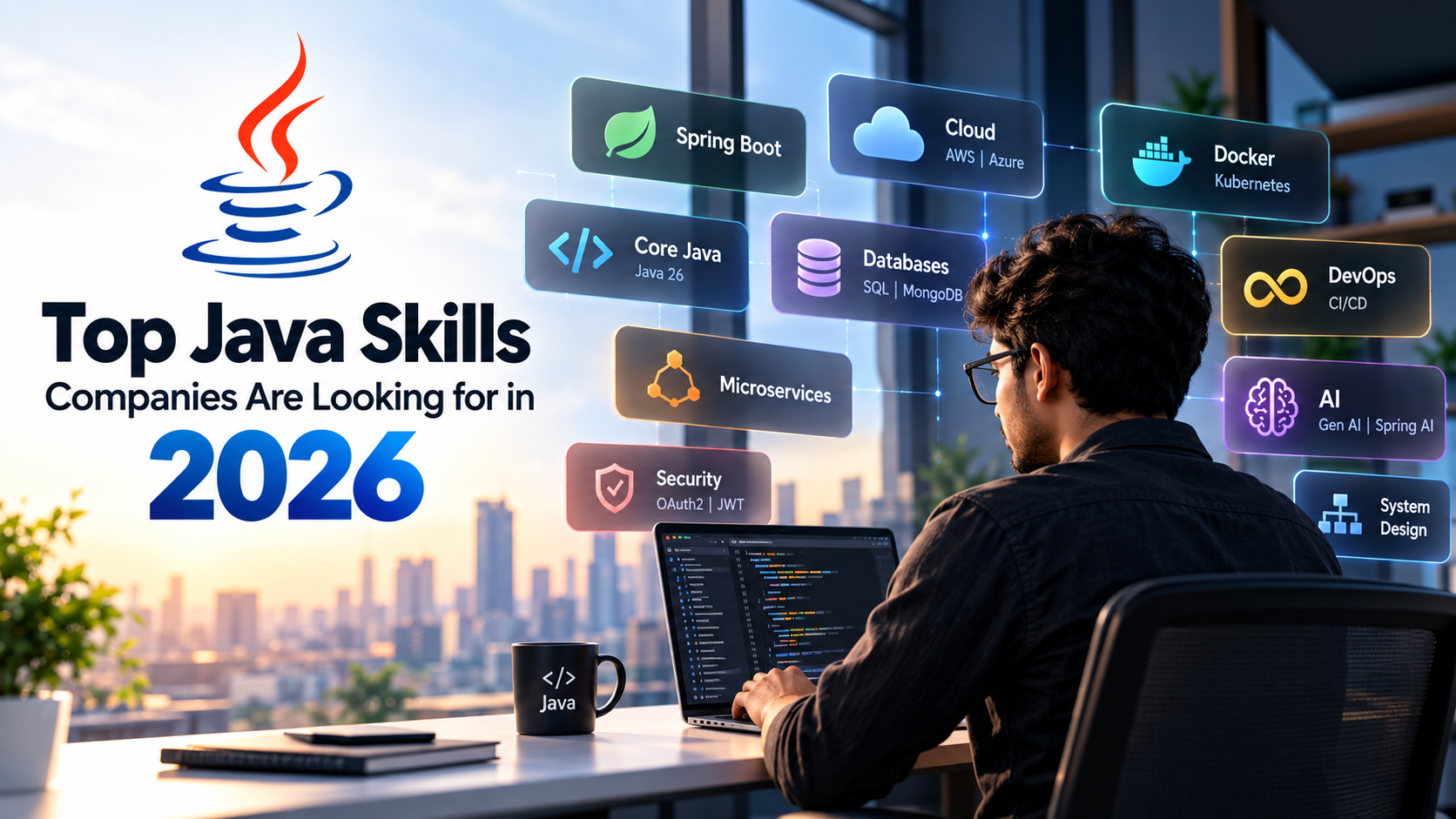
Top Java Skills Companies Are Looking for in 2026
Java continues to be an important technology for backend and enterprise software development. But the skills expected from Java developers are changing.
Knowing Core Java and writing basic Spring Boot applications is no longer the entire picture.
Modern Java development increasingly involves Spring Boot, REST APIs, databases, microservices, cloud platforms, containers, DevOps, testing, and AI-assisted development.
A 2026 analysis of more than 360,000 job postings found Java mentioned in 10.5% of postings overall. Within software-engineering postings, Java appeared in 31.5%, while backend postings mentioned Java in 37% of cases. The same dataset also showed strong demand for AI, AWS, SQL, Docker, Kubernetes and CI/CD alongside software-development roles.
So, what should Java developers learn in 2026?
Let's break it down.
1. Core Java
The first and most important skill is still Core Java.
Modern frameworks can make development faster, but developers need a strong understanding of the language and JVM to build reliable applications.
Important topics include:
- Object-oriented programming
- Classes and objects
- Inheritance
- Interfaces
- Collections
- Generics
- Exception handling
- Streams
- Lambda expressions
- Multithreading
- Concurrency
- JVM fundamentals
- Memory management
Modern Java developers should also be familiar with newer language and platform capabilities such as records, pattern matching and virtual threads.
Why it matters: AI tools can generate Java code, but developers still need to understand whether that code is correct, efficient and appropriate for the application.
2. Spring Boot
For Java backend development, Spring Boot is one of the most important skills to learn.
Current job-posting data shows Spring Boot frequently appearing alongside Java, Docker, Kubernetes, AWS, SQL and microservices.
Developers should know:
- Spring Boot
- Dependency Injection
- Spring MVC
- REST APIs
- Spring Data JPA
- Hibernate
- Validation
- Exception handling
- Configuration
- Spring Security
- Actuator
- Testing
A developer should be able to build a complete production-style REST API rather than only follow tutorials.
3. REST API Development
Modern Java developers frequently work on backend APIs.
You should understand:
- HTTP methods
- Status codes
- Request/response design
- JSON
- Authentication
- Authorization
- API validation
- Exception handling
- Pagination
- Filtering
- API versioning
- OpenAPI/Swagger
For example:
Frontend
↓
REST API
↓
Spring Boot
↓
Service Layer
↓
Repository
↓
Database
Understanding the complete request lifecycle is more valuable than simply knowing how to create a controller.
4. SQL and Database Skills
Java developers work closely with data.
You should be comfortable with:
Relational databases
- MySQL
- PostgreSQL
- Oracle
NoSQL
- MongoDB
- Redis
SQL fundamentals
- SELECT
- JOIN
- GROUP BY
- Indexes
- Transactions
- Constraints
- Query optimization
You should also understand how Hibernate and JPA interact with databases.
Knowing Java without understanding the database layer can make it difficult to troubleshoot real production applications.
5. Hibernate and JPA
Hibernate remains an important part of the Java ecosystem.
Learn:
- Entities
- Relationships
- Lazy vs eager loading
- JPQL
- Native queries
- Transactions
- Cascading
- Entity lifecycle
- N+1 query problems
- Pagination
For example, developers should understand why a seemingly simple JPA query might generate hundreds of database queries.
That kind of knowledge becomes especially important as applications scale.
6. Microservices
Many modern Java backend systems are built using distributed architectures.
Developers should understand:
- Microservice architecture
- Service-to-service communication
- API gateways
- Service discovery
- Configuration management
- Distributed transactions
- Fault tolerance
- Circuit breakers
- Observability
You don't need to turn every application into microservices.
You do need to understand when microservices make sense and what problems they introduce.
7. Cloud Computing
Cloud knowledge is becoming increasingly relevant for backend developers.
AWS, Azure and other cloud platforms are common in modern development environments.
For Java developers, useful cloud concepts include:
- Compute
- Storage
- Databases
- Networking
- IAM
- Containers
- Serverless
- Monitoring
- Load balancing
Current job-posting data shows AWS frequently paired with Java and Spring Boot roles.
You don't need to learn every cloud service.
Start with one cloud platform and understand its core services.
8. Docker and Kubernetes
Containerization has become an important part of modern backend development.
Learn Docker
Understand:
- Images
- Containers
- Dockerfiles
- Volumes
- Networks
- Docker Compose
Then move into Kubernetes fundamentals:
- Pods
- Deployments
- Services
- ConfigMaps
- Secrets
- Ingress
- Scaling
In one 2026 job-posting dataset, Docker and Kubernetes were among the frequently requested skills across software and backend roles.
9. Apache Kafka and Event-Driven Architecture
Large applications often need asynchronous communication.
This is where technologies such as Apache Kafka become useful.
Learn:
- Topics
- Producers
- Consumers
- Consumer groups
- Partitions
- Offsets
- Event-driven architecture
A Java application might look like:
Order Service
↓
Kafka
↓
┌────┴────┐
↓ ↓
Payment Notification
Service Service
This architecture can help applications communicate asynchronously and process large volumes of events.
10. Git and CI/CD
Being able to write Java code isn't enough in a professional development environment.
Developers should know:
- Git
- GitHub/GitLab
- Branching
- Pull requests
- Code reviews
- Merge conflicts
- CI/CD
- Automated builds
- Automated testing
- Deployment pipelines
Tools can vary between companies, but the underlying concepts are transferable.
11. Testing and Code Quality
Testing is another important skill that should not be overlooked.
Java developers should learn:
- JUnit
- Mockito
- Integration testing
- REST API testing
- Testcontainers
- Test automation
- Code coverage
A developer should be able to test both individual components and complete application flows.
12. Spring Security
Security is particularly important for backend developers.
Learn:
- Authentication
- Authorization
- JWT
- OAuth 2.0
- Role-based access control
- Password hashing
- CORS
- CSRF
- Secure API design
Understanding security is especially important when building applications that handle personal, financial or business data.
13. AI and Generative AI
One of the biggest additions to the Java developer skill set in 2026 is AI.
A 2026 survey of more than 2,000 Java professionals reported that 62% of surveyed enterprises were using Java to power AI functionality.
Developers should start learning:
- Generative AI
- Large Language Models
- Prompt engineering
- Embeddings
- Vector databases
- RAG
- Tool calling
- AI agents
- Model APIs
- MCP
This doesn't mean every Java developer needs to become a machine-learning engineer.
The practical goal is learning how to integrate AI into applications.
14. Spring AI
For Java developers, Spring AI is particularly relevant because it connects the Java/Spring ecosystem with modern AI application development.
You can use it to explore:
- Chat models
- Embeddings
- Vector stores
- RAG
- Tool calling
- AI agents
- Structured outputs
A typical architecture could be:
Spring Boot
↓
Spring AI
↓
AI Model
↓
Vector Database
↓
Enterprise Data
This makes AI a natural extension of the Java backend stack.
15. AI-Assisted Development
Developers should also learn how to use AI as a development tool.
AI coding assistants can help with:
- Code generation
- Refactoring
- Debugging
- Unit tests
- Documentation
- SQL
- Code explanations
- API development
But there is an important distinction:
Using AI effectively requires understanding the code it generates.
Developers should learn how to review AI-generated code for:
- Correctness
- Security
- Performance
- Maintainability
- Edge cases
- Architecture
This is increasingly becoming part of the modern developer workflow. CoderPad's 2026 developer survey found that 36% of surveyed developers had focused on AI/LLM application skills in the previous year, while 52% had focused on programming-language skills.
16. System Design
As developers progress into mid-level and senior roles, system design becomes increasingly important.
Learn:
- Scalability
- Load balancing
- Caching
- Database design
- Distributed systems
- Message queues
- Rate limiting
- Fault tolerance
- High availability
- Observability
Instead of thinking only about:
"How do I write this Java method?"
you should also be able to think about:
"How should this entire system work when one million users access it?"
17. Problem-Solving and Communication
Technical skills aren't the entire picture.
Job-posting data from 2026 also shows communication and analytical thinking appearing frequently across roles.
Java developers should be able to:
- Understand requirements
- Break down complex problems
- Explain technical decisions
- Communicate with teammates
- Review code
- Debug production issues
- Document solutions
Strong technical communication becomes especially valuable as developers work with larger teams and more complex systems.
The Java Developer Skill Stack for 2026
A practical Java developer roadmap can look like this:
JAVA DEVELOPER 2026
Core Java
↓
SQL + JPA
↓
Spring Boot
↓
REST APIs
↓
Spring Security
↓
Microservices
↓
Kafka / Messaging
↓
Docker + Kubernetes
↓
AWS / Cloud
↓
CI/CD
↓
Testing
↓
Generative AI
↓
Spring AI
↓
RAG / MCP
You don't have to learn everything simultaneously.
Build the foundation first and progressively add the technologies needed for your target role.
What Should Freshers Learn?
If you're a fresher starting Java development in 2026, don't try to learn 30 technologies at once.
A practical sequence is:
Phase 1 — Fundamentals
- Core Java
- OOP
- Collections
- Exception handling
- Streams
- SQL
- Git
Phase 2 — Backend
- Spring
- Spring Boot
- REST APIs
- JPA/Hibernate
- Spring Security
Phase 3 — Professional Development
- Microservices
- Kafka
- Docker
- Testing
- CI/CD
Phase 4 — Cloud
- AWS or Azure
- Cloud databases
- Deployment
- Monitoring
Phase 5 — AI
- Generative AI
- LLMs
- RAG
- Vector databases
- Spring AI
- AI agents
- MCP
What Should Experienced Java Developers Learn?
Experienced developers can focus more on depth rather than simply collecting technologies.
Consider strengthening:
- System design
- JVM performance
- Modern Java
- Distributed systems
- Cloud architecture
- Kubernetes
- Event-driven systems
- Security
- AI integration
- Technical leadership
For senior developers, understanding why a technology should be used can be as important as knowing how to use it.
Final Thoughts
The Java developer skill set in 2026 is broader than traditional Java programming.
The core remains important:
Java + OOP + SQL + Data Structures + Problem Solving
But modern development increasingly adds:
Spring Boot + REST + Microservices + Cloud + Docker + Kubernetes + Kafka + DevOps + AI
Current job-posting datasets consistently show Java appearing alongside technologies such as Spring Boot, AWS, Kubernetes, Docker and SQL, while AI is becoming a significant additional skill across software roles.
The goal isn't to learn every technology available.
Instead, build a strong foundation in Java and progressively develop the backend, cloud and AI skills that match the type of applications you want to build.
Java is still the foundation. The modern Java developer is becoming a broader backend, cloud and AI engineer.