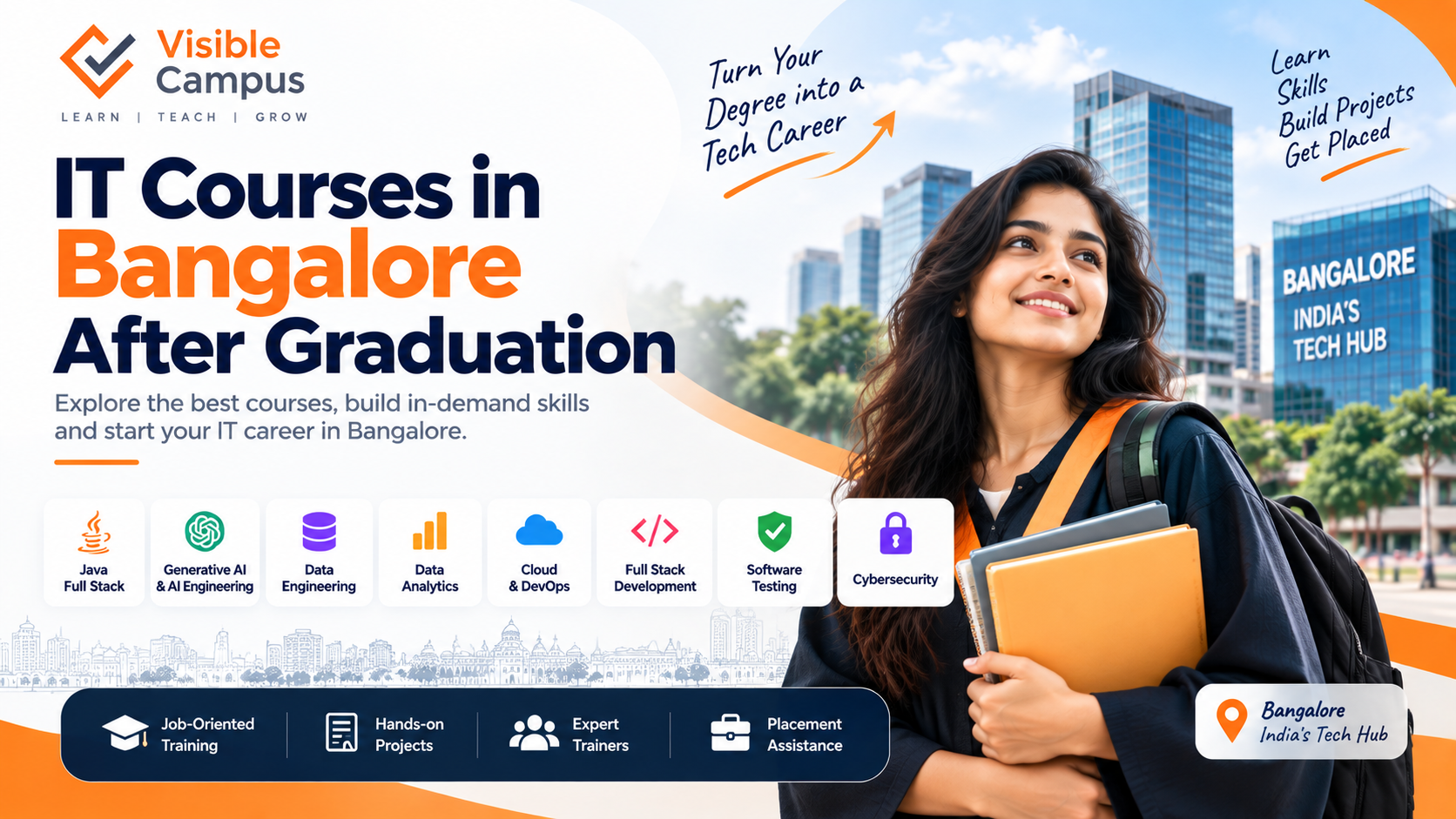
IT Courses in Bangalore After Graduation: A Complete Guide for 2026
Graduating from college is an exciting milestone, but it can also bring an important question:
"What should I learn next to build a career in IT?"
Bangalore is one of India's major technology hubs, with training programs covering software development, artificial intelligence, data, cloud computing, DevOps, testing and cybersecurity. Current Bangalore training offerings include Java Full Stack, Python Full Stack, Generative AI, Data Analytics, Data Engineering, DevOps, Cloud and Software Testing programs.
For graduates, choosing the right IT course is not simply about selecting the technology that is currently popular. Your educational background, interests, programming experience and desired career path should all be considered.
This guide explains some of the IT courses you can consider after graduation in Bangalore in 2026.
Why Consider an IT Course After Graduation?
A degree provides a foundation, but many technology roles require practical knowledge of specific tools and technologies.
For example, a graduate interested in software development may need practical experience with:
- Programming languages
- Databases
- Web development
- APIs
- Frameworks
- Git
- Cloud platforms
- Testing
- Deployment
An industry-focused course can provide a structured environment to learn these technologies and build projects.
The goal should not simply be to complete a course. It should be to develop practical skills that you can demonstrate through projects and technical interviews.
1. Java Full Stack Development
Java Full Stack Development is an option for graduates interested in becoming software developers.
A comprehensive Java Full Stack curriculum can include:
- Core Java
- Object-Oriented Programming
- Collections
- SQL
- HTML and CSS
- JavaScript
- Spring
- Spring Boot
- Hibernate/JPA
- REST APIs
- Microservices
- React
- Git
- Cloud and deployment
Some current Bangalore programs are also combining Java Full Stack with Cloud, DevOps and Generative AI concepts.
Who can consider Java Full Stack?
This path can be suitable for:
- BE/B.Tech graduates
- BCA graduates
- MCA graduates
- Computer Science graduates
- IT graduates
- Students interested in programming
If you enjoy coding and want to build web applications, Java Full Stack can provide a broad foundation.
2. Full Stack Web Development
Full Stack Development is another option for graduates who want to build web applications.
A typical Full Stack course can cover:
Frontend
- HTML
- CSS
- JavaScript
- React
- TypeScript
Backend
- Node.js
- Express
- REST APIs
Database
- MySQL
- MongoDB
Additional Skills
- Git and GitHub
- Authentication
- API integration
- Testing
- Deployment
- Cloud
- AI integration
Full Stack Development can be useful for students who want to understand both the frontend and backend sides of application development.
3. Generative AI and AI Engineering
Artificial Intelligence has become an important part of modern technology education.
Graduates interested in AI can explore Generative AI and AI Engineering programs.
Topics may include:
- AI fundamentals
- Prompt engineering
- Large Language Models
- Generative AI tools
- AI APIs
- Retrieval-Augmented Generation
- Vector databases
- AI agents
- Agentic AI
- AI application development
Students with programming knowledge can also learn how to integrate AI capabilities into traditional software applications.
For example:
React + Node.js + AI APIs
or
Java + Spring Boot + Generative AI
This approach combines software development fundamentals with newer AI capabilities.
4. Data Engineering
Data Engineering is an option for graduates interested in databases, data processing and large-scale systems.
A Data Engineering course can include:
- Python
- SQL
- Databases
- ETL pipelines
- Data warehouses
- Cloud platforms
- Apache Spark
- Data pipelines
- Snowflake
- Data processing
Graduates who enjoy programming and working with data may want to explore this career path.
Modern academic and training curricula are also increasingly combining data engineering with AI concepts, including large language models and AI agents.
5. Data Analytics
If you enjoy working with data but aren't sure whether you want to become a software developer, Data Analytics is another option.
A typical Data Analytics program may cover:
- Excel
- SQL
- Python
- Statistics
- Power BI
- Tableau
- Data visualization
- Data cleaning
- Business intelligence
A Data Analyst generally works with data to identify patterns, create reports and help organizations make data-driven decisions.
6. Cloud Computing
Cloud computing is an important skill across many IT roles.
Graduates can explore cloud platforms such as:
- AWS
- Microsoft Azure
- Google Cloud
A beginner-level cloud program may introduce:
- Cloud fundamentals
- Compute
- Storage
- Networking
- Databases
- Identity and access management
- Virtual machines
- Containers
- Cloud security
- Monitoring
Cloud knowledge can also complement software development, DevOps, data engineering and cybersecurity.
7. DevOps and Cloud Engineering
DevOps combines development, infrastructure and automation.
A DevOps course commonly includes:
- Linux
- Git
- Docker
- Kubernetes
- Jenkins
- CI/CD
- AWS/Azure
- Infrastructure concepts
- Monitoring
- Automation
For graduates interested in deployment, infrastructure and automation, DevOps can be an area worth exploring.
However, beginners should build fundamentals in areas such as Linux, networking and Git rather than focusing only on DevOps tools.
8. Software Testing and Automation Testing
Software Testing can provide another entry point into the technology industry.
A modern testing program may include:
- Manual testing
- SDLC
- STLC
- Test case design
- API testing
- SQL
- Selenium
- Playwright
- Automation testing
- Java or Python
- Agile methodologies
Automation testing combines software testing concepts with programming and automation.
This can be suitable for graduates who are interested in software quality but may not initially want to focus heavily on application development.
9. Cybersecurity
Cybersecurity is another area graduates can explore.
A beginner cybersecurity course may introduce:
- Networking
- Linux
- Security fundamentals
- Vulnerability assessment
- Web security
- Ethical hacking concepts
- Security monitoring
- Identity management
- Cloud security
Cybersecurity is a broad field, so students should understand the difference between areas such as security operations, ethical hacking, application security and cloud security before choosing a specialization.
Which IT Course Should You Choose After Graduation?
There is no single course that is suitable for every graduate.
Your choice can depend on your interests:
If You EnjoyCourse to Explore
Building applications
Full Stack Development
Java programming
Java Full Stack
Artificial Intelligence
Generative AI / AI Engineering
Working with data
Data Analytics
Data pipelines and databases
Data Engineering
Cloud infrastructure
Cloud Computing
Automation and deployment
DevOps
Software quality
Testing & Automation
Security and networks
Cybersecurity
This table is a starting point, not a ranking. The right choice depends on your background and career goals.
IT Course for Non-Computer Science Graduates
You don't necessarily need a Computer Science degree to start learning technology.
Graduates from fields such as:
- B.Com
- BBA
- B.Sc
- BCA
- BA
- B.Tech
- BE
- MCA
- Other degree programs
can explore different technology paths depending on their interests and existing skills.
However, students from non-technical backgrounds may need additional time to build fundamentals such as programming, databases, operating systems and computer concepts.
Starting with a beginner-friendly curriculum can make the transition easier.
What Should You Learn Before Joining an IT Course?
You don't need to master programming before joining a beginner course.
However, learning a few fundamentals can help.
Start With:
1. Basic Computer Skills
Understand files, applications, browsers and operating systems.
2. Basic Programming Concepts
Learn variables, conditions, loops and functions.
3. Problem Solving
Practice simple programming problems.
4. Basic English Communication
Technical interviews often require you to explain your approach clearly.
5. Git and GitHub
Understanding basic version control can help when working on projects.
Projects Are More Important Than Just Completing a Course
One common mistake graduates make is focusing only on certificates.
A certificate can show that you completed a course, but a project allows you to demonstrate what you can actually build.
For example, a Java Full Stack student could build:
Employee Management System
using:
Java + Spring Boot + React + MySQL
A Data Engineering student could create:
Data Pipeline
using:
Python + SQL + Cloud + Snowflake
A Testing student could build:
Automated Testing Framework
using:
Playwright/Selenium + Java/Python
Projects give you something concrete to discuss during technical interviews.
How Long Does It Take to Learn an IT Course?
There is no universal duration.
It depends on:
- Your existing knowledge
- Course depth
- Number of technologies
- Practice time
- Project complexity
- Learning consistency
Some Bangalore programs currently advertise programs ranging from roughly 2–6 months, depending on the specialization and depth.
However, completing classroom training does not automatically mean you have mastered the technology.
A better learning cycle is:
Learn → Practice → Build → Debug → Improve → Prepare for Interviews
How to Choose an IT Training Institute in Bangalore
There are many training providers across Bangalore, so compare the actual learning experience rather than choosing only based on advertisements.
Look at:
1. Curriculum
Is the syllabus updated?
2. Practical Training
How much time is dedicated to hands-on practice?
3. Projects
Will you build real applications or only follow tutorials?
4. Trainers
Do instructors have relevant practical experience?
5. Batch Size
Will you have enough opportunity to ask questions?
6. Interview Preparation
Does the course include:
- Mock interviews
- Coding practice
- Resume preparation
- Technical interview preparation?
7. Learning Platform
Check whether students receive:
- Class recordings
- Assignments
- Assessments
- Attendance tracking
- Learning materials
- Student dashboards
8. Placement Assistance
Understand exactly what placement assistance means.
Don't assume that "placement assistance" automatically means a guaranteed job.
Ask about previous batches, hiring companies, roles, eligibility requirements and the exact terms of the placement support.
Why Bangalore Is a Popular Destination for IT Training
Bangalore has a large technology ecosystem and numerous training providers across areas such as Marathahalli, Whitefield, BTM, Jayanagar, Electronic City and other parts of the city.
Current local training listings show institutes offering combinations of Java, Python, Full Stack Development, Data Analytics, Data Science, Cloud, DevOps and Testing.
This gives graduates multiple options for classroom and online learning.
Should You Learn AI Along With Your Main IT Skill?
For many graduates, learning AI as a complementary skill can be useful.
You don't necessarily have to become an AI engineer.
Instead, consider learning how AI applies to your chosen field.
For example:
Java Developer
Java + Spring Boot + AI APIs
Full Stack Developer
React + Node.js + AI integration
Data Analyst
SQL + Power BI + AI-assisted analysis
Software Tester
Automation + AI-assisted testing
DevOps Engineer
Cloud + DevOps + AI-assisted automation
This allows you to build strong fundamentals while understanding how AI tools are being incorporated into modern technology workflows.
Common Mistakes Graduates Should Avoid
Choosing a Course Only Because It Is Trending
Technology changes quickly. Choose a path that matches your interests and strengths.
Learning Too Many Technologies at Once
It's usually better to become comfortable with one career path before adding additional technologies.
Focusing Only on Certificates
Projects and practical skills are important.
Not Practicing Outside Class
Classroom learning alone is rarely enough. Regular practice matters.
Ignoring Communication Skills
Technical professionals often need to explain their work to interviewers, teammates and clients.
Believing Every Placement Claim
Always understand what placement assistance or placement guarantees actually include.
A Simple Roadmap After Graduation
If you're unsure where to start, use this approach:
Step 1 — Choose a Career Direction
Decide whether you're more interested in:
Development | AI | Data | Cloud | DevOps | Testing | Cybersecurity
Step 2 — Learn the Fundamentals
Build your programming, database and technical foundations.
Step 3 — Choose a Structured Course
Look for a curriculum that includes practical work.
Step 4 — Build Projects
Create at least a few projects that demonstrate your skills.
Step 5 — Build Your Resume
Highlight technologies, projects, GitHub work and practical experience.
Step 6 — Practice Interviews
Work on:
- Technical questions
- Coding problems
- Project explanations
- HR questions
Step 7 — Start Applying
Apply consistently while continuing to improve your skills.
Conclusion
Choosing an IT course after graduation can be an important step toward building a technology career.
In Bangalore, graduates can explore several paths including:
Java Full Stack | Full Stack Development | Generative AI | Data Engineering | Data Analytics | Cloud Computing | DevOps | Software Testing | Cybersecurity
The right choice depends on your educational background, interests and career goals.
Instead of choosing a course only because it is popular, focus on building strong fundamentals, practical projects, relevant technical skills and interview readiness.
The goal isn't simply to complete an IT course.
The goal is to develop skills that you can demonstrate.
Start Your IT Journey With Visible Campus
Visible Campus provides structured, job-oriented technology training designed to help students develop practical skills through guided learning, projects, assignments and interview preparation.
Programs include:
Java Full Stack | Generative AI | Full Stack Development | Data Engineering | Cloud & DevOps | Software Testing
Learn the fundamentals. Build projects. Develop practical skills. Prepare for your technology career.