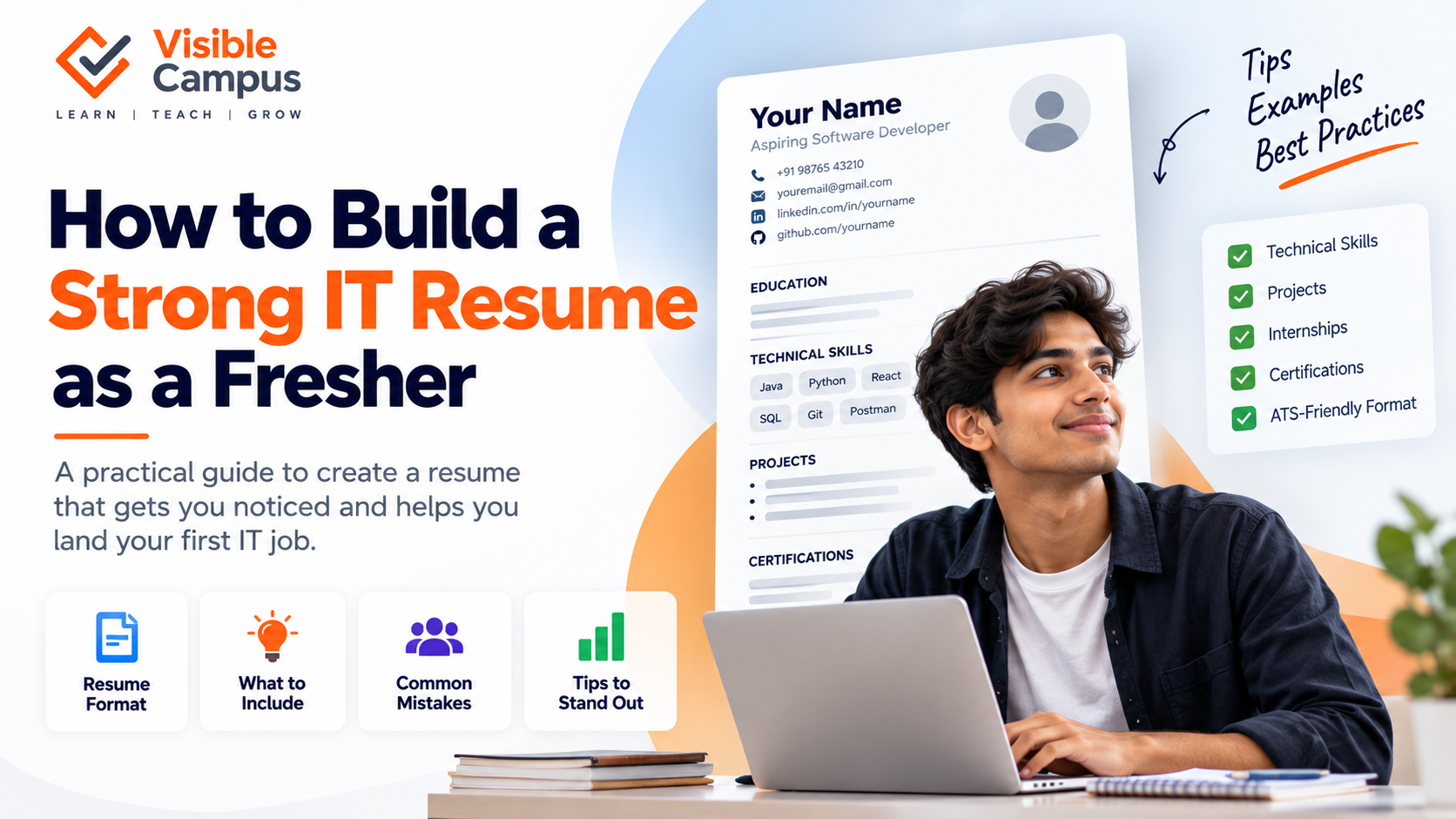
How to Build a Strong IT Resume as a Fresher
Getting your first IT job can be challenging, especially when you don't have professional experience to add to your resume.
Many fresh graduates make the mistake of thinking:
"I don't have work experience, so I don't have anything valuable to put on my resume."
That's not true.
As a fresher, your projects, technical skills, internships, certifications, academic work, problem-solving ability, and practical experience can all help demonstrate your potential to employers.
A strong fresher resume doesn't need to be filled with years of experience. It needs to clearly show what you know, what you have built, and what role you are preparing for.
In this guide, we'll explain how to create a strong IT resume as a fresher and the common mistakes you should avoid.
What Is an IT Fresher Resume?
An IT fresher resume is a concise document that presents your:
- Education
- Technical skills
- Projects
- Internships
- Certifications
- Achievements
- Relevant experience
- Career objective
The purpose is to help a recruiter quickly understand whether your skills match the role.
For example, if you're applying for a Java Developer position, your resume should make your Java, Spring Boot, SQL, projects, and related skills easy to find.
If you're applying for Software Testing, your resume should highlight testing knowledge, SQL, API testing, automation tools, and testing projects.
1. Start With a Clear Resume Header
Your resume should begin with your basic contact information.
Include:
Full Name
Phone Number
Professional Email
LinkedIn Profile
GitHub Profile
Location
Example
Rahul Kumar
Bangalore, India
+91 XXXXX XXXXX
LinkedIn | GitHub
You don't need to include unnecessary personal information such as:
- Father's name
- Mother's name
- Religion
- Marital status
- Passport number
- Full residential address
Keep the header professional and simple.
2. Write a Short Professional Summary
A fresher doesn't always need a long career objective.
A short 2–3 line professional summary can explain your background, skills, and career direction.
Example — Java Developer
Computer Science graduate with hands-on experience in Java, Spring Boot, SQL, React, and REST APIs. Built full-stack applications through academic and personal projects and currently seeking an entry-level software development opportunity.
Example — Software Testing
IT graduate with knowledge of manual testing, SQL, API testing, and Playwright automation. Experienced in creating test cases and testing web application workflows through hands-on projects.
Example — Data Analyst
Recent graduate with knowledge of SQL, Python, Excel, and Power BI. Built data analysis and visualization projects and interested in starting a career in data analytics.
Your summary should match the role you're applying for.
3. Highlight Relevant Technical Skills
Your technical skills should be easy for recruiters to find.
Instead of creating one huge list, organize your skills into categories.
Example
Programming:
Java, Python, JavaScript, TypeScript
Frontend:
HTML, CSS, React
Backend:
Spring Boot, Node.js, REST APIs
Database:
MySQL, MongoDB
Testing:
Selenium, Playwright, Postman
Tools:
Git, GitHub, VS Code
This makes your resume easier to scan.
4. Don't List Every Technology You've Ever Tried
A common fresher mistake is adding every technology they have encountered.
For example:
Java, Python, C, C++, JavaScript, React, Angular, Vue, Node.js, PHP, .NET, AWS, Azure, Docker, Kubernetes...
If you only watched a two-hour tutorial on Kubernetes, don't present yourself as proficient in Kubernetes.
Instead, focus on technologies you can actually discuss in an interview.
Quality is more important than quantity.
5. Projects Are Extremely Important for Freshers
If you don't have professional experience, projects can demonstrate your practical skills.
A good project section should explain:
What did you build?
Which technologies did you use?
What did you personally work on?
Example
E-Commerce Web Application
Technologies: React, Node.js, Express, MongoDB
- Developed a responsive e-commerce application with product search and filtering.
- Implemented user authentication and shopping cart functionality.
- Created REST APIs for products, users, and orders.
- Integrated MongoDB for application data management.
- Used Git for version control.
This is much stronger than simply writing:
Project: E-Commerce Website
6. Build Projects Related to Your Target Job
Your projects should support the role you're applying for.
Java Developer
Consider projects such as:
- Employee Management System
- E-Commerce Application
- Banking Application
- Library Management System
- Hospital Management System
Technologies could include:
Java + Spring Boot + React + MySQL
Software Testing
Build projects involving:
- E-commerce testing
- Banking application testing
- API testing
- Automation frameworks
Mention:
Test cases + Bug reports + SQL + Postman + Selenium/Playwright
Data Analyst
Projects could include:
- Sales dashboard
- Customer analysis
- Business performance analysis
- E-commerce analytics
Technologies:
SQL + Excel + Python + Power BI
Data Engineering
Projects could include:
- ETL pipeline
- Data warehouse
- Batch processing pipeline
- Cloud data pipeline
7. Add GitHub to Your Resume
For technical roles, GitHub can help demonstrate your practical work.
Your GitHub profile can contain:
- Projects
- Source code
- README files
- Documentation
- SQL scripts
- Automation frameworks
- Data analysis notebooks
Make sure your repositories are organized.
A good README can include:
Project Overview
Technologies Used
Features
Installation
Screenshots
How It Works
Don't create a GitHub profile simply for the sake of adding a link to your resume.
Keep it useful and relevant.
8. Add Internships and Practical Experience
If you have completed an internship, include it.
Example
Software Development Intern
ABC Technologies | Bangalore
- Developed frontend components using React.
- Integrated REST APIs with application workflows.
- Worked with Git for version control.
- Fixed UI issues and implemented feature enhancements.
- Participated in Agile development activities.
Even a short internship can demonstrate exposure to a professional development environment.
9. Certifications Can Support Your Resume
Certifications can be useful, particularly when they demonstrate structured learning.
Relevant examples might include certifications in:
- Cloud computing
- Java
- Python
- Software testing
- SQL
- Data analytics
- AI
- DevOps
However, don't fill your resume with dozens of certificates.
A few relevant certifications are generally more useful than a long list of unrelated ones.
10. Include Your Education Clearly
For freshers, education is an important section.
Example:
Bachelor of Computer Applications — BCA
XYZ University, Bangalore
2023–2026
CGPA: 8.2/10
You can also include relevant coursework if it strengthens your application:
- Data Structures
- Database Management
- Object-Oriented Programming
- Computer Networks
- Software Engineering
You don't need to list every subject you studied.
11. Add Achievements When Relevant
Achievements can help differentiate your resume.
Examples include:
- Hackathon participation
- Coding competitions
- Academic awards
- Technical presentations
- Open-source contributions
- College technology events
- Relevant competition rankings
Avoid adding unrelated achievements simply to make the resume longer.
12. Use Numbers Where They Make Sense
Numbers can make project descriptions more concrete.
Instead of:
Improved application performance.
You could write:
Reduced API response time by approximately 25% through query optimization.
Only use numbers that you can genuinely support.
Don't invent statistics to make your resume look impressive.
13. Keep Your Resume Concise
For most freshers, one page is often enough.
A simple structure is:
Name & Contact
↓
Professional Summary
↓
Technical Skills
↓
Projects
↓
Internship / Experience
↓
Education
↓
Certifications
↓
Achievements
You don't need to fill two or three pages just because you have more information.
14. Use a Professional Design
Your resume doesn't need complicated graphics.
A clean design is usually easier to read.
Use:
- Clear headings
- Consistent fonts
- Proper spacing
- Simple formatting
- Bullet points
- Consistent alignment
Avoid:
- Excessive colors
- Large graphics
- Skill bars
- Unnecessary icons
- Complicated tables
- Decorative fonts
Your technical experience should be the focus.
15. Make Your Resume ATS-Friendly
Many organizations use Applicant Tracking Systems (ATS) to help process applications.
To make your resume easier for such systems to parse:
- Use standard section headings.
- Include relevant keywords naturally.
- Avoid excessive graphics.
- Avoid putting important information inside images.
- Use simple formatting.
- Match your skills to the job description when appropriate.
For example, if a job description mentions:
Java, Spring Boot, SQL, REST API
and you genuinely have those skills, make sure they're clearly mentioned in your resume.
16. Customize Your Resume for Each Job
You don't necessarily need a completely different resume for every application.
But you should adjust relevant sections based on the job.
Job Description
Looking for a Java developer with Java, Spring Boot, SQL, REST APIs and Git.
Your resume should clearly highlight those skills if you have them.
For a testing position, your resume might instead emphasize:
Manual Testing + SQL + API Testing + Playwright + Selenium
The goal is to make the connection between your skills and the job obvious.
17. Don't Lie on Your Resume
This is one of the most important rules.
Don't claim:
- Professional experience you don't have
- Projects you didn't build
- Technologies you don't understand
- Certifications you haven't earned
- Job titles you never held
Technical interviews can quickly expose skills that aren't genuine.
It's better to say:
Basic knowledge of Docker
than to claim:
Expert in Docker
when you have only beginner-level experience.
Common Resume Mistakes Freshers Should Avoid
❌ Using a Generic Career Objective
Avoid long statements such as:
"To work in a challenging organization where I can utilize my skills and contribute to the growth of the organization..."
Instead, use a short, specific summary.
❌ Listing Too Many Skills
Only include technologies you can discuss confidently.
❌ No Projects
Projects are particularly important when you don't have professional experience.
❌ Huge Paragraphs
Use concise bullet points.
❌ Spelling and Grammar Mistakes
Proofread your resume carefully.
❌ Unprofessional Email Address
Use something like:
firstname.lastname@gmail.com
rather than an informal username.
❌ One Resume for Every Job
Adjust relevant skills and projects based on the position.
❌ Fake Experience
Never invent experience.
Example Fresher Resume Structure
Here's a simple structure you can follow:
YOUR NAME
Bangalore, India | Phone | Email | LinkedIn | GitHub
PROFESSIONAL SUMMARY
2–3 lines describing your background, skills and target role.
TECHNICAL SKILLS
Programming:
Java, Python, JavaScript
Frontend:
HTML, CSS, React
Backend:
Spring Boot, Node.js
Database:
MySQL, MongoDB
Tools:
Git, GitHub, Postman
PROJECTS
Project Name
Technologies: Java, Spring Boot, React, MySQL
• Developed...
• Implemented...
• Integrated...
• Tested...
INTERNSHIP
Company Name | Role
• Worked on...
• Developed...
• Assisted with...
EDUCATION
Degree
University | Year
CGPA
CERTIFICATIONS
Certification Name
Platform / Organization
ACHIEVEMENTS
• Achievement
• Achievement
How to Make Your Resume Stand Out
A strong fresher resume doesn't need to look flashy.
Instead, make these five things clear:
1. What role are you targeting?
Java Developer? Tester? Data Analyst? Cloud Engineer?
2. What technologies do you know?
Make relevant technical skills easy to find.
3. What have you built?
Projects demonstrate practical application.
4. What have you practiced?
Internships, assignments, GitHub work and technical projects can help.
5. Can you explain everything on your resume?
This is perhaps the most important test.
If an interviewer asks about something on your resume, you should be able to explain it.
Final Thoughts
Building an IT resume as a fresher isn't about trying to make your resume look like someone with five years of experience.
Instead, focus on showing your potential, practical skills, projects, learning ability, and career direction.
A strong fresher resume should clearly communicate:
What you learned → What you built → What you practiced → What role you're ready for
Keep it concise, honest, relevant, and easy to read.
Most importantly, don't wait until your resume is finished to start building your skills.
Build projects first. Document them. Then turn those projects into a strong resume.
Build Skills That Strengthen Your Resume with Visible Campus
At Visible Campus, students can build practical technology skills through structured courses, hands-on projects, assignments, mock interviews, and industry-focused learning.
Whether you're learning:
Java Full Stack | Full Stack Development | Generative AI | Data Engineering | Cloud & DevOps | Software Testing
focus on developing skills that you can demonstrate through real projects.
Learn. Build. Practice. Prepare. Start your IT career.