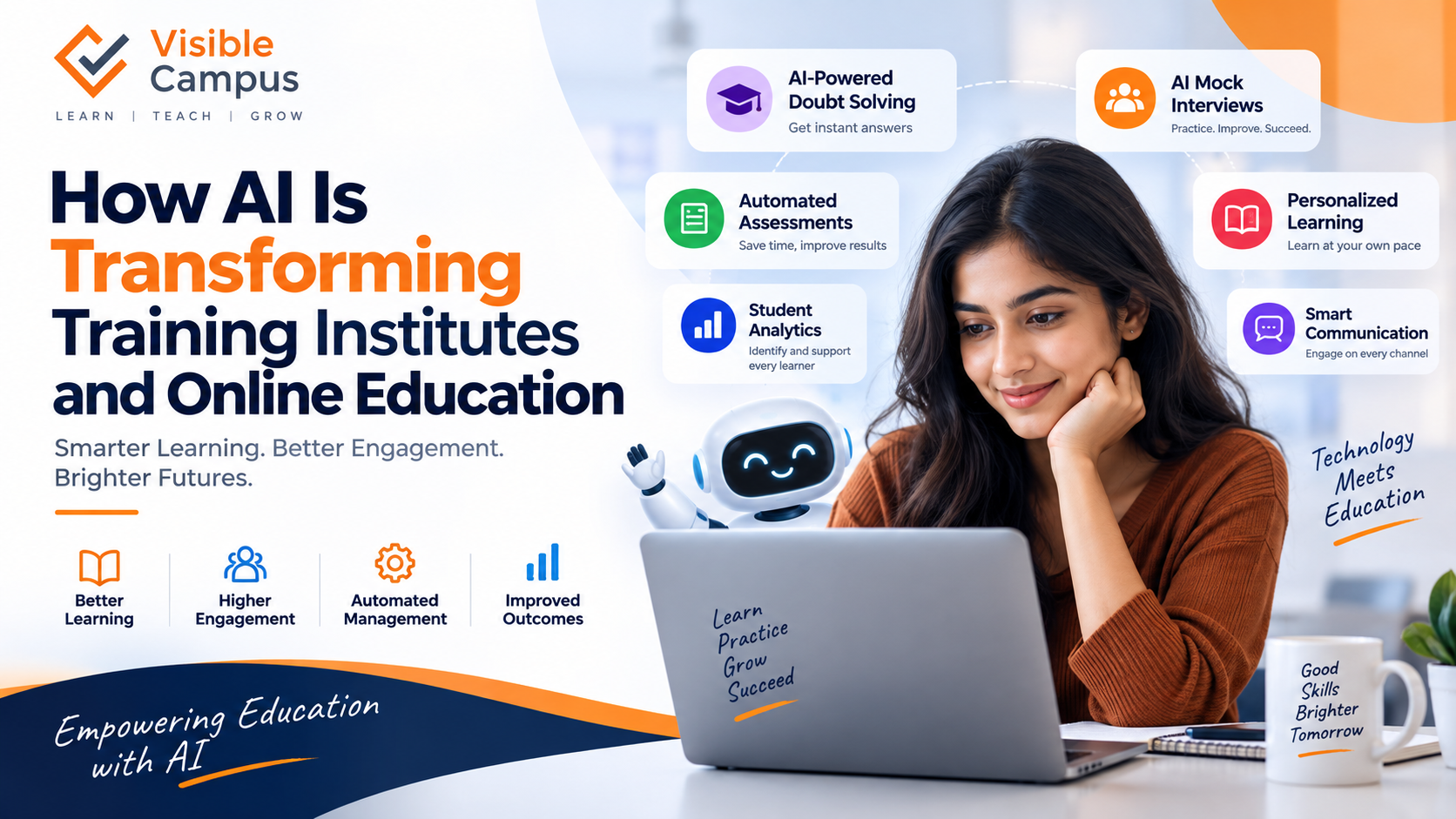
How AI Is Transforming Training Institutes and Online Education
Artificial Intelligence (AI) is changing the way students learn and how training institutes manage education. From personalized learning and AI-powered doubt solving to automated assessments and student performance analysis, AI is helping create smarter and more engaging learning experiences.
For training institutes, AI is becoming more than just a new technology. It can help automate repetitive tasks, support instructors, improve student engagement, and provide students with personalized learning assistance.
In this blog, we explore how AI is transforming training institutes and online education and how modern LMS platforms can bring these capabilities together.
What Is AI in Education?
AI in education refers to the use of artificial intelligence technologies to improve teaching, learning, student support, and educational management.
Training institutes can use AI for:
- AI-powered doubt solving
- Personalized learning recommendations
- Automated assessments and quizzes
- AI mock interviews
- Student performance analysis
- AI chatbots
- Automated communication
- Coding assistance
- Learning content generation
- Student engagement
When integrated with an LMS, these technologies can create a more connected and efficient learning environment.
1. Personalized Learning
Every student learns at a different pace.
Some students may understand a concept quickly, while others may need additional explanations and practice. AI can analyze learning activity and recommend relevant resources based on a student's progress.
For example, if a student is struggling with Java exception handling, an AI-powered learning assistant can provide additional explanations, examples, practice questions, and revision materials.
This creates a more personalized learning experience instead of providing exactly the same learning path to every student.
2. AI-Powered Doubt Solving
Students often have questions while studying online or after a class.
An instructor may not always be available to answer every question immediately. AI-powered learning assistants can provide instant support for many common doubts.
For example, a programming student can ask:
"Why am I getting a NullPointerException in Java?"
An AI assistant can explain possible causes and guide the student through the debugging process.
AI does not have to replace instructors. Instead, it can provide students with an additional support system whenever they need help.
3. AI Chatbots for Student Support
Training institutes handle many repetitive student questions every day.
Students may ask:
- When does the next batch start?
- What is the course duration?
- When are classes scheduled?
- Where can I find my recordings?
- How do I submit an assignment?
- What topics are covered in the course?
- How can I contact my instructor?
An AI chatbot can handle many routine questions automatically.
This allows administrative teams and instructors to spend more time on activities that require human involvement.
4. Automated Assessments and Quizzes
Creating assessments manually can take significant time.
AI can help instructors generate quizzes, multiple-choice questions, practice exercises, and assessments based on course topics.
For example, after completing a Spring Boot module, an AI system can help generate questions around:
- REST APIs
- Dependency Injection
- Controllers
- Services
- Exception Handling
- Database Integration
Students can then practice immediately after completing the lesson.
5. AI Mock Interviews
Interview preparation is an important part of professional training.
Traditional mock interviews require an instructor or mentor to conduct individual sessions. This can become difficult when an institute has a large number of students.
AI-powered mock interviews can give students additional opportunities to practice technical and HR interview questions.
AI interview systems can provide feedback on areas such as:
- Technical understanding
- Answer relevance
- Communication
- Interview structure
- Response quality
This allows students to practice before attending real interviews.
6. Student Performance Analysis
Training institutes generate large amounts of student data, including:
- Attendance
- Assignment submissions
- Quiz scores
- Course progress
- Assessment results
- Learning activity
AI can analyze these patterns and help instructors identify students who may need additional support.
For example, a student with declining assessment scores, low attendance, and incomplete assignments may benefit from early intervention.
This allows instructors to identify potential learning difficulties before the end of the course.
7. Automated Attendance Management
Managing attendance manually can become challenging when institutes conduct multiple classes and batches.
An LMS with automated attendance features can help institutes maintain attendance records more efficiently.
Administrators and instructors can access attendance information from a centralized platform and monitor student participation across batches.
8. AI-Generated Learning Content
AI can also assist instructors in creating educational materials.
It can help generate:
- Course summaries
- Practice questions
- Revision notes
- Quiz questions
- Assignment ideas
- Interview questions
- Learning examples
- Course outlines
However, AI-generated content should be reviewed by instructors to ensure that it is accurate, relevant, and suitable for students.
AI works best as an assistant to educators rather than a replacement for them.
9. Better Student Engagement
Maintaining student engagement is one of the challenges of online education.
AI can make learning more interactive through:
- Personalized recommendations
- AI learning assistants
- Automated quizzes
- Coding exercises
- Mock interviews
- Instant feedback
- Progress tracking
Instead of only watching recorded classes, students can actively interact with learning tools and practice what they have learned.
10. AI-Powered Coding Practice
For technology training institutes, practical coding experience is essential.
AI can help students understand:
- Programming errors
- Syntax issues
- Debugging approaches
- Code structure
- Programming concepts
- Problem-solving techniques
When combined with an online coding environment, students can practice programming without spending time configuring a development environment.
This can be useful for students learning Java, Python, JavaScript, React, and other programming technologies.
11. AI and WhatsApp Communication
WhatsApp is widely used for communication, making it a useful channel for student engagement.
AI-powered WhatsApp automation can help institutes send:
- Class reminders
- Assignment notifications
- Attendance updates
- Batch announcements
- Course information
- Payment reminders
- Student support messages
When connected with an LMS, these workflows can reduce manual communication and help students stay informed.
12. AI for Training Institute Management
AI can support more than classroom learning.
Training institutes can use AI and automation across the complete student journey:
Lead → Enquiry → Admission → Batch Allocation → Classes → Attendance → Assignments → Assessments → Certification
An LMS can bring these processes together into a centralized platform.
This can reduce repetitive administrative work while giving institutes better visibility into students, batches, instructors, and learning activities.
Benefits of AI for Training Institutes
For Students
- Personalized learning assistance
- Faster doubt resolution
- More practice opportunities
- AI mock interviews
- Instant feedback
- Better access to learning resources
For Instructors
- Reduced repetitive tasks
- Faster content creation
- Student performance insights
- Automated assessments
- Better student communication
For Administrators
- Automated workflows
- Centralized student management
- Better batch management
- Automated communication
- Improved operational efficiency
The Role of an LMS in AI-Powered Education
AI becomes even more useful when integrated into a Learning Management System.
An LMS can bring together:
Students + Courses + Batches + Instructors + Classes + Attendance + Assignments + Assessments + Recordings + Performance Data
When AI is integrated into this ecosystem, training institutes can create a more intelligent and connected learning environment.
An AI-enabled LMS can help provide learning assistance, automate communication, analyze student progress, support assessments, and simplify daily institute operations.
Challenges of Using AI in Education
AI also comes with important considerations.
Accuracy
AI-generated information can sometimes be incorrect. Educational content should be reviewed when accuracy is important.
Data Privacy
Training institutes handle student information, assessments, attendance, and other data. Appropriate security and privacy controls are important when implementing AI.
Human Interaction
AI should support instructors rather than eliminate meaningful interaction between teachers and students.
Human mentors remain important for practical guidance, career advice, and personalized support.
Responsible AI Usage
Students should learn to use AI as a learning assistant rather than becoming completely dependent on it.
The goal should be to combine AI assistance with independent thinking and problem-solving.
The Future of AI in Training and Education
The future of education is likely to combine human expertise with AI-powered technology.
Students can benefit from personalized AI assistants, intelligent practice systems, automated assessments, AI interview simulations, and learning recommendations.
At the same time, instructors can focus more on mentoring, practical teaching, and helping students develop real-world skills.
For training institutes, the opportunity is not simply to add AI to their existing systems. It is to create an ecosystem where AI, instructors, students, and an LMS work together.