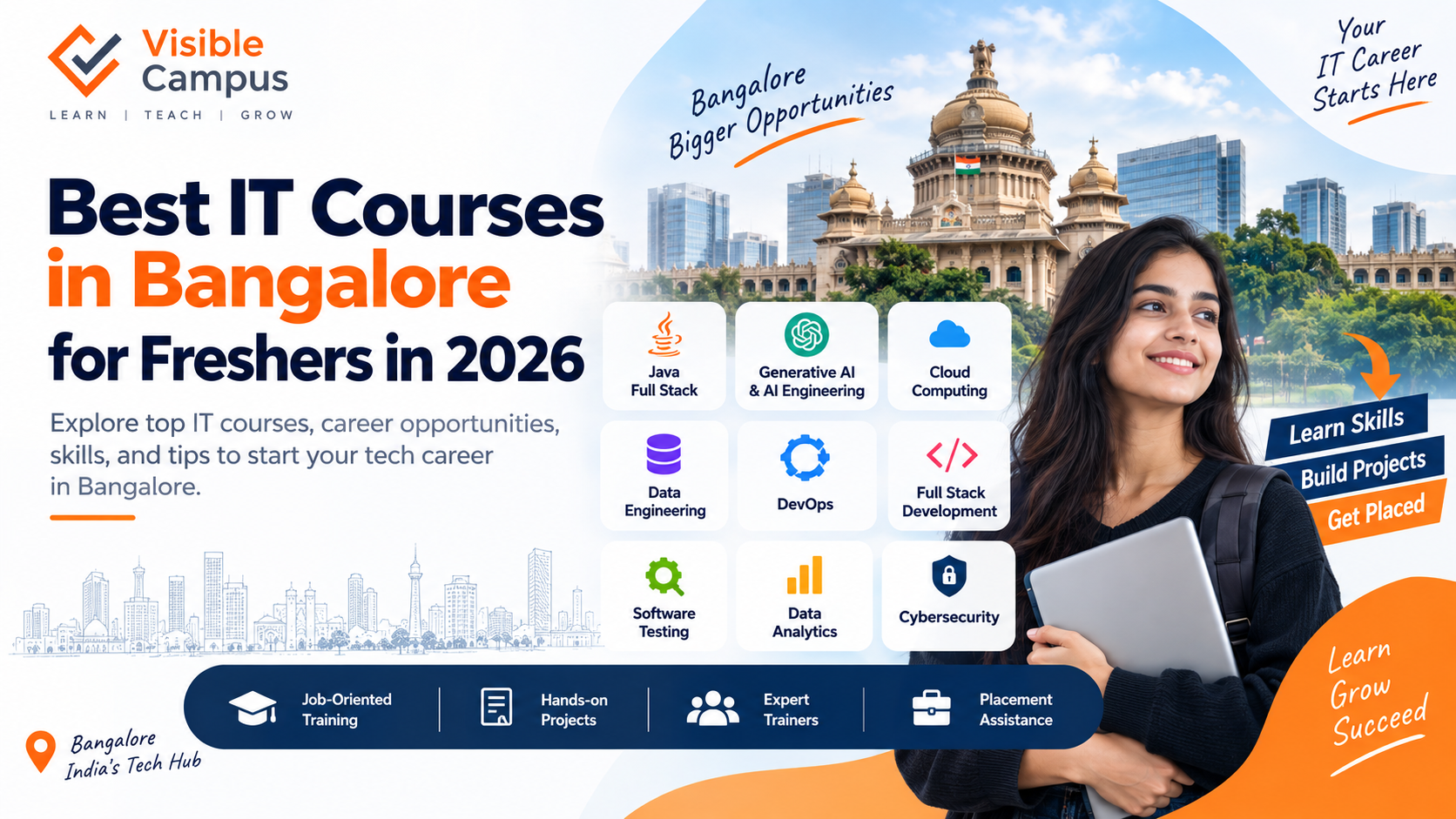
Best IT Courses in Bangalore for Freshers in 2026
Bangalore continues to be one of India's major technology and startup hubs, creating opportunities across software development, cloud computing, artificial intelligence, data, cybersecurity, testing, and IT infrastructure.
For fresh graduates, however, choosing an IT course can be confusing. There are hundreds of programs covering different technologies, and the right option depends on your educational background, interests, existing skills, and career goals.
In 2026, many training programs are also incorporating AI tools and AI-assisted development alongside traditional technical skills. Current Bangalore training offerings span areas such as full-stack development, AI, data, DevOps, cloud, cybersecurity, and software testing.
This guide covers some of the major IT course options that freshers can consider in Bangalore.
What Should Freshers Look for in an IT Course?
Before choosing a course, don't focus only on the course name.
A good training program should ideally include:
- Industry-relevant technologies
- Hands-on projects
- Practical assignments
- Coding or technical practice
- Interview preparation
- Resume guidance
- Mock interviews
- Instructor support
- Updated curriculum
- Placement assistance
- Exposure to AI tools where relevant
The curriculum should also match the role you eventually want to pursue.
1. Java Full Stack Development
Java Full Stack Development remains an important option for freshers who want to pursue software development.
A comprehensive Java Full Stack program generally covers:
- Core Java
- Object-Oriented Programming
- Data Structures
- SQL
- HTML and CSS
- JavaScript
- Spring
- Spring Boot
- REST APIs
- Hibernate/JPA
- React or another frontend framework
- Git
- Database development
- Deployment
Some current Bangalore programs are also adding AI tooling and AI-assisted development to traditional Java Full Stack curricula.
Who can consider Java Full Stack?
This path can be suitable for:
- B.Tech/BE graduates
- BCA graduates
- MCA graduates
- Computer Science students
- IT graduates
- Beginners interested in software development
If you enjoy programming and want to build web applications, Java Full Stack can provide a broad technical foundation.
2. Full Stack Web Development
Full Stack Development is another popular option for students interested in building complete web applications.
A typical curriculum may include:
Frontend
- HTML
- CSS
- JavaScript
- React
- TypeScript
Backend
- Node.js
- Express
- REST APIs
Database
- MySQL
- MongoDB
Additional skills
- Git and GitHub
- Cloud deployment
- API integration
- Authentication
- Testing
- AI integration
Full-stack programs can be particularly useful for students who want exposure to both frontend and backend development.
3. Generative AI and AI Engineering
Generative AI has become an important area of technology education.
Instead of learning only traditional programming, students can now learn how applications interact with modern AI models.
A beginner-oriented Generative AI program may cover:
- AI fundamentals
- Prompt engineering
- Large Language Models
- Generative AI tools
- API integration
- AI application development
- RAG
- Vector databases
- AI agents
- Agentic AI
- AI-powered automation
For students with a programming foundation, combining software development with AI can provide a broader technical skill set.
Who should consider Generative AI?
It can be suitable for:
- Computer Science graduates
- IT graduates
- Software developers
- Students interested in emerging technologies
- Programmers interested in building AI-powered applications
4. Data Engineering
Data Engineering is another technology area students can explore.
Data engineers work with systems that collect, process, transform, and store large volumes of data.
A Data Engineering course may include:
- Python
- SQL
- Data structures
- ETL pipelines
- Data warehouses
- Cloud platforms
- Apache Spark
- Data pipelines
- Snowflake
- Databases
- Data processing
Students interested in databases, programming, cloud technologies, and large-scale data systems may find this area particularly interesting.
5. Data Analytics
Data Analytics is another possible entry point for graduates interested in working with business and data.
A typical course can include:
- Excel
- SQL
- Python
- Statistics
- Power BI
- Tableau
- Data visualization
- Data cleaning
- Business intelligence
Data Analytics can also be considered by graduates who are interested in technology but don't necessarily want to become full-time software developers.
6. Cloud Computing
Cloud computing has become an important part of modern IT infrastructure.
Students can explore platforms such as:
- AWS
- Microsoft Azure
- Google Cloud
A beginner cloud course may cover:
- Cloud fundamentals
- Compute
- Storage
- Networking
- Databases
- Identity and access management
- Virtual machines
- Containers
- Cloud security
- Monitoring
Cloud knowledge can also complement other career paths such as development, DevOps, data engineering, and cybersecurity.
7. DevOps
DevOps combines software development, automation, infrastructure, and deployment practices.
A DevOps course commonly includes:
- Linux
- Git
- Docker
- Kubernetes
- Jenkins
- CI/CD
- Cloud platforms
- Infrastructure concepts
- Monitoring
- Automation
Students should understand that DevOps can involve a broader technical foundation than some beginner-level courses. Learning Linux, networking, Git, and cloud fundamentals first can make the transition easier.
8. Software Testing and Automation Testing
Software testing can be another route into the IT industry.
A modern testing program can include:
- Manual testing
- SDLC
- STLC
- Test case design
- API testing
- SQL
- Selenium
- Playwright
- Test automation
- Java or Python
- Agile methodologies
- Bug tracking
Automation testing can allow students to combine testing knowledge with programming and automation skills.
This can be particularly useful for students interested in software quality and engineering processes.
9. Cybersecurity
Cybersecurity is another technology area that students can explore.
A beginner cybersecurity program may introduce:
- Networking fundamentals
- Linux
- Security concepts
- Vulnerability assessment
- Web security
- Ethical hacking fundamentals
- Security monitoring
- Identity and access management
- Cloud security
Cybersecurity generally requires continuous learning because security technologies and threats continue to evolve.
Which IT Course Should a Fresher Choose?
There isn't one course that is suitable for every fresher.
Your choice can depend on your interests and background.
Your InterestCourse to Explore
Building websites and applications
Full Stack Development
Java and enterprise software
Java Full Stack
AI and emerging technologies
Generative AI
Working with large-scale data
Data Engineering
Business data and dashboards
Data Analytics
Cloud infrastructure
Cloud Computing
Automation and deployment
DevOps
Software quality and testing
Software Testing
Security and networks
Cybersecurity
This is a starting framework rather than a ranking. The best fit depends on your existing skills and the type of work you want to pursue.
How Long Does It Take to Learn an IT Skill?
The duration depends on the technology, your existing knowledge, and the depth of the program.
A short introductory course can provide basic exposure, while becoming job-ready generally requires additional practice outside classroom hours.
For example:
Learning → Practice → Projects → Interview Preparation → Job Applications
Freshers should avoid choosing a course only because it promises to make them job-ready in an unusually short period.
The more important question is whether the program gives you enough time to build practical skills.
Projects Are Important for Freshers
One of the biggest differences between learning a technology and becoming job-ready is hands-on practice.
A strong training program should give students opportunities to build projects.
For example:
Java Full Stack Project
Build an employee management or e-commerce application using:
Java + Spring Boot + React + MySQL
Data Engineering Project
Build a data pipeline using:
Python + SQL + Cloud + Snowflake
Full Stack Project
Build an application using:
React + Node.js + MongoDB
Testing Project
Automate a web application using:
Playwright/Selenium + Java/Python
Projects help students understand how individual technologies work together in a real application.
Don't Choose an IT Course Only Because of Salary Claims
One of the most important things freshers should evaluate is whether the course matches their skills and interests.
Training advertisements sometimes highlight salary figures or placement claims. Students should ask for specific information before enrolling.
For example:
- How many students completed the previous batch?
- How many received offers?
- What companies recruited them?
- What roles were offered?
- What was the salary range?
- Is placement assistance different from a placement guarantee?
- Can previous students be contacted?
Placement assistance and a guaranteed job are not necessarily the same thing. Some current Bangalore training guidance also recommends checking the exact meaning and conditions behind placement claims.
Why Bangalore Is an Important Location for IT Training
Bangalore has a large ecosystem of technology companies, startups, service providers, and training organizations.
Training institutes are present across areas such as:
- Marathahalli
- Whitefield
- Electronic City
- BTM Layout
- HSR Layout
- Jayanagar
- Rajajinagar
- Koramangala
- Hebbal
- Manyata Tech Park area
Current local listings show training providers covering areas including Java, AI, data science, Python, DevOps, and other software skills across Bangalore.
This gives students a variety of classroom and online learning options.
How to Choose an IT Training Institute in Bangalore
Before enrolling, compare institutes based on:
1. Curriculum
Check whether the syllabus includes current technologies rather than outdated content.
2. Practical Projects
Ask how many projects students will build.
3. Trainer Experience
Understand whether instructors have practical industry experience.
4. Batch Size
Smaller batches can provide more opportunities for interaction and questions.
5. Interview Preparation
Check whether the program includes:
- Mock interviews
- Coding practice
- Resume preparation
- Technical interview preparation
6. Placement Support
Understand exactly what "placement assistance" includes.
7. Learning Platform
Check whether the institute provides:
- Class recordings
- Assignments
- Assessments
- Attendance tracking
- Learning materials
- Student dashboards
A modern LMS can make it easier for students to access these resources from one place.
Why AI Skills Matter in 2026
AI is increasingly being incorporated into software development, analytics, education, testing, and other technology workflows.
That doesn't mean every fresher needs to become an AI engineer.
Instead, students can consider learning AI tools relevant to their chosen field.
For example:
Java Developer → Java + Spring Boot + AI APIs
Full Stack Developer → React + Node.js + AI integration
Data Analyst → SQL + Power BI + AI-assisted analytics
Tester → Automation + AI-assisted testing
DevOps → Cloud + DevOps + AI-assisted automation
This approach can help students build a core technical foundation while also understanding how AI tools are used in their chosen field.