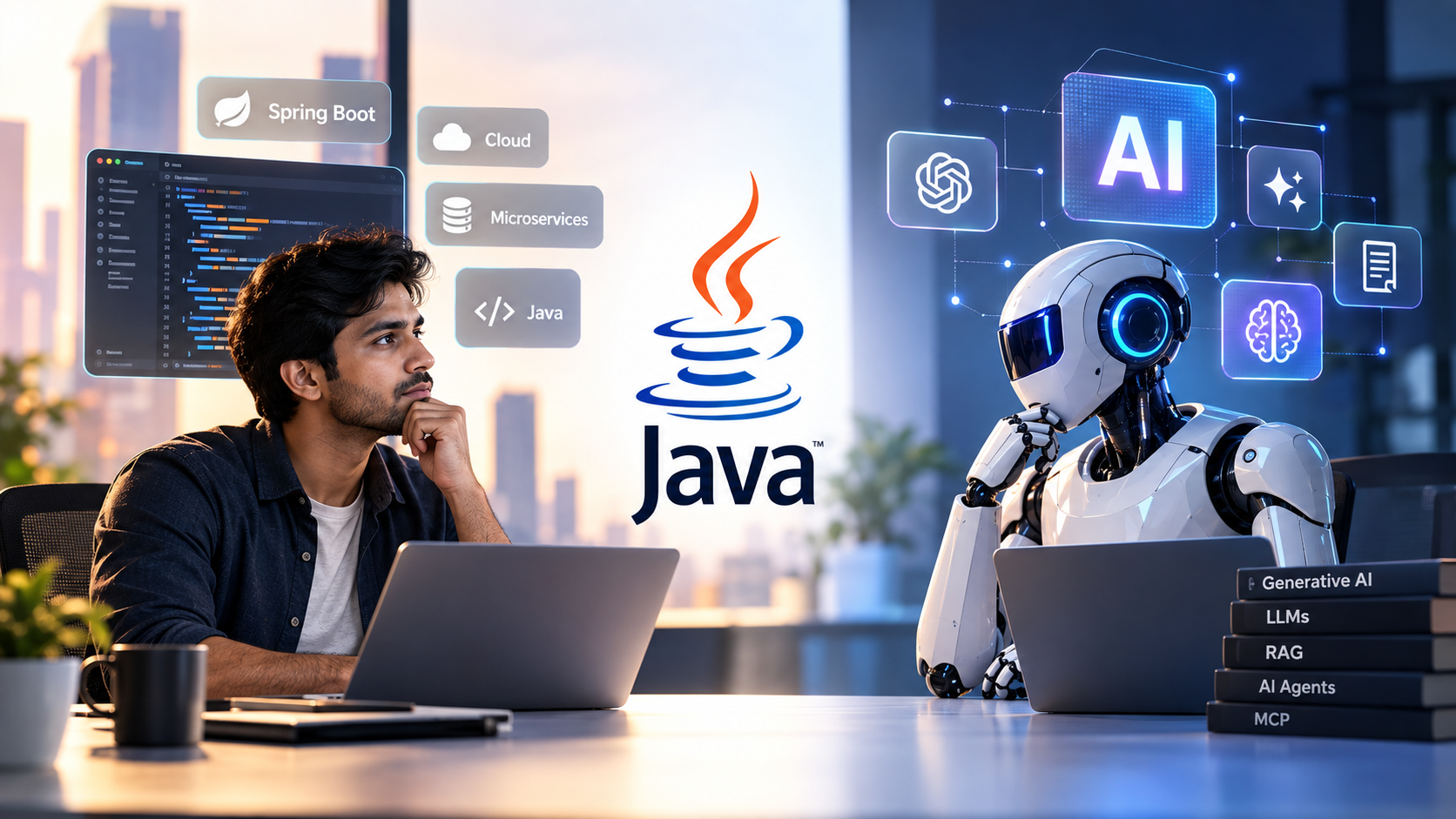
Can AI Replace Java Developers? What Developers Should Learn in 2026
Artificial intelligence is changing the way software is designed, developed, tested, and maintained.
AI coding assistants and coding agents can now generate code, explain existing code, write tests, debug errors, and help developers work through complex programming tasks. In 2026, AI coding tools are no longer experimental tools used by a small group of developers. JetBrains' 2026 Developer Ecosystem Survey reports that 90% of professional developers surveyed were using AI coding agents at work at least weekly during May–July 2026.
This raises an important question for Java developers:
Can AI replace Java developers?
The more useful question is perhaps:
What should Java developers learn to stay effective in an AI-powered software industry?
The answer involves much more than learning another AI coding tool.
How AI Is Changing Software Development
AI is increasingly being used across different stages of the software development lifecycle.
Developers can use AI to:
- Generate code
- Explain unfamiliar codebases
- Create unit tests
- Find potential bugs
- Refactor existing code
- Generate SQL queries
- Create API documentation
- Generate boilerplate code
- Debug errors
- Create development prototypes
- Review code
- Assist with DevOps tasks
According to JetBrains' 2026 research, 68% of professional developers surveyed reported using AI coding agents daily, showing how deeply these tools have entered everyday development workflows.
But generating code is only one part of software engineering.
A production application still requires developers to understand requirements, architecture, security, data, performance, testing, deployment, and business constraints.
Does This Mean Java Developers Will Disappear?
Not necessarily.
AI is changing how developers work, but software engineering involves considerably more than writing lines of code.
Consider a typical enterprise application.
A business might need:
Customer Requirement
↓
System Architecture
↓
Database Design
↓
API Design
↓
Security
↓
Business Logic
↓
Java / Spring Boot
↓
Testing
↓
Cloud Deployment
↓
Monitoring
↓
Maintenance
An AI tool can assist with many of these activities.
However, someone still needs to determine:
- What the application should actually do
- Which architecture is appropriate
- How sensitive data should be protected
- How services should communicate
- How failures should be handled
- Whether generated code is correct
- Whether an implementation satisfies business requirements
- How the application should operate in production
These decisions require engineering context and responsibility.
AI Is Already Writing More Code
The change should not be underestimated.
BairesDev's Q3 2026 Dev Barometer, based on 705 developers across 60 countries, reported that only 21% of surveyed developers spent most of their week writing new code. The report also found that developers were spending more time on learning, reviewing, and debugging AI-generated work.
This suggests that the developer role is moving toward a different workflow.
Instead of:
Developer → Write Code → Test → Deploy
the workflow increasingly looks like:
Developer
↓
Define Problem
↓
Ask / Direct AI
↓
Review Generated Solution
↓
Test
↓
Debug
↓
Improve Architecture
↓
Deploy
The ability to understand and validate code therefore becomes increasingly important.
What Happens to Junior Java Developers?
This is one of the biggest questions for people starting their careers.
AI can generate relatively simple code quickly.
For example, a developer can ask an AI tool to create:
@RestController
@RequestMapping("/api/users")
public class UserController {
@GetMapping("/{id}")
public User getUser(@PathVariable Long id) {
return userService.findById(id);
}
}
But knowing how to generate a controller is different from understanding:
- REST API design
- Authentication
- Authorization
- Transactions
- Database indexing
- Exception handling
- Validation
- API versioning
- Distributed systems
- Observability
- Security
This is why fundamentals still matter.
A developer who cannot understand generated code can struggle to identify incorrect assumptions, security issues, performance problems, or architectural mistakes.
A 2026 BairesDev survey illustrates this concern: among the surveyed developers, only 16% of senior developers said juniors fully understood AI-generated code they submitted, while 57% said juniors understood it only to some extent.
The Java Developer of 2026 Looks Different
A modern Java developer doesn't necessarily need to choose between:
Java OR AI
Instead, the skill set increasingly looks like:
Java + Spring Boot + Cloud + AI
Java is also becoming more involved in enterprise AI development.
Azul's 2026 State of Java survey, based on more than 2,000 Java professionals worldwide, reported that 62% of surveyed enterprises were using Java to power AI functionality.
Spring itself now has a dedicated AI ecosystem. Spring AI provides abstractions for connecting applications to AI models and enterprise data, including capabilities such as chat, embeddings, tool calling, and vector stores.
1. Master Core Java
AI tools make learning Java fundamentals more important, not less.
Developers should understand:
- Object-oriented programming
- Collections
- Generics
- Exception handling
- Streams
- Lambda expressions
- Multithreading
- Concurrency
- JVM fundamentals
- Memory management
- Design patterns
You don't need to memorize every API.
You do need to understand what your code is doing.
2. Learn Spring Boot
Spring Boot remains one of the most important technologies for Java backend development.
Developers should understand:
- REST APIs
- Dependency injection
- Spring Data JPA
- Hibernate
- Spring Security
- Validation
- Exception handling
- Configuration
- Actuator
- Testing
- Microservices
The goal shouldn't be:
"I can ask AI to create a Spring Boot application."
Instead:
"I understand Spring Boot well enough to evaluate and improve what AI generates."
That's a much more valuable skill.
3. Learn SQL and Databases
AI can generate SQL queries.
That doesn't mean developers can ignore databases.
Learn:
- SQL
- Joins
- Indexes
- Transactions
- Normalization
- Query optimization
- PostgreSQL/MySQL
- MongoDB
- Database design
When an AI-generated query performs poorly against millions of records, database knowledge becomes extremely important.
4. Learn Cloud and DevOps
Modern backend development doesn't stop when the code is written.
Learn:
- Docker
- Kubernetes fundamentals
- AWS / Azure
- CI/CD
- Git
- Linux
- Logging
- Monitoring
- Distributed systems
A developer who understands both application code and its production environment can reason about problems that go beyond a single source file.
5. Learn AI Fundamentals
Java developers don't necessarily need to become machine-learning researchers.
But understanding AI fundamentals is increasingly useful.
Start with:
- Generative AI
- Large Language Models
- Prompt engineering
- Embeddings
- Vector databases
- RAG
- Tool calling
- AI agents
- Model APIs
- MCP
Java's AI ecosystem is expanding rapidly. Spring AI 2.0, released in June 2026, includes capabilities around agents, MCP, tool calling, structured outputs, memory, and vector stores.
6. Learn Spring AI
For Java developers, Spring AI is one of the most practical ways to enter AI application development.
A typical application could look like:
Spring Boot
↓
Spring AI
↓
LLM
↓
RAG / Vector Database
↓
Enterprise Data
For example, you could build an internal company assistant that answers questions using an organization's documentation.
The developer would still need to design:
- Data ingestion
- Embeddings
- Retrieval
- Access control
- Prompt design
- Model integration
- Error handling
- Evaluation
- Monitoring
AI becomes another capability within the application rather than a replacement for the entire application architecture.
7. Learn RAG
Retrieval-Augmented Generation (RAG) is an important concept for developers building enterprise AI applications.
Instead of relying entirely on an LLM's existing knowledge, a RAG system retrieves relevant information from a knowledge source and provides that information to the model.
A simplified architecture is:
User Question
↓
Embedding
↓
Vector Database
↓
Relevant Documents
↓
LLM
↓
Generated Answer
Java developers can build these systems using Spring AI and vector-store integrations.
8. Learn AI Agents and MCP
AI development is moving beyond simple chatbot interactions.
Modern AI applications increasingly involve:
- Tool calling
- Agents
- Multi-step workflows
- External APIs
- Enterprise systems
- MCP servers
MCP, or Model Context Protocol, is becoming an important part of the AI application ecosystem.
For Java developers, understanding how applications expose tools and services to AI systems can become a useful addition to the traditional backend skill set.
9. Improve Your Software Architecture Skills
This may become one of the most important developer skills in the AI era.
AI can generate individual components very quickly.
But large applications still require architecture.
Learn:
- SOLID principles
- Design patterns
- Clean architecture
- Domain-driven design
- Microservices
- Event-driven architecture
- API design
- Scalability
- Reliability
- Security
Instead of only asking:
"How do I write this method?"
Developers increasingly need to ask:
"Should this method exist here at all?"
10. Become Good at Reviewing AI-Generated Code
AI-generated code should be treated as something to review, not automatically trust.
When AI generates Java code, check:
Correctness
Does it actually solve the problem?
Security
Does it introduce vulnerabilities?
Performance
Will it work with realistic data volumes?
Maintainability
Can another developer understand it?
Testing
Are important edge cases covered?
Architecture
Does the solution fit the existing system?
This is where strong programming fundamentals become extremely valuable.
What Should a Java Developer Learn in 2026?
A practical roadmap could look like this:
JAVA DEVELOPER 2026
Core Java
↓
SQL + Databases
↓
Spring Boot
↓
REST APIs + Security
↓
Microservices
↓
Docker + Cloud
↓
DevOps
↓
AI Fundamentals
↓
Spring AI
↓
RAG + Vector DB
↓
AI Agents + MCP
↓
AI-Assisted Development
This doesn't mean every developer needs to master every technology immediately.
Instead, build the foundation first and progressively add AI capabilities.
Will AI Change Java Developer Jobs?
The job itself is likely to continue changing as AI adoption increases.
The evidence already shows significant changes in developer workflows. JetBrains reported high adoption of AI coding agents among professional developers in 2026, while BairesDev's surveys show developers spending less of their working time exclusively on writing new code.
That means developers may increasingly spend their time on:
- Problem solving
- Architecture
- Code review
- Debugging
- System design
- Security
- Integration
- Testing
- AI-assisted development
- Business requirements
The exact impact on employment will depend on factors including company adoption, productivity changes, economic conditions, and how development roles evolve. Current evidence does not establish a single outcome for all Java developers.
AI + Java: A New Opportunity
Java is not limited to traditional enterprise applications.
Developers can now combine Java with AI to build:
AI-powered chatbots
Java + Spring Boot + Spring AI + LLM
Enterprise RAG applications
Java + Spring AI + Vector Database + LLM
AI agents
Java + Spring AI + Tools + MCP
Intelligent business applications
Java Backend
+
Enterprise Data
+
AI Models
↓
AI-powered Application
This is why learning AI doesn't necessarily mean abandoning Java.
For many developers, AI can become another layer of their existing technology stack.