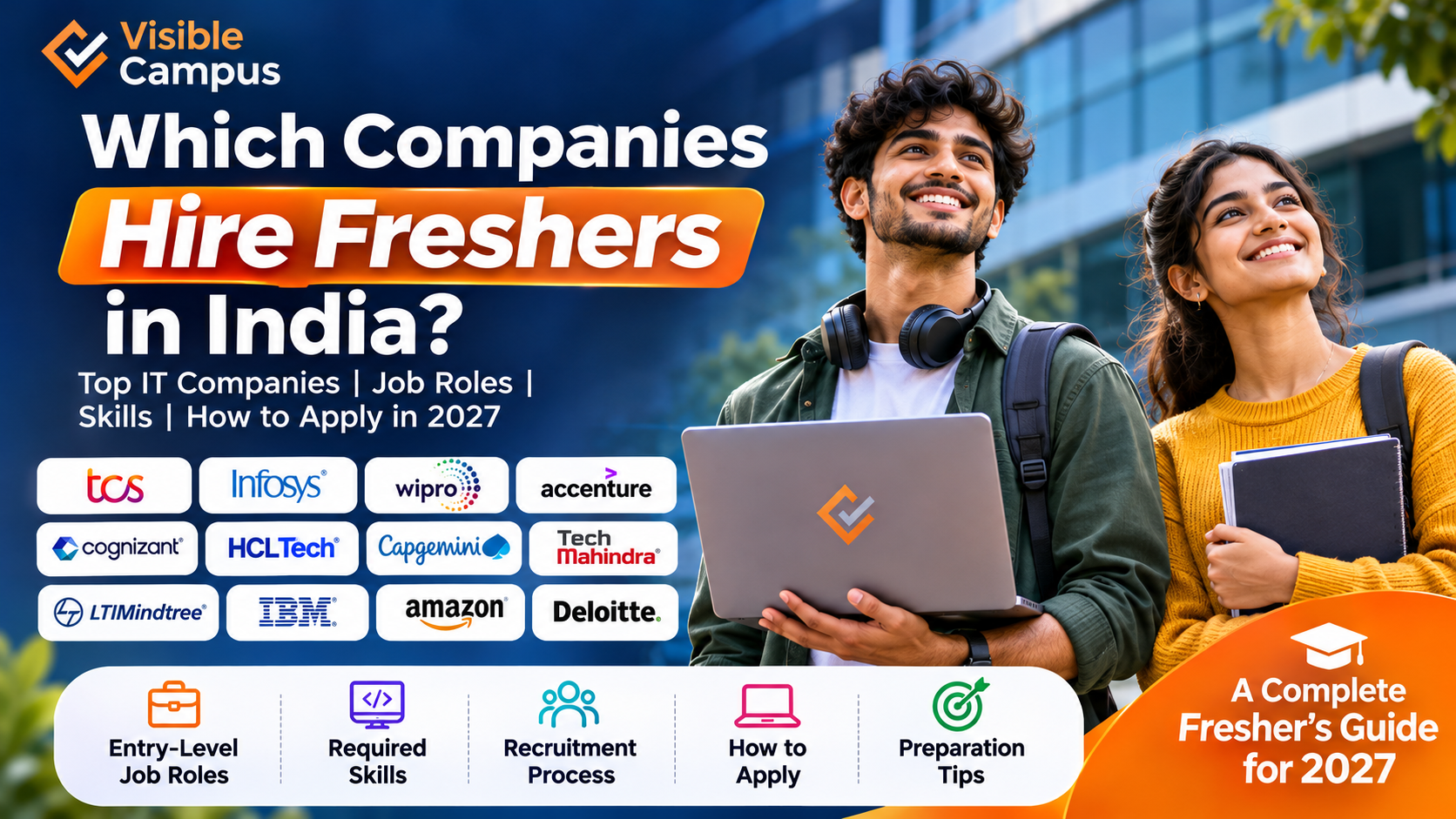
Which Companies Hire Freshers in India? Top IT Companies, Job Roles & How to Apply in 2027
Are you a recent graduate looking for your first job in the IT industry? One of the biggest questions every fresher has is: Which companies hire freshers in India, and how can I get selected?
The good news is that several IT companies, multinational corporations, consulting firms, startups and technology-driven businesses recruit graduates for entry-level positions. Companies such as TCS, Infosys, Wipro, Accenture, Cognizant, HCLTech, Capgemini and Tech Mahindra are among the well-known employers that fresh graduates should monitor.
However, getting your first IT job is not just about applying to big companies. You need to understand which roles are available, what skills employers expect, how recruitment works and how to prepare for technical interviews.
In this guide, we will explore companies that freshers should consider, career opportunities for different graduates, essential skills and practical steps to apply for your first IT job in India.
1. Top IT Companies That Hire Freshers in India
India has a large technology and IT services industry, creating opportunities for graduates from engineering, computer science, commerce, science and other educational backgrounds.
Here are some companies worth exploring when searching for fresher opportunities.
1. Tata Consultancy Services (TCS)
Tata Consultancy Services is one of India's largest IT services companies. It recruits graduates through campus recruitment and other early-career hiring programmes.
Potential entry-level roles:
- Assistant System Engineer
- Software Developer
- IT Analyst
- Data Analyst
- Graduate Trainee
Skills to prepare:
- Programming fundamentals
- Java, Python or C++
- SQL and database concepts
- Data structures and algorithms
- Communication and problem-solving
How to apply: Visit the TCS Careers website.
2. Infosys
Infosys provides technology consulting, software development, cloud, data and digital transformation services.
It recruits fresh graduates through graduate hiring programmes and specialised technical recruitment.
Potential entry-level roles:
- Systems Engineer
- Specialist Programmer
- Digital Specialist Engineer
- Technology Analyst
- Software Developer
Skills to prepare:
- Java or Python
- Object-oriented programming
- Data structures
- SQL
- Problem-solving and coding
How to apply: Visit Infosys Careers.
3. Wipro
Wipro is a global technology services and consulting company offering opportunities in software engineering, cloud, cybersecurity and IT infrastructure.
Potential entry-level roles:
- Project Engineer
- Graduate Engineer Trainee
- Software Developer
- IT Support Engineer
- Application Support Associate
Skills to prepare:
- Programming fundamentals
- Java, Python or JavaScript
- SQL
- Operating systems
- Communication skills
How to apply: Visit Wipro Careers.
4. Accenture
Accenture works across consulting, technology, operations, cloud, cybersecurity and artificial intelligence.
It offers opportunities for graduates interested in software development as well as technology and business support roles.
Potential entry-level roles:
- Associate Software Engineer
- Application Development Associate
- Technology Analyst
- Cloud Support Associate
- Data and Analytics Associate
Skills to prepare:
- Programming fundamentals
- SQL
- Java, Python or JavaScript
- Analytical thinking
- Communication and logical reasoning
How to apply: Visit Accenture Careers.
5. Cognizant
Cognizant provides IT consulting, digital engineering, application development and business process services.
Its graduate recruitment programmes are an important channel for fresh graduates.
Potential entry-level roles:
- Programmer Analyst Trainee
- Software Engineer
- Quality Engineer
- Junior Developer
- IT Support Associate
Skills to prepare:
- Java or Python
- SQL
- Programming logic
- Software development fundamentals
- Analytical and communication skills
How to apply: Visit Cognizant Careers.
6. HCLTech
HCLTech offers opportunities across software development, engineering, cloud computing, infrastructure and enterprise technology.
It has dedicated campus hiring and graduate trainee opportunities.
Potential entry-level roles:
- Graduate Engineer Trainee
- Software Engineer
- Technical Support Engineer
- Graduate Trainee
- Application Support Associate
Skills to prepare:
- Programming fundamentals
- Java, Python or C++
- Database concepts
- Networking basics
- Problem-solving
HCLTech also lists graduate trainee opportunities for graduates from backgrounds such as BA, BBA, B.Com, BCA, B.Sc and B.Pharma, depending on the programme and eligibility criteria.
How to apply: Visit HCLTech Careers.
7. Capgemini
Capgemini works in consulting, technology services, engineering and digital transformation.
Fresh graduates can explore opportunities in application development, testing, cloud and technology consulting.
Potential entry-level roles:
- Analyst
- Software Engineer
- Associate Consultant
- Software Tester
- Application Support Associate
Skills to prepare:
- Java or Python
- SQL
- Software development lifecycle
- Testing fundamentals
- Communication skills
How to apply: Visit Capgemini Careers.
8. Tech Mahindra
Tech Mahindra offers opportunities in IT services, telecommunications, digital engineering and enterprise solutions.
Potential entry-level roles:
- Associate Software Engineer
- Software Developer
- Technical Support Associate
- Network Support Engineer
- Application Support Engineer
Skills to prepare:
- Programming basics
- Networking fundamentals
- SQL
- Java or Python
- Communication skills
How to apply: Visit Tech Mahindra Careers.
9. LTIMindtree
LTIMindtree provides technology consulting, application development, cloud and digital transformation services.
Potential entry-level roles:
- Graduate Engineer Trainee
- Software Engineer
- Junior Developer
- Data Analyst
- Testing Engineer
Skills to prepare:
- Java or Python
- SQL
- Data structures
- Cloud fundamentals
- Logical reasoning
How to apply: Visit LTIMindtree Careers.
10. Other Companies Freshers Should Explore
Apart from large IT service providers, freshers can explore opportunities at:
CompanyAreas to explore
IBM
Software development, data, infrastructure and consulting
Amazon
Software engineering, operations and technical support
Deloitte
Technology consulting, analytics and software roles
Persistent Systems
Software engineering and digital technology
Mphasis
Application development and IT services
Hexaware
Software development, testing and technology services
CGI
Application development and IT consulting
Oracle
Software engineering, cloud and database technology
Cisco
Networking, software and cybersecurity
Honeywell
Software engineering and technology development
Important: Job titles, eligibility, locations and experience requirements vary by recruitment drive. Always check the official careers website for the latest openings.
2. Which Companies Hire Non-IT Graduates?
You do not necessarily need a B.Tech or Computer Science degree to begin an IT career.
Graduates from B.Com, BBA, BA, B.Sc and other streams can explore technology-related opportunities, depending on the employer's eligibility criteria and the skills they have developed.
For example:
DegreePossible entry-level career paths
B.Com
Finance operations, data analysis, business analysis and IT support
BBA
Business analysis, application support, operations and digital services
BA
Business operations, technical support, digital services and testing
B.Sc
Data analysis, software testing, IT support and development
BCA
Software development, testing, web development and IT support
B.Tech / BE
Software engineering, cloud, data, cybersecurity and testing
Companies such as HCLTech also advertise graduate trainee opportunities for selected non-engineering qualifications.
However, remember that eligibility is different for each job. Some software engineering positions require a specific technical degree, while other technology and business roles accept graduates from multiple disciplines.
The important thing is to identify the right career path and build the skills required for that role.
3. What Job Roles Can Freshers Apply For?
Before applying, understand the different types of entry-level jobs available in the IT industry.
Software Developer
Software developers build websites, applications, APIs and software products.
Skills required:
- Java, Python or JavaScript
- HTML and CSS
- React or Angular
- Node.js or Spring Boot
- SQL and MongoDB
- Git and GitHub
Frontend Developer
Frontend developers build the user interfaces of websites and applications.
Skills required:
- HTML
- CSS
- JavaScript
- React or Angular
- Responsive web design
- API integration
Backend Developer
Backend developers build the server-side functionality of applications.
Skills required:
- Java with Spring Boot or Node.js
- REST APIs
- SQL and MongoDB
- Authentication
- Database management
Software Tester
Software testers identify bugs and verify that applications work correctly.
Skills required:
- Manual testing
- Test cases
- Software testing lifecycle
- Selenium or other automation tools
- Basic SQL
- API testing
Data Analyst
Data analysts work with information to identify trends and help businesses make decisions.
Skills required:
- Excel
- SQL
- Python
- Power BI or Tableau
- Data visualisation
- Analytical thinking
Cloud and DevOps Associate
Cloud and DevOps professionals help manage infrastructure, deployment and application operations.
Skills required:
- Linux
- AWS or Azure fundamentals
- Git
- Docker
- CI/CD concepts
- Basic networking
IT Support Engineer
IT support engineers help users troubleshoot software, hardware, network and system-related problems.
Skills required:
- Windows and Linux fundamentals
- Networking basics
- Troubleshooting
- Microsoft 365
- Communication skills
4. What Skills Do IT Companies Expect from Freshers?
A degree is important, but employers also evaluate your practical knowledge and ability to solve problems.
Here are the skills you should focus on.
1. Programming Fundamentals
Learn at least one programming language properly.
Good starting options include:
- Java
- Python
- JavaScript
Understand variables, data types, conditions, loops, functions, arrays and object-oriented programming.
2. SQL and Database Knowledge
Most software applications work with databases.
Learn:
- SELECT, INSERT, UPDATE and DELETE
- WHERE and ORDER BY
- JOIN operations
- GROUP BY
- Primary and foreign keys
- Database design basics
3. Web Development
If you want to become a full stack developer, learn how frontend and backend applications communicate.
Recommended technologies:
- HTML and CSS
- JavaScript
- React
- Node.js or Java Spring Boot
- MySQL or MongoDB
- REST APIs
4. Git and GitHub
Companies expect developers to understand version control.
Learn how to:
- Create repositories
- Commit code
- Push changes
- Create branches
- Merge code
- Collaborate with other developers
5. AI and Modern Technology Awareness
AI is increasingly influencing entry-level work and recruitment. Understanding how to use AI tools responsibly can improve your productivity.
Start learning:
- Generative AI fundamentals
- Prompt engineering
- AI-assisted coding
- Basic Python for AI
- APIs and automation
6. Communication and Problem-Solving
Technical knowledge alone is not enough.
You should be able to explain your projects, communicate your ideas, understand requirements and solve problems logically.
5. How Do IT Companies Recruit Freshers?
Most companies follow a recruitment process involving several stages.
The exact process varies depending on the company, role and hiring programme.
Common fresher recruitment process
- Application: Submit your application through the company's careers portal or campus recruitment programme.
- Resume screening: Recruiters check your education, skills, projects and eligibility.
- Aptitude assessment: You may be tested on quantitative aptitude, logical reasoning and verbal ability.
- Technical assessment: Depending on the role, you may face coding questions, technical MCQs or practical assessments.
- Technical interview: Interviewers evaluate your programming knowledge, projects and technical fundamentals.
- HR interview: Recruiters assess communication, career interests, availability and role fit.
- Offer and onboarding: Selected candidates receive an offer, subject to the company's process.
Recruitment flowchart
flowchart TD
    A["Graduate / Fresher"] --> B["Find Job Opportunities"]
    B --> C["Apply Through Careers Portal"]
    C --> D["Resume Screening"]
    D --> E["Aptitude / Online Assessment"]
    E --> F["Technical Assessment"]
    F --> G["Technical Interview"]
    G --> H["HR Interview"]
    H --> I{"Selected?"}
    I -->|Yes| J["Offer Letter"]
    I -->|No| K["Improve and Prepare Again"]
    K --> B
6. Where Can Freshers Find IT Job Openings?
Do not depend on a single job portal. Explore multiple channels.
PlatformHow to use it
LinkedIn Jobs
Search for fresher and entry-level positions
Naukri
Create a profile and upload your resume
Indeed
Search for graduate and fresher jobs
Foundit
Explore IT and technology opportunities
Wellfound
Find startup opportunities
Company career portals
Apply directly to employers
College placement cells
Attend campus recruitment drives
Useful job search keywords
Try searching with these phrases:
- Software Developer Fresher
- Java Developer Fresher
- Python Developer Trainee
- Graduate Engineer Trainee
- Associate Software Engineer
- Frontend Developer Fresher
- Software Testing Fresher
- Data Analyst Trainee
- IT Support Engineer Fresher
- Off-Campus Hiring 2027
You can also filter job listings by city, experience level, graduation year and qualification.
7. How Can Freshers Get an IT Job Without Experience?
One of the biggest challenges for graduates is the experience requirement.
Many job descriptions ask for practical experience, even for entry-level positions. So how can you demonstrate your abilities when you have not worked in a company?
The answer is to build practical experience through projects, internships and hands-on learning.
Step 1: Choose a career path
Do not try to learn every technology at once.
Choose one direction:
- Java Full Stack Development
- Python Development
- Frontend Development
- Data Analytics
- Software Testing
- Cloud and DevOps
Step 2: Learn the required technologies
Understand the fundamentals before moving to advanced topics.
For example, if you choose Java Full Stack Development, learn Java, SQL, HTML, CSS, JavaScript, Spring Boot and React.
Step 3: Build practical projects
Create two or three projects that demonstrate your skills.
Some project ideas include:
ProjectTechnologies
Student Management System
Java, Spring Boot, MySQL
E-commerce Website
React, Node.js, MongoDB
Employee Management System
React, Java, SQL
Expense Tracker
JavaScript, React
Data Analysis Dashboard
Python, SQL, Power BI
Online Examination System
Java, Spring Boot, MySQL
Do not simply copy projects from tutorials. Understand the code and be prepared to explain how your application works.
Step 4: Create a GitHub portfolio
Upload your projects to GitHub.
Include:
- Project description
- Technologies used
- Installation instructions
- Screenshots
- Important features
This gives recruiters a way to evaluate your practical work.
Step 5: Prepare your resume
Your fresher resume should include:
- Name and contact information
- Career objective or professional summary
- Educational qualifications
- Technical skills
- Academic and personal projects
- Internship experience, if available
- Certifications
- GitHub and LinkedIn links
Keep your resume clear, concise and relevant to the job you are applying for.
8. Which Indian Cities Offer IT Job Opportunities for Freshers?
Several Indian cities have major IT companies, technology parks, consulting firms and startup ecosystems.
CityOpportunities
Bengaluru
Software development, AI, cloud, startups and IT services
Hyderabad
IT services, product companies, cloud and engineering
Pune
Software development, consulting and enterprise technology
Chennai
IT services, software engineering and automotive technology
Mumbai
Fintech, consulting, IT and financial technology
Gurugram
Consulting, technology, enterprise services and startups
Noida
IT services, software development and technology support
Kochi
IT services, software development and startups
Bengaluru is particularly important for technology graduates because of its concentration of IT companies, startups and global technology centres.
However, do not restrict your search to one city. Consider opportunities in other locations and remote roles where available.
9. How to Prepare for IT Company Interviews
Getting shortlisted is only the first step. You also need to prepare for the interview.
Here are some topics to practise.
Programming:
- Reverse a string.
- Check whether a number is prime.
- Find the largest element in an array.
- Check whether a string is a palindrome.
- Explain object-oriented programming.
SQL:
- Difference between WHERE and HAVING.
- Explain INNER JOIN and LEFT JOIN.
- Find the second-highest salary.
- Explain primary and foreign keys.
- Write a query using GROUP BY.
Web Development:
- What is HTML?
- Difference between CSS Grid and Flexbox.
- Explain JavaScript promises.
- What is React?
- What is a REST API?
Project Discussion:
Interviewers may ask:
- Explain your project.
- Why did you choose these technologies?
- What challenges did you face?
- How does your application communicate with the database?
- What would you improve if you developed it again?
Practise explaining your projects in simple language. Do not memorise answers without understanding them.
10. A 90-Day Roadmap to Prepare for Your First IT Job
If you are starting from zero, follow a structured learning plan.
TimelineWhat to focus on
Days 1–15
Choose a career path and learn programming fundamentals
Days 16–30
Learn SQL, databases and problem-solving
Days 31–45
Learn your chosen technology stack
Days 46–60
Build practical projects
Days 61–70
Upload projects to GitHub and prepare your resume
Days 71–80
Practise aptitude and technical interviews
Days 81–90
Apply for jobs, attend interviews and improve based on feedback
Your job preparation journey
flowchart TD
    A["Start as a Beginner"] --> B["Choose Your IT Career"]
    B --> C["Learn Programming"]
    C --> D["Learn Database and Tools"]
    D --> E["Build Real-World Projects"]
    E --> F["Create GitHub Portfolio"]
    F --> G["Prepare Your Resume"]
    G --> H["Practise Interviews"]
    H --> I["Apply for Fresher Jobs"]
    I --> J["Attend Interviews"]
    J --> K["Start Your IT Career"]
The timeline is a suggested preparation plan, not a guarantee of employment within 90 days. Your progress depends on your starting level, consistency and the requirements of the roles you target.
11. Common Mistakes Freshers Should Avoid
Avoid these mistakes while preparing for your first IT job:
- Learning too many technologies: Focus on one career path and build strong fundamentals.
- Only watching tutorials: Practise by writing code and building projects.
- Ignoring SQL: Database knowledge is useful across many technology roles.
- Using copied projects: Build projects you can explain confidently.
- Sending the same resume everywhere: Tailor your resume to the role.
- Ignoring communication skills: Practise explaining technical concepts clearly.
- Applying only to big companies: Explore startups, mid-sized companies and smaller IT service providers.
- Waiting until you feel completely ready: Start applying when you meet the basic requirements and keep improving.
- Ignoring job eligibility: Check degree, graduation year, marks, location and experience criteria.
- Falling for recruitment scams: Never pay money for a job offer or share OTPs and banking credentials with unverified recruiters.
12. Frequently Asked Questions (FAQs)
1. Which IT companies hire freshers in India?
Companies worth exploring include TCS, Infosys, Wipro, Accenture, Cognizant, HCLTech, Capgemini, Tech Mahindra, LTIMindtree, IBM and other technology companies. Hiring depends on business demand and individual recruitment programmes.
2. Can freshers get IT jobs without experience?
Yes. Many companies recruit graduates for trainee, graduate engineer, associate developer and entry-level support positions. Projects, internships and practical skills can help demonstrate your abilities.
3. Which IT company is best for freshers?
There is no single best company for everyone. Consider the role, training, work environment, technology exposure, career growth, location and compensation before accepting an offer.
4. Can B.Com students get IT jobs?
Yes. B.Com graduates can explore eligible opportunities in business analysis, data analytics, finance technology, IT support, operations and selected software-related roles. Technical development roles may require additional programming skills and specific degree eligibility.
5. Can non-IT students become software developers?
Yes. Non-IT graduates can learn programming, databases, web development and software engineering fundamentals. They should also check the degree requirements of each employer before applying.
6. Which programming language should a fresher learn first?
Java and Python are good starting options. Java is widely used in enterprise software development, while Python is popular in automation, data and AI applications. JavaScript is essential for web development.
7. How many projects should a fresher include in a resume?
Two or three well-developed projects are usually more valuable than many incomplete projects. Choose projects that demonstrate your skills and explain the technologies and features clearly.
8. How can I find off-campus jobs for freshers?
Check company career portals, LinkedIn, Naukri, Indeed and other job platforms. Search using job titles such as Graduate Engineer Trainee, Associate Software Engineer and Software Developer Fresher.
9. Are there IT jobs for freshers in Bangalore?
Yes. Bengaluru has opportunities across IT services, startups, product companies, cloud, data, software engineering and technical support. Check company career pages and job portals for current openings.
10. Do IT companies hire freshers in 2027?
Companies continue to recruit graduates through campus programmes, off-campus hiring, internships and graduate trainee opportunities. The number of openings and eligibility requirements vary throughout the year.
13. Start Your IT Career with Visible Campus
Getting your first IT job becomes easier when you have the right technical foundation, practical project experience and interview preparation.
At Visible Campus, we help aspiring technology professionals develop industry-relevant skills through structured, practical training.
Explore learning opportunities in:
- Java Full Stack Development
- Python Programming
- Frontend Development
- Generative AI
- Data Science and Analytics
- Cloud Computing and DevOps
Our training focuses on programming fundamentals, hands-on projects, practical learning and interview preparation, along with placement assistance.
Whether you are from B.Tech, BCA, B.Sc, B.Com, BBA or another graduate background, start by choosing a career path that matches your interests and building the skills required for it.
Your first IT job starts with the skills you build today.
Visit Visible Campus to explore training programmes and take the next step towards your technology career.