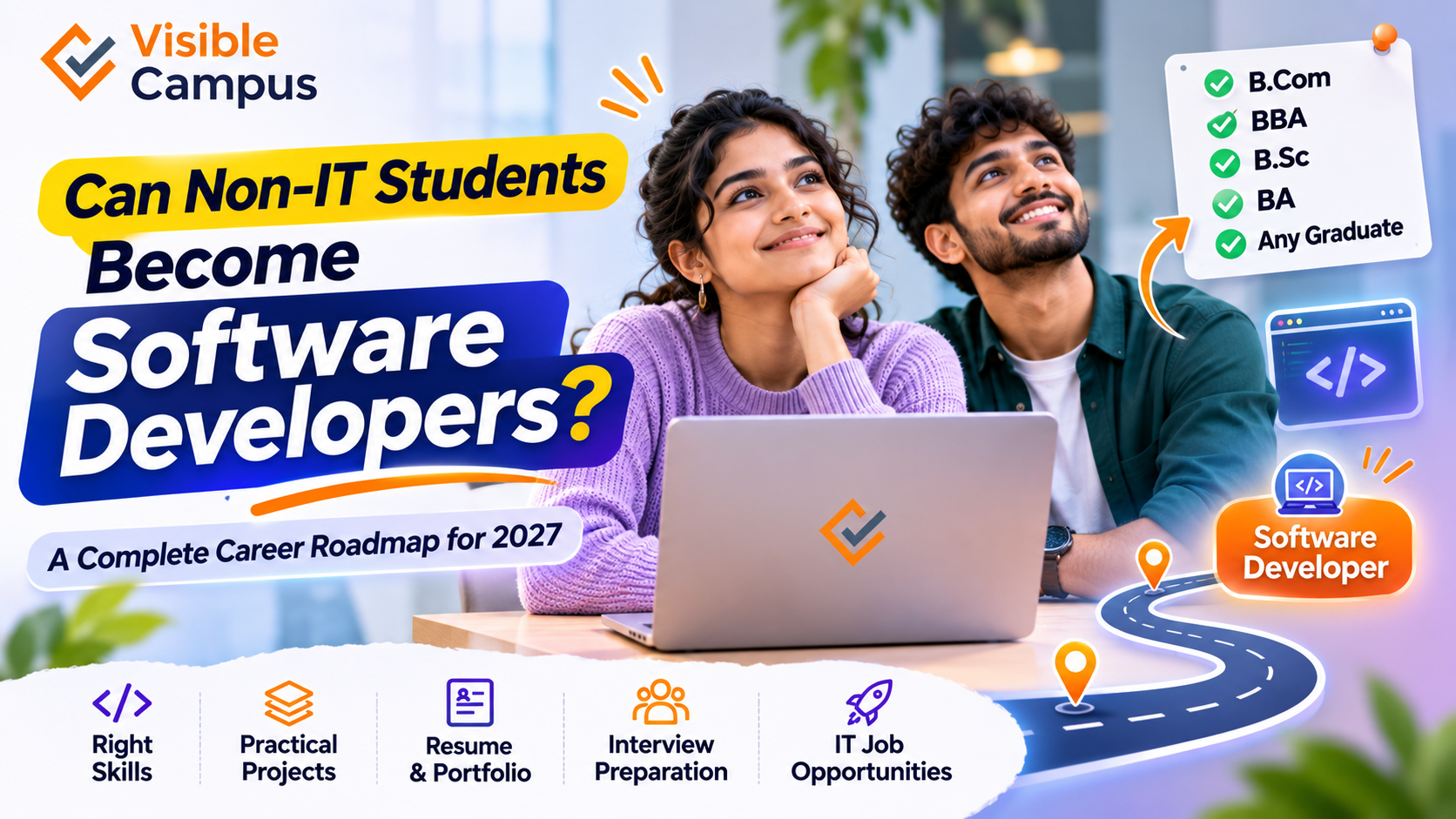
Can Non-IT Students Become Software Developers? Complete Career Roadmap for 2027
Category: Career Guidance
Target Audience: B.Com, BBA, B.Sc, BA, BCA, Non-CS Graduates and Beginners
Reading Time: 10–12 Minutes
Introduction
Have you completed B.Com, BBA, B.Sc, BA or another non-computer science degree and are thinking about entering the IT industry?
You might have questions like:
- Can non-IT students become software developers?
- Is a computer science degree compulsory for software development jobs?
- Can I learn programming without any coding knowledge?
- Which programming language should I learn first?
- Can I get a software developer job after completing a non-IT degree?
The answer is Yes! Non-IT students can learn software development and pursue careers in the IT industry.
A computer science degree can be helpful, but it is not the only way to develop software development skills. Many technical roles value programming knowledge, problem-solving abilities, practical projects and hands-on experience.
With the right learning approach, consistent practice and industry-relevant technical skills, graduates from non-IT backgrounds can work towards becoming software developers.
In this blog, we will explore how non-IT students can enter the software development industry, which programming languages they should learn, what projects they should build and how to prepare for IT jobs in 2027.
1. Can Non-IT Students Really Become Software Developers?
Yes. Students from different educational backgrounds can learn programming and build software applications.
Software development is a skill-based profession that involves writing code, solving problems, designing applications and working with different technologies.
You do not necessarily need a computer science degree to start learning these skills.
For example:
- A B.Com graduate can learn Java, SQL and Full Stack Development.
- A BBA graduate can learn Python, programming and Data Analytics.
- A B.Sc graduate can explore Python, JavaScript and software development.
- A BA graduate can start with programming fundamentals and progress towards web development.
However, eligibility requirements vary between employers. Some companies require specific degrees, while others consider candidates based on their skills, experience and hiring criteria.
The important thing is to build the technical knowledge required for your chosen role.
2. Which Non-IT Graduates Can Enter the IT Industry?
Different educational backgrounds can provide different starting points for a technology career.
Here are some possible career pathways.
Educational BackgroundSuggested IT Career Paths
B.Com
Data Analyst, Software Tester, Business Analyst
BBA
Business Analyst, Data Analyst, Application Support
B.Sc
Python Developer, Data Analyst, Software Developer
BA
Software Testing, Technical Support, Web Development
BCA
Full Stack Developer, Software Developer
B.Tech Non-CS
Java Developer, Full Stack Developer, Cloud Engineer
These are suggested learning pathways, not guaranteed job eligibility. Always check the degree and qualification requirements in individual job descriptions.
Why do companies consider candidates from non-IT backgrounds?
Companies need employees who can understand problems, learn new technologies, communicate effectively and contribute to projects.
A candidate's educational background is one part of their profile. Technical knowledge, practical experience, aptitude and role-specific qualifications also matter.
3. Which Programming Language Should Non-IT Students Learn First?
One of the biggest challenges for beginners is choosing the right programming language.
You don't need to learn five programming languages simultaneously. Start with one language and understand its fundamentals.
Here are four useful options.
A. Python – Best for Beginners and AI
Python is known for its simple syntax and readability.
It is commonly used in:
- Artificial Intelligence
- Machine Learning
- Data Science
- Automation
- Backend Development
- Data Analytics
Example Python program:
name = "Rahul"
marks = 85

if marks >= 40:
    print(name, "has passed")
else:
    print(name, "has failed")
Output:
Rahul has passedPython is a good starting point for students interested in AI, Data Science, automation and backend development.
B. Java – Best for Enterprise and Full Stack Development
Java is a popular programming language used in enterprise applications, banking systems, backend services and large-scale software platforms.
It is widely used for:
- Backend Development
- Enterprise Applications
- Banking Software
- Full Stack Development
- Microservices
Example Java program:
public class Main {

    public static void main(String[] args) {

        String name = "Rahul";
        int age = 22;

        System.out.println("Name: " + name);
        System.out.println("Age: " + age);
    }
}
Output:
Name: Rahul
Age: 22
Java is a strong option for students who want to pursue backend development or Java Full Stack Development.
C. JavaScript – Best for Web Development
JavaScript is one of the core technologies used to develop interactive websites and web applications.
It is used for:
- Frontend Development
- Backend Development
- Full Stack Applications
- Interactive Websites
- Web Applications
Example JavaScript program:
const student = {
    name: "Rahul",
    course: "Web Development"
};

console.log("Student:", student.name);
console.log("Course:", student.course);
Output:
Student: Rahul
Course: Web Development
JavaScript is a practical choice for beginners interested in website development and Full Stack Development.
D. SQL – Essential for Working with Databases
SQL (Structured Query Language) is used to store, retrieve and manage information in relational databases.
It is important for:
- Software Developers
- Data Analysts
- Backend Developers
- Database Administrators
- Business Intelligence Professionals
Example SQL query:
SELECT name, department, salary
FROM employees
WHERE salary > 30000;
This query retrieves employees whose salary is greater than 30,000.
SQL is not a general-purpose programming language, but it is an essential technical skill for many IT roles.
4. Which IT Career Path Should Non-IT Students Choose?
Before starting your training, understand the different career paths available.
1. Java Full Stack Development
Java Full Stack Development involves building both frontend and backend parts of an application.
Technologies to learn:
- Core Java
- Object-Oriented Programming
- HTML and CSS
- JavaScript
- React or Angular
- Spring Boot
- Hibernate
- MySQL
- REST APIs
Possible job roles:
- Java Developer
- Java Full Stack Developer
- Backend Developer
- Software Engineer
2. Python Development
Python developers build backend applications, automation tools and software solutions.
Technologies to learn:
- Python Fundamentals
- Object-Oriented Programming
- Django or FastAPI
- SQL
- REST APIs
- Git and GitHub
Possible job roles:
- Python Developer
- Backend Developer
- Automation Developer
3. Data Analytics
Data Analytics focuses on collecting, processing and analyzing data to help organizations make informed decisions.
Technologies to learn:
- Microsoft Excel
- SQL
- Python
- Power BI
- Data Visualization
- Statistics Fundamentals
Possible job roles:
- Data Analyst
- Business Intelligence Analyst
- Reporting Analyst
4. Frontend Development
Frontend developers build the user interfaces that people interact with on websites and applications.
Technologies to learn:
- HTML
- CSS
- JavaScript
- React
- Angular
- TypeScript
- Git
Possible job roles:
- Frontend Developer
- React Developer
- UI Developer
- Web Developer
5. Software Testing
Software testing involves identifying defects and verifying whether applications work as expected.
Technologies to learn:
- Manual Testing
- Software Testing Fundamentals
- SQL
- Java or JavaScript
- Selenium
- Cypress or Playwright
Possible job roles:
- Software Tester
- QA Engineer
- Automation Tester
- Test Engineer
5. Step-by-Step Roadmap to Become a Software Developer
If you have never written code before, don't worry.
Start with basic concepts and gradually move towards advanced development.
Here is a structured learning roadmap for non-IT students.
Step 1: Understand Computer and Programming Fundamentals
Start with:
- Basic computer concepts
- How software applications work
- Programming logic
- Variables and data types
- Conditions and loops
- Functions
- Arrays and objects
Step 2: Choose One Programming Language
Select a language based on your career goal.
For example:
- Java for enterprise and Full Stack Development.
- Python for AI, Data Science and backend development.
- JavaScript for frontend and web development.
Step 3: Learn Object-Oriented Programming
Understand important concepts such as:
- Classes and Objects
- Inheritance
- Encapsulation
- Polymorphism
- Abstraction
These concepts are particularly important when learning Java and other object-oriented programming languages.
Step 4: Learn Databases
Understand how applications store and retrieve information.
Start with:
- Database fundamentals
- SQL queries
- Tables and relationships
- Primary and Foreign Keys
- Joins
- CRUD operations
Step 5: Learn Frameworks
Once you understand programming fundamentals, move towards frameworks.
Examples:
- Java: Spring Boot
- Python: Django or FastAPI
- JavaScript: React or Angular
Step 6: Build Practical Projects
Create applications that demonstrate your technical knowledge.
Examples include:
- Student Management System
- Employee Management System
- E-commerce Website
- Expense Tracker
- Online Examination System
Step 7: Prepare for IT Interviews
Practise:
- Programming questions
- SQL queries
- Technical fundamentals
- Project explanations
- Aptitude questions
- Communication skills
6. Complete Career Roadmap for Non-IT Students
The following flowchart explains how a student can progress from a non-IT educational background towards an entry-level technology role.
flowchart TD
    A([Non-IT Graduate]) --> B[Understand Computer Fundamentals]
    B --> C[Learn Programming Basics]
    C --> D{Choose Career Path}

    D -->|Software Development| E[Learn Java or Python]
    D -->|Web Development| F[Learn HTML CSS JavaScript]
    D -->|Data Analytics| G[Learn Excel SQL Python]
    D -->|Software Testing| H[Learn Testing Fundamentals]

    E --> I[Learn Frameworks and Databases]
    F --> I
    G --> J[Learn Power BI and Data Tools]
    H --> K[Learn Automation Testing]

    I --> L[Build Practical Projects]
    J --> L
    K --> L

    L --> M[Create Resume and Portfolio]
    M --> N[Prepare for Interviews]
    N --> O[Apply for Relevant IT Jobs]
    O --> P([Start Your Technology Career])
7. Six-Month Learning Plan for Non-IT Beginners
A structured learning schedule can make the transition easier.
The following is an illustrative six-month plan for someone pursuing Full Stack Development. The actual duration depends on the learner's starting knowledge, practice and learning pace.
MonthLearning FocusExpected Outcome
Month 1
Programming Fundamentals and Java
Understand coding basics
Month 2
OOP, Collections and SQL
Develop programming foundations
Month 3
HTML, CSS and JavaScript
Build basic web pages
Month 4
React and Spring Boot
Understand frontend and backend
Month 5
REST APIs and Full Stack Projects
Build complete applications
Month 6
GitHub, Resume and Interview Preparation
Prepare for entry-level opportunities
Six-month preparation flow
flowchart LR
    A[Month 1<br/>Programming Basics] --> B[Month 2<br/>Java and SQL]
    B --> C[Month 3<br/>Frontend]
    C --> D[Month 4<br/>Frameworks]
    D --> E[Month 5<br/>Real Projects]
    E --> F[Month 6<br/>Interview Preparation]
8. Real-World Projects Non-IT Students Should Build
Learning concepts is important, but implementing them through projects helps you understand how software applications work.
Here are some projects beginners can build.
ProjectTechnologiesConcepts Learned
Student Management System
Java, Spring Boot, MySQL
CRUD, APIs, Database
E-commerce Website
React, Java, MySQL
Full Stack Development
Employee Management System
Java, React, SQL
Application Development
Expense Tracker
Python, Django, SQL
Backend Development
Sales Dashboard
Excel, SQL, Power BI
Data Analytics
Example: How a Full Stack application works
Let's understand how a student management application works.
flowchart TD
    A[Student or Admin] --> B[React Frontend]
    B --> C[REST API Request]
    C --> D[Spring Boot Backend]
    D --> E[Business Logic]
    E --> F[MySQL Database]
    F --> E
    E --> D
    D --> B
    B --> A
Technology explanation:
- React handles the user interface.
- Spring Boot handles backend logic.
- REST APIs allow communication between frontend and backend.
- MySQL stores application data.
Building a project like this gives beginners an opportunity to understand how different technologies work together.
9. How Can Non-IT Students Build a Resume Without Experience?
Not having professional experience does not mean you have nothing to show recruiters.
You can highlight your technical learning and practical work.
Recommended resume structure
- Name and contact details.
- Career objective.
- Technical skills.
- Academic qualifications.
- Practical projects.
- Internship experience, if applicable.
- Certifications.
- Achievements.
Example career objective
"Motivated graduate from a non-computer science background with foundational knowledge of Java, SQL, HTML, CSS and JavaScript. Interested in software development and experienced in building academic projects using modern development technologies. Eager to apply technical knowledge and develop professional skills in an entry-level software development role."
What should you include in your portfolio?
- At least two or three meaningful projects.
- Source code on GitHub.
- Project documentation.
- Screenshots or demo links.
- Technologies used.
- Your specific contribution to each project.
Always represent your skills and experience honestly.
10. Common Challenges Faced by Non-IT Students
Starting a software development career from a non-IT background may involve some challenges.
Here are common difficulties and ways to overcome them.
ChallengeHow to Overcome It
No coding knowledge
Start with programming fundamentals
Difficulty understanding logic
Practise simple coding problems daily
Fear of mathematics
Focus on the mathematics relevant to your chosen role
Lack of practical experience
Build real-world projects
Interview anxiety
Practise mock interviews
Too many technologies
Follow one structured learning path
Lack of confidence
Track your progress and practise consistently
Important advice for beginners
Do not compare your progress with someone who has been coding for several years.
Focus on understanding concepts, solving problems and building something practical every week.
Consistency is more important than trying to learn everything in a short period.
11. What Skills Do IT Companies Expect from Freshers?
Companies hiring entry-level candidates may evaluate several technical and professional skills.
Technical skills
- Programming fundamentals
- Problem-solving
- Data structures and algorithms
- Database knowledge
- Basic application development
- Version control using Git
- Relevant frameworks and tools
Professional skills
- Communication
- Teamwork
- Logical thinking
- Time management
- Adaptability
- Willingness to learn
Your required skills will depend on the specific job role and employer.
12. Frequently Asked Questions (FAQs)
1. Can a B.Com student become a software developer?
Yes. A B.Com graduate can learn programming languages such as Java or Python, study web development and build practical software projects. Job eligibility will depend on the employer's educational requirements.
2. Can BBA students get IT jobs?
Yes. BBA graduates can explore Data Analytics, Business Analysis, Software Testing and suitable software development pathways by acquiring the required technical skills.
3. Is coding difficult for non-IT students?
Programming may feel challenging initially, especially if you have never written code. However, starting with simple concepts, practising regularly and following a structured learning path can make it easier.
4. Which programming language is best for non-IT students?
Python is a beginner-friendly option. Java is useful for enterprise and backend development, while JavaScript is important for web development. Choose according to your career goal.
5. Can I become a Java Full Stack Developer after B.Com?
Yes, you can learn Java, Spring Boot, SQL, HTML, CSS and React and build Full Stack applications. However, check the educational eligibility requirements of the jobs you apply for.
6. Do I need mathematics to become a software developer?
Advanced mathematics is not required for every software development role. Basic logical thinking and problem-solving are important. Specialized fields such as Machine Learning and Data Science may require stronger mathematical knowledge.
7. How long does it take for a non-IT student to learn coding?
The time varies based on your background, learning pace and practice. A structured six-month learning plan can provide a starting framework, but becoming job-ready may take longer.
8. Can non-IT students get jobs in MNC companies?
Some MNCs hire candidates from non-IT backgrounds for suitable roles, while others specify particular degree requirements. Check individual recruitment eligibility criteria before applying.
9. Is a certificate enough to get a software developer job?
A certificate alone does not guarantee employment. Employers may also evaluate programming fundamentals, practical projects, technical interviews and problem-solving abilities.
10. Can I learn software development without joining a college course?
Yes. You can use online resources and self-study. Structured training can provide guidance, practice schedules, mentorship and project support, which may help some beginners stay consistent.
Conclusion
Your educational background does not have to be the end of your technology career journey.
Students from B.Com, BBA, B.Sc, BA and other non-computer science backgrounds can learn programming, develop practical applications and work towards entering the IT industry.
The journey starts with choosing the right programming language, understanding fundamentals, learning relevant frameworks, building real-world projects and preparing for technical interviews.
You don't need to learn every technology at once. Start with one skill, practise consistently and gradually develop your technical expertise.
Your degree defines what you studied. Your skills can help shape what you do next.
Start Your Software Development Journey with Visible Campus
Are you a non-IT graduate looking to enter the software development industry?
At Visible Campus, we offer industry-oriented technical training programs designed to help beginners and aspiring developers build practical skills.
Explore our training programs
Java Full Stack Development
- Core Java and Advanced Java
- Spring Boot and Hibernate
- HTML, CSS and JavaScript
- React and Angular
- SQL and Database Management
- Real-world application development
Other Training Programs
- Python Programming
- Generative AI
- Artificial Intelligence and Machine Learning
- Data Science and Analytics
- Cloud Computing and DevOps
- Frontend Development
What you can gain
- Structured technical learning.
- Hands-on coding practice.
- Real-world project exposure.
- Technical interview preparation.
- Career guidance.
- Placement assistance.
Whether you come from an IT or non-IT background, take the first step towards developing your technical skills.
Start learning. Build projects. Prepare for your IT career.
Visit: https://visiblecampus.com
Contact Visible Campus to explore courses and upcoming batches.